
Independent evaporator training for dairy plant operators and supervisors — falling-film evaporator operation, control, CIP and troubleshooting.
Plant-specific training built on 50 years of dairy evaporator experience. Generic supplier training is for commissioning; this is operator training built around your specific evaporator and your operators' actual competence levels.
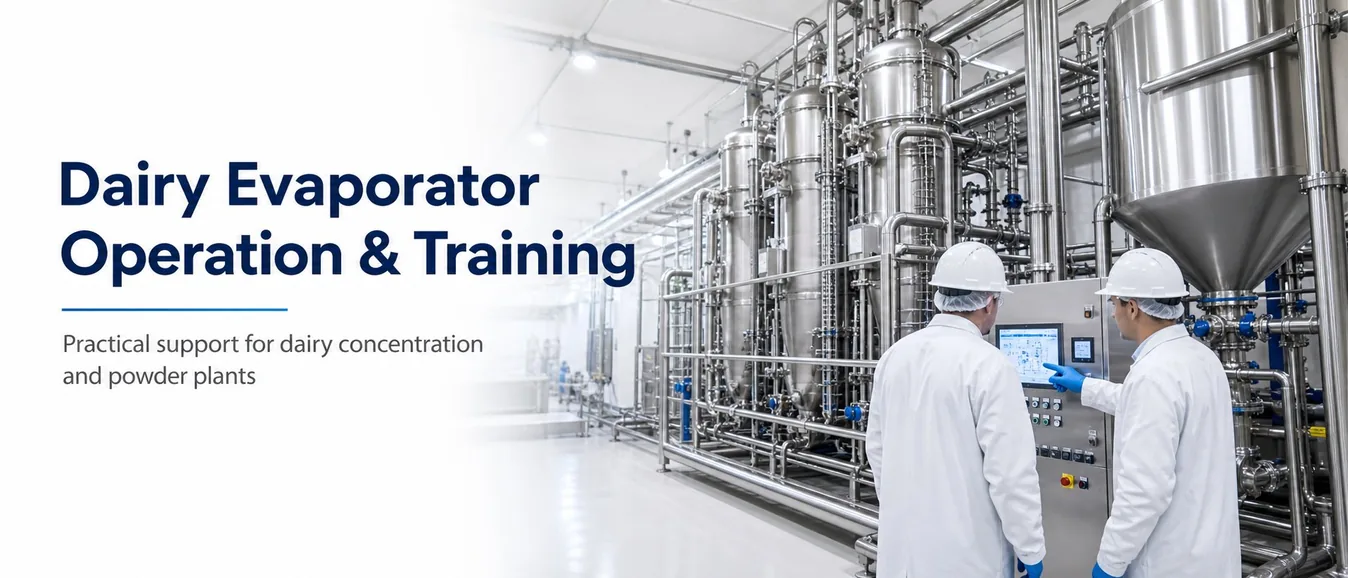
Dairy evaporator operation and operator training for milk powder, whey, infant formula and dairy concentration plants.
Watson Dairy Consulting provides practical support covering falling-film evaporators, multi-effect evaporation, TVR/MVR systems, start-up, steady-state control, shutdown, CIP, fouling, thermophile control, solids control, energy use and operator troubleshooting.
Practical Dairy Evaporator Training
Dairy evaporators are often treated as if they are simply “concentration machines”, but in a powder plant they control far more than water removal. Evaporator performance affects dryer load, energy cost, concentrate viscosity, run length, fouling, thermophile growth, powder quality, solids recovery and operator confidence.
Good evaporator training should explain the cause-and-effect relationship between feed rate, feed solids, steam pressure, vacuum, temperature profile, thermocompressor performance, concentrate solids, viscosity, CIP quality and downstream dryer stability. Operators need to understand what the plant is telling them, not just which button to press.
Operator Understanding
Training that explains how multi-effect evaporation works, why vacuum matters, how steam economy is achieved and how small changes affect the whole plant.
Start-up and Shutdown
Practical sequencing, water balance, product introduction, stabilisation, product-to-water changeover, controlled shutdown and avoiding unnecessary product loss.
Solids and Quality Control
Understanding feed solids, concentrate total solids, viscosity, heat classification, age thickening, concentrate handling and powder plant knock-on effects.
CIP, Fouling and Hygiene
Training on fouling mechanisms, cleaning discipline, CIP verification, chemical effectiveness, thermophile risk and practical hygiene control.
Why Evaporator Operation Matters
| Evaporator Area | What Operators Need to Understand | Why It Matters |
|---|---|---|
| Feed rate and feed solids | How incoming milk or whey solids and flow rate affect evaporation load, steam demand and concentrate stability. | Controls capacity, dryer loading, energy use and finished powder consistency. |
| Steam and thermocompressor performance | How steam pressure, TVR performance and boiler stability affect effect temperatures and evaporation rate. | Poor steam stability can reduce efficiency, raise late-effect temperatures and accelerate fouling. |
| Vacuum and temperature profile | Why each effect operates at a different pressure and temperature and how this protects product quality. | Supports heat-sensitive products, reduces damage and improves process stability. |
| Concentrate solids and viscosity | How total solids, temperature, age, shear and storage conditions affect viscosity and dryer feed behaviour. | Prevents unstable atomisation, poor dryer control and blocked or inconsistent feed. |
| Fouling and deposits | How heat treatment, protein stability, minerals, thermophiles and operating conditions contribute to deposits. | Improves run length, cleaning success and powder quality. |
| CIP quality | How cleaning temperature, concentration, flow, time, turbulence, sequencing and inspection affect cleaning results. | Reduces repeated failures, microbiological risk and shortened production runs. |
Training Content for Evaporator Operators
Operator training should be tailored to the actual evaporator and product mix. A skim milk evaporator, whole milk evaporator, whey evaporator and infant formula concentration system may share principles, but each has different risks around heat treatment, deposits, viscosity, microbiology, concentrate storage and dryer interface.
- Basic principles of evaporation, boiling under vacuum and multi-effect operation
- Falling-film evaporator operation and why good wetting of tubes matters
- Steam economy, TVR/MVR operation and how vapour recompression affects energy use
- Feed introduction, water running, product cut-in, stabilisation and avoiding unnecessary product loss
- How to read trends: temperatures, pressures, feed rate, concentrate solids, density, flow and vacuum
- How boiler pressure variation affects thermocompressor performance and plant stability
- Why operators often reduce feed rate when the real issue may be steam, vacuum, fouling, viscosity or control tuning
- Heat treatment impact on powder quality, WPNI, heat classification and downstream dryer behaviour
- Thermophile awareness, run length discipline, swabbing/monitoring and hygiene escalation
- CIP principles, chemical selection, sequestering agents, rinse quality and inspection discipline
- Abnormal condition response: poor vacuum, high concentrate temperature, falling solids, unstable density, rising deposits, blocked strainers, air leaks or poor condensate removal
Training should be practical: the best sessions combine classroom explanation, operator log-sheet review, trend analysis, line-side coaching, P&ID walk-throughs, standard operating procedure review and real examples from the plant.
Typical Evaporator Training Modules
| Training Module | Content | Outcome |
|---|---|---|
| Evaporation fundamentals | Boiling under vacuum, heat transfer, vapour flow, multi-effect layout and energy efficiency. | Operators understand why the evaporator behaves as it does. |
| Start-up control | Water running, heating, vacuum establishment, product introduction, stabilisation and routing. | Reduces product loss, start-up instability and unsafe improvisation. |
| Steady-state operation | Feed rate, solids control, density measurement, temperature profile, steam pressure and vacuum response. | Improves consistency, capacity and confidence. |
| Product quality | Heat impact, concentrate solids, viscosity, storage age, powder quality and dryer feed behaviour. | Operators understand how evaporator decisions affect finished powder. |
| Fouling and run length | Deposit formation, thermophile growth, protein/mineral effects and practical warning signs. | Improves run discipline and reduces unplanned cleaning. |
| CIP and hygiene | CIP stages, temperature, concentration, time, turbulence, conductivity, rinse checks and inspection. | Improves cleaning reliability and reduces repeat failures. |
| Troubleshooting | Vacuum loss, unstable solids, poor thermocompressor performance, air leaks, condensate problems, blocked routes and control issues. | Faster fault finding and better escalation. |
Performance Review and Troubleshooting
Evaporator problems are often misdiagnosed. A plant may respond to instability by cutting feed rate, but the real issue may be poor steam stability, vacuum leakage, fouling, condensate removal, incorrect solids measurement, viscosity rise, thermocompressor nozzle condition, inadequate wetting, concentrate age or poor control tuning.
Watson Dairy Consulting can review evaporator performance using operator logs, trend data, CIP records, product results, heat treatment conditions, energy data and observed operator practice. The aim is to identify what is actually limiting performance rather than simply accepting inherited operating habits.
Log Sheet Diagnostics
Review of hourly data, solids, temperatures, pressures, vacuum, flow rates, steam use, density and CIP outcomes to identify practical patterns.
Run Length Improvement
Assessment of fouling drivers, cleaning effectiveness, thermophile risk, feed quality and process discipline.
Energy and Capacity
Review of steam economy, thermocompressor performance, effect balance, concentrate solids and dryer interface.
Operator Coaching
Line-side support to improve decision-making, abnormal condition recognition and confidence in stable operation.
Evaporator CIP
Evaporator CIP is the most demanding cleaning duty in a typical dairy plant. High temperatures, high solids, long residence times and complex geometry mean that CIP cycles are longer, hotter and chemically stronger than elsewhere on site. Operators need to understand why each step matters and what to do when something doesn't look right.
Additional Evaporator Training Video
Additional training reference covering evaporator operation, control and key operator decisions.
For a full overview of dairy CIP — tank, pipeline, evaporator, chemistry and validation — see our dedicated CIP training page.
Products and Plant Types Covered
Training and review can be adapted for skim milk, whole milk, whey, cream, buttermilk, infant formula base, fat-filled products, specialist dairy ingredients and other concentration duties. Support can cover falling-film evaporators, multi-effect systems, TVR evaporators, MVR evaporators, evaporator-to-dryer interfaces and concentrate storage systems.
| Product / System | Specific Focus | Typical Risk |
|---|---|---|
| Skim milk powder plants | Heat classification, WPNI, concentrate solids, dryer load and energy use. | Wrong heat effect, unstable solids or avoidable dryer constraint. |
| Whole milk powder plants | Fat handling, free fat risk, oxidation, viscosity and concentrate age. | Poor powder functionality or unstable dryer feed. |
| Whey concentration | Minerals, lactose behaviour, fouling, crystallisation and viscosity control. | Rapid fouling, poor run length or concentrate handling issues. |
| Infant formula | Hygiene, heat history, ingredient handling, microbiological risk and process discipline. | High consequence quality or compliance failures. |
| TVR/MVR systems | Steam/vapour balance, compressor performance, energy use and capacity limitation. | Loss of efficiency or misunderstood operating constraints. |
Evaporator Training: Frequently Asked Questions
What is dairy evaporator operator training?
It is practical training that helps operators understand how a dairy evaporator actually behaves – feed rate and solids, steam and thermocompressor performance, vacuum and temperature profile, concentrate solids and viscosity, fouling and CIP – so they can run it confidently and recognise problems early, rather than just pressing buttons.
Why do operators cut the feed rate when an evaporator becomes unstable?
It is the most familiar lever, but it is often the wrong one. The real cause is frequently poor steam stability, vacuum leakage, fouling, condensate removal, incorrect solids measurement, rising viscosity, thermocompressor nozzle condition, poor wetting or control tuning. Training helps operators diagnose the actual limiting factor instead of masking it.
What causes evaporator fouling and short run lengths?
Fouling is driven by heat treatment, protein stability, minerals, thermophile growth and operating conditions. Understanding these drivers, along with cleaning discipline and CIP verification, is what improves run length and cleaning success.
Can you train operators on our specific evaporator and product?
Yes. Training is tailored to the actual evaporator and product mix – skim milk, whole milk, whey, infant formula base, fat-filled and other duties – and to the plant type, whether falling-film, multi-effect, TVR or MVR, including the evaporator-to-dryer interface.
Do you provide on-site or remote evaporator support?
Both. Support can combine classroom explanation, log-sheet and trend review, P&ID walk-throughs and line-side coaching on site, as well as remote performance review using operator logs, trend data, CIP records and product results.
Need evaporator operator training or performance support? Watson Dairy Consulting can help with evaporator training, troubleshooting, log-sheet review, CIP improvement, run length optimisation and practical operator coaching for dairy concentration and powder plants. Please contact us to discuss your requirements.
Further reading: John Watson publishes articles on dairy industry topics on LinkedIn — from infant formula safety and milk supply to plant design, yield improvement and dairy commodity outlook. Browse all articles by John Watson on LinkedIn →
John Watson
Office: +44 1224 861 507
Mobile: +44 7931 776 499
jw@dairyconsultant.co.uk
We are a longstanding member of the Society of Dairy Technology
and have Fellowship of the Institute of Food Science and Technology.



Contact Details
John Watson
Office: +44 1224 861 507
Mobile: +44 7931 776 499
jw@dairyconsultant.co.uk
What Our Clients Say
We are a longstanding member of the Society of Dairy Technology
and have Fellowship of the Institute of Food Science and Technology.
Locations

Services
Enquiry Form

