
Dairy Market Research
Independent dairy market research and intelligence — market sizing, competitive landscape, channel analysis, regulatory mapping, and category-specific opportunity assessment for investors, strategics and new entrants.
Watson Dairy Consulting combines dairy operational expertise with structured market research. We tell you what the market actually looks like, not what a press-release-driven consultant report would say.
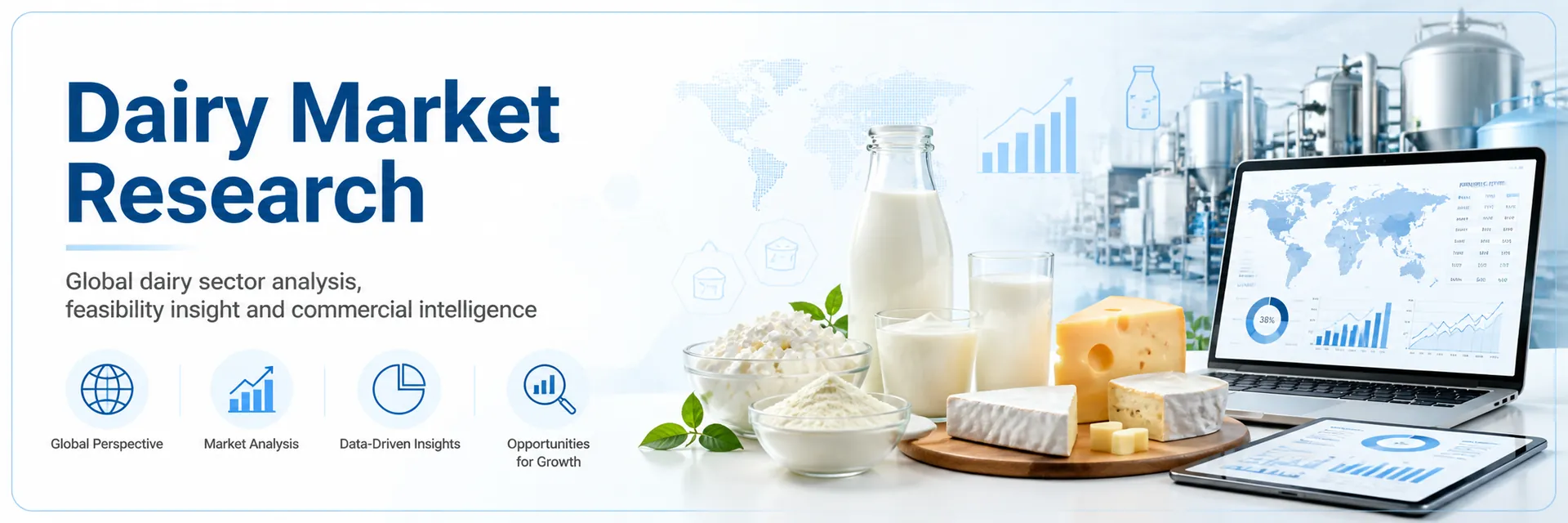
Dairy Industry Market Research
Watson Dairy Consulting provides independent dairy market research and feasibility study support for dairy manufacturers, investors, lenders, advisers and project teams. The focus is practical and commercial: identifying whether a dairy opportunity is real, whether the assumptions are credible, and whether the proposed project, product or market entry strategy is likely to work.
Dairy market research should not be treated as a generic desk exercise. The dairy industry has its own economics, product functionality issues, cold-chain requirements, ingredient dependencies, yield implications, processing constraints, regulatory pressures and route-to-market challenges. A market may look attractive on headline demand figures, but still be commercially weak if distribution, pricing, local competition, import duties, product specification or manufacturing cost assumptions are wrong.
Watson Dairy Consulting helps clients evaluate opportunities in dairy products, dairy ingredients, manufacturing, distribution, export, market entry, acquisitions and factory investment. Assignments can be short and focused, or part of a wider feasibility study, due diligence review, board paper, investor pack or project development plan.
Dairy Market Research Services
Research can be tailored to the decision being made. Typical work may include market sizing, competitor mapping, customer and distributor review, price positioning, product category analysis, supply-chain assessment, route-to-market review, import and local production comparison, project feasibility support, and commercial challenge of expansion assumptions.
- Country and regional dairy market reviews
- Dairy product category assessments
- Infant formula and milk powder market research
- Dairy ingredients, whey, milk proteins and lactose market review
- Dairy fats, butter, butteroil and AMF market research
- Competitor benchmarking and market positioning review
- Factory expansion and new project feasibility support
- Export opportunity assessment and route-to-market review
- Investor, lender and acquisition support
- Confidential research for advisers, agencies and project teams
Why Specialist Dairy Market Research Matters
Good dairy market research helps a business make better decisions before committing significant capital. It can support new product development, export planning, acquisition review, new factory investment, category repositioning and entry into new markets. Poor research can lead to overestimated demand, unrealistic margins, unsuitable product specifications, weak distribution assumptions or investment in the wrong type of processing capacity.
The value of specialist dairy research is not simply collecting data. The value is interpreting that data against real dairy manufacturing experience, product behaviour, plant economics, customer expectations and commercial risk. This is particularly important in sectors such as infant formula, milk powders, whey ingredients, cheese, UHT, yogurt, butter and value-added dairy ingredients.
Product Areas Covered
- Infant formula, follow-on formula and growing-up milks
- Skimmed milk powder, whole milk powder and fat-filled milk powders
- Dairy ingredients, whey powders, whey proteins, lactose and milk proteins
- Dairy fats, butter, butteroil, AMF and cream-based products
- Cheese, processed cheese, cream cheese and soft cheese
- UHT milk, ESL milk, pasteurised milk and cultured products
- Yogurt, drinking yogurt, frozen yogurt and fermented dairy products
- Non-dairy milk and plant-based alternatives where relevant to the project
- Packaging, distribution, import replacement and local manufacturing opportunities
Dairy Market Research Experience
Watson Dairy Consulting has supported dairy market research, feasibility and project review work connected with international dairy markets and product categories. Experience and reference material includes work linked to infant formula, milk powders, dairy ingredients, manufacturing opportunities, distribution and route-to-market considerations across Africa, the Middle East, Europe, Asia and other international markets.
- Global infant formula milk market research
- Manufacturing and distribution of dairy products in Iran
- Iran infant formula milk powder market research
- Pakistan dairy industry reference material
- Global milk price trends and market commentary
- Africa dairy market research and feasibility review
- Ethiopia dairy market research — practical project experience
- Ghana dairy market research — practical project experience
- Djibouti dairy market research — practical project experience
- Nigeria dairy market research — practical project experience
- Togo dairy market research — practical project experience
- Middle East dairy market research and project review
- Europe dairy market review
- USA dairy market research
- India dairy market research
- Pakistan dairy market research
- Iran dairy market research — practical project experience
- Iraq, Iran and Afghanistan infant formula market review
- Iran processed cheese and soft cheese market review
- Global non-dairy milk and alternative dairy market review
Dairy Market Research FAQs
Clients often need clear answers to practical commercial questions before moving forward. Some of the most common are answered below.
How do you know if there is enough real demand to justify a new product or factory?
Is the market usually supplied by imports, local production or informal channels?
What product specifications, pack sizes and price points are realistic?
Which route to market is most credible?
Are the assumed margins realistic?
Would a local factory, import model, joint venture or contract manufacturing route make more sense?
What are the main commercial, technical and regulatory risks?
Can the research be kept confidential?
How a Typical Assignment Works
The scope depends on the question being asked. A short assignment may focus on a single country, product or competitor issue. A wider feasibility study may combine market demand, competitor structure, pricing, distribution, factory implications, investment assumptions and strategic options.
- Scope definition: clarify the decision, geography, product area, timescale and required output.
- Research: gather and review relevant market, industry, competitor and product information.
- Commercial interpretation: assess what the information means in practical dairy-sector terms.
- Challenge of assumptions: test whether the project assumptions are realistic.
- Reporting: provide clear findings, implications and recommended next steps.
Who Uses This Support?
- Dairy manufacturers considering growth, exports, acquisition or product diversification
- Investors and lenders reviewing dairy projects or acquisition opportunities
- Project developers planning new dairy plants or factory expansion
- Consultancies and advisers needing specialist dairy sector input
- Ingredient, equipment or packaging suppliers assessing dairy market opportunities
- Government, development or trade bodies reviewing dairy sector potential
Confidential and Flexible Support
Watson Dairy Consulting can provide short focused market research assignments, wider feasibility studies, ongoing market monitoring or confidential input as part of a larger advisory team. The work can be adapted to suit manufacturers, investors, lenders, project teams, agencies and professional advisers.
The aim is not to produce a generic report full of unsupported optimism. The aim is to help clients understand the opportunity, the risks, the likely constraints and the practical commercial implications before making important decisions.
Related Dairy Consultancy Services
- Dairy Due Diligence
- Feasibility & Business Planning
- Dairy Factory Design
- Dairy Process Optimisation
- Evaporator Operation & Training
- Spray Dryer Operation & Training
Contact Watson Dairy Consulting
Planning a dairy investment, market entry or feasibility study? For a confidential discussion about a dairy market research requirement, feasibility study, market-entry review or strategic dairy project, please contact Watson Dairy Consulting.
Discuss Your Market Research RequirementFor more information or to discuss a dairy market research requirement, feasibility study, market-entry review or strategic dairy project, please contact Watson Dairy Consulting.
Related Downloads
Reference documents and worked examples (PDF):
- Dairy industry SWOT analysis example (PDF)
Worked example SWOT analysis covering strengths, weaknesses, opportunities and threats in the dairy manufacturing sector.
Further reading: John Watson publishes articles on dairy industry topics on LinkedIn — from infant formula safety and milk supply to plant design, yield improvement and dairy commodity outlook. Browse all articles by John Watson on LinkedIn →
John Watson
Office: +44 1224 861 507
Mobile: +44 7931 776 499
jw@dairyconsultant.co.uk
We are a longstanding member of the Society of Dairy Technology
and have Fellowship of the Institute of Food Science and Technology.



Contact Details
John Watson
Office: +44 1224 861 507
Mobile: +44 7931 776 499
jw@dairyconsultant.co.uk
What Our Clients Say
We are a longstanding member of the Society of Dairy Technology
and have Fellowship of the Institute of Food Science and Technology.
Locations

Services
Enquiry Form

