
Dairy Process Optimisation
Independent dairy process optimisation — identifying and recovering yield losses, reducing energy and CIP consumption, improving OEE, raising quality consistency and lowering cost of conversion.
Watson Dairy Consulting works alongside plant management, not in competition with it. Findings are quantified, actionable and prioritised by payback. No success fees or contingent arrangements that bias the assessment.
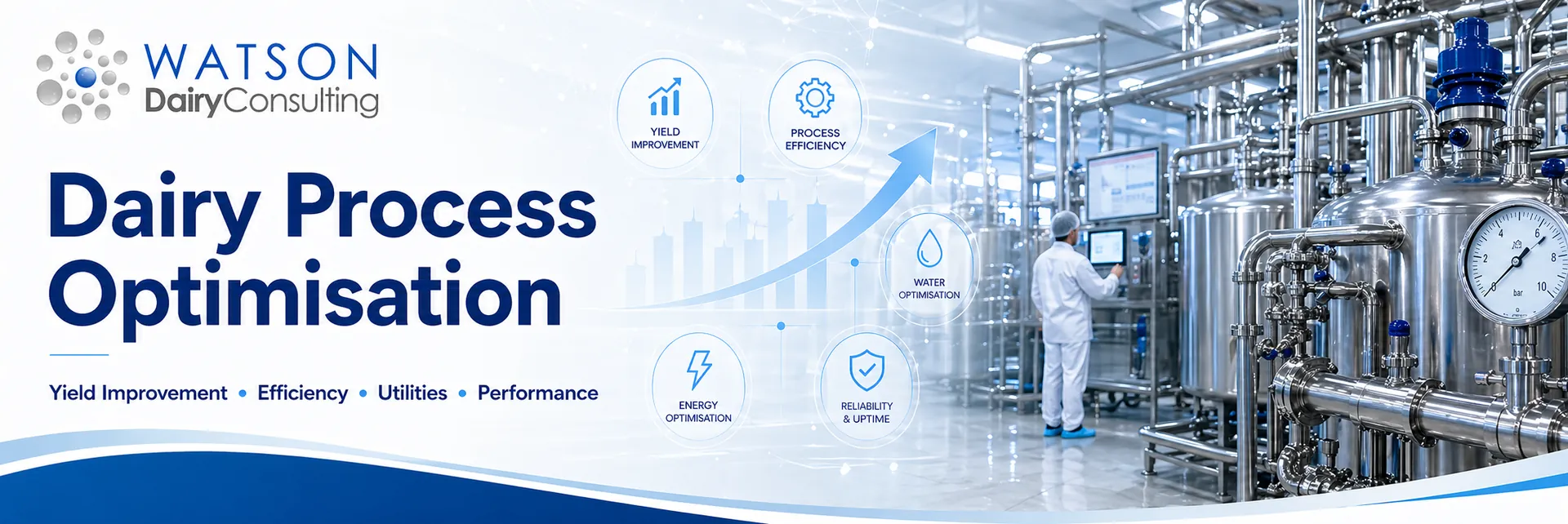
Independent dairy process optimisation for manufacturers who want to improve yield, efficiency, utility use, process control and factory performance.
Watson Dairy Consulting helps identify practical improvement opportunities, prioritise actions by commercial impact, and support teams in delivering measurable operational gains.
Dairy Process Optimisation, Development and Improvement
Watson Dairy Consulting provides independent dairy process review and optimisation support for single-site and multi-site dairy manufacturers. The focus is practical: identify where performance can be improved, quantify the likely benefit, and help management teams prioritise actions that can improve profitability, quality, reliability and operating discipline.
Process optimisation is not just about equipment. It includes yield recovery, water and utility use, product losses, downtime, changeovers, process settings, hygiene interfaces, operator routines, maintenance priorities, planning discipline, reporting quality and the way decisions are made during production.
Commercial focus: dairy process optimisation should lead to clearer priorities, measurable savings, better process stability and stronger factory control. It should not become a generic report that sits on a shelf.
Where Dairy Process Value Is Commonly Lost
Yield and Solids Recovery
Losses through effluent, drain losses, start-up, shutdown, transfers, rework, over-standardisation and specification safety margins.
Utilities and Carbon
Excess water, steam, refrigeration, compressed air and electricity use that increases operating cost and carbon footprint.
Downtime and Throughput
Minor stops, slow running, changeover delays, bottleneck assets, poor scheduling and avoidable production interruptions.
Process Control
Unstable settings, shift-to-shift variation, weak KPI visibility, poor intervention routines and unclear ownership of losses.
Why Use an Outside Dairy Consultant?
An experienced external dairy consultant can challenge assumptions that may have become normal inside the business. Internal teams often know where many issues are, but they may lack the time, independence or cross-functional authority to turn those observations into a prioritised improvement plan.
Watson Dairy Consulting works with operational staff, supervisors, engineers, quality teams and management to identify practical savings and paybacks. The best results normally come when improvement ideas are developed with site teams, not imposed on them. Staff commitment matters because they are the people who will sustain the changes after the review.
Independent review can also help directors and finance managers understand which opportunities are immediate, which need capital, which require better management control, and which are unlikely to deliver a worthwhile return.
Typical Process Optimisation Review Areas
| Review Area | What Is Assessed | Commercial Purpose |
|---|---|---|
| Yield performance | Product losses, solids recovery, drain losses, effluent loading, rework, overfill and specification giveaway. | Protect margin and improve recovery from the same milk input. |
| Factory efficiency | Throughput, downtime, minor stops, changeovers, line utilisation, bottlenecks and shift performance. | Increase output, reduce avoidable delay and improve capacity use. |
| Utility performance | Water, wastewater, steam, electricity, refrigeration, compressed air and cleaning system use. | Reduce cost, energy use, water consumption and carbon impact. |
| Process stability | Process settings, control routines, operator adjustments, standard operating practice and shift-to-shift variation. | Improve repeatability, product quality and management control. |
| Quality and brand protection | Quality risks, product holds, rejects, rework, hygiene interfaces, corrective action and process vulnerabilities. | Reduce risk, protect customers and strengthen technical assurance. |
| KPI and reporting systems | Management reports, KPI relevance, data accuracy, loss visibility, meeting routines and ownership of actions. | Make losses visible and convert data into action. |
Utilities, Water and Carbon Reduction
Rising utility costs and carbon reduction pressure make process optimisation increasingly important. In dairy factories, high water use usually brings additional costs in wastewater, pumping, heating, chemicals, labour and treatment. Utility performance is often a strong indicator of wider operational discipline.
A review can identify opportunities in water use, CIP discipline, steam use, heat recovery, refrigeration efficiency, compressed air, transfer losses, product-to-drain events, start-up and shutdown routines, and excessive flushing or rinsing. Some improvements may require capital, but many are rooted in operating practice and management control.
Dairy Factory and Processing Benchmark Reviews
Dairy operations and process scans can produce rapid results when the loss points are clear, measurable and commercially significant. Previous dairy processing reviews have identified immediate improvement opportunities and annualised savings exceeding £1m on a single site or process area.
The purpose is not to compare numbers for the sake of comparison. The purpose is to understand what level of performance should be achievable for the specific plant, product mix, equipment, team and operating constraints.
Lean Manufacturing and Performance Management
Lean manufacturing and performance management only work when the measures are relevant to the factory and understood by the people who run it. Generic KPI packs are often less useful than a small number of high-quality measures linked directly to yield, downtime, changeovers, quality, utility use and recovery.
Watson Dairy Consulting can help identify, prepare and implement practical management reporting formats and key performance indicators relevant to your product range and processes.
Important point: improvement is strongest when operators, supervisors and managers can see the losses during the shift, understand the cause and have a clear route to act before the cost is already lost.
Action List Before Starting a Dairy Process Optimisation Review
The action list should be tailored to the specific plant, product range and business priorities. A typical review structure includes the following:
- Define objectives: agree whether the priority is yield, cost, capacity, quality, utilities, brand protection, carbon reduction, or a combination of these.
- Agree scope: define the product areas, process lines, utility systems, reporting routines and production periods to be reviewed.
- Assemble a cross-functional team: include production, engineering, maintenance, technical, quality, operations, finance and relevant site leadership.
- Gather process data: collect production volumes, losses, downtime, utility data, quality records, CIP data, equipment information and existing KPI reports.
- Map the process: identify all key steps, interfaces, transfer points, start-up/shutdown routines, cleaning boundaries and likely product-loss points.
- Evaluate performance: review throughput, downtime, yield rates, utility consumption, quality metrics, rework, rejects and process stability.
- Identify improvement opportunities: separate quick wins from longer-term capital or system changes.
- Prioritise initiatives: rank actions by value, practicality, risk, timescale, cost and site capability.
- Develop action plans: define owners, timelines, expected benefits and measurement methods.
- Implement and monitor: track actions against the agreed objectives and review performance regularly.
- Standardise improvements: update working practices, KPI reports, training, control settings and operating routines where needed.
Dairy Process Optimisation FAQs
Products and Process Areas Covered
Watson Dairy Consulting reviews a wide range of dairy manufacturing operations including liquid milk, pasteurised milk, UHT, cream, butter, cheese, yogurt, cultured products, whey processing, milk powders and infant formula milk powders.
Need to improve dairy yield, utilities or factory performance? Watson Dairy Consulting can help review your process, identify where value is being lost, and prioritise the improvements that are most likely to deliver measurable benefit. Please contact us to discuss your requirements.
Discuss a Process Optimisation ReviewRelated services: Dairy Factory Benchmarking · Dairy Yield Savings Calculator · Evaporator Steam Economy Calculator · Spray Dryer Fines · Dairy Factory Design · Evaporator Training · Spray Dryer Training
Contact Watson Dairy Consulting
For more information about dairy process optimisation, factory performance review or yield improvement, please contact us.
Further reading: John Watson publishes articles on dairy industry topics on LinkedIn — from infant formula safety and milk supply to plant design, yield improvement and dairy commodity outlook. Browse all articles by John Watson on LinkedIn →
John Watson
Office: +44 1224 861 507
Mobile: +44 7931 776 499
jw@dairyconsultant.co.uk
We are a longstanding member of the Society of Dairy Technology
and have Fellowship of the Institute of Food Science and Technology.



Contact Details
John Watson
Office: +44 1224 861 507
Mobile: +44 7931 776 499
jw@dairyconsultant.co.uk
What Our Clients Say
We are a longstanding member of the Society of Dairy Technology
and have Fellowship of the Institute of Food Science and Technology.
Locations

Services
Enquiry Form

