
Dairy Cost Reduction Reviews
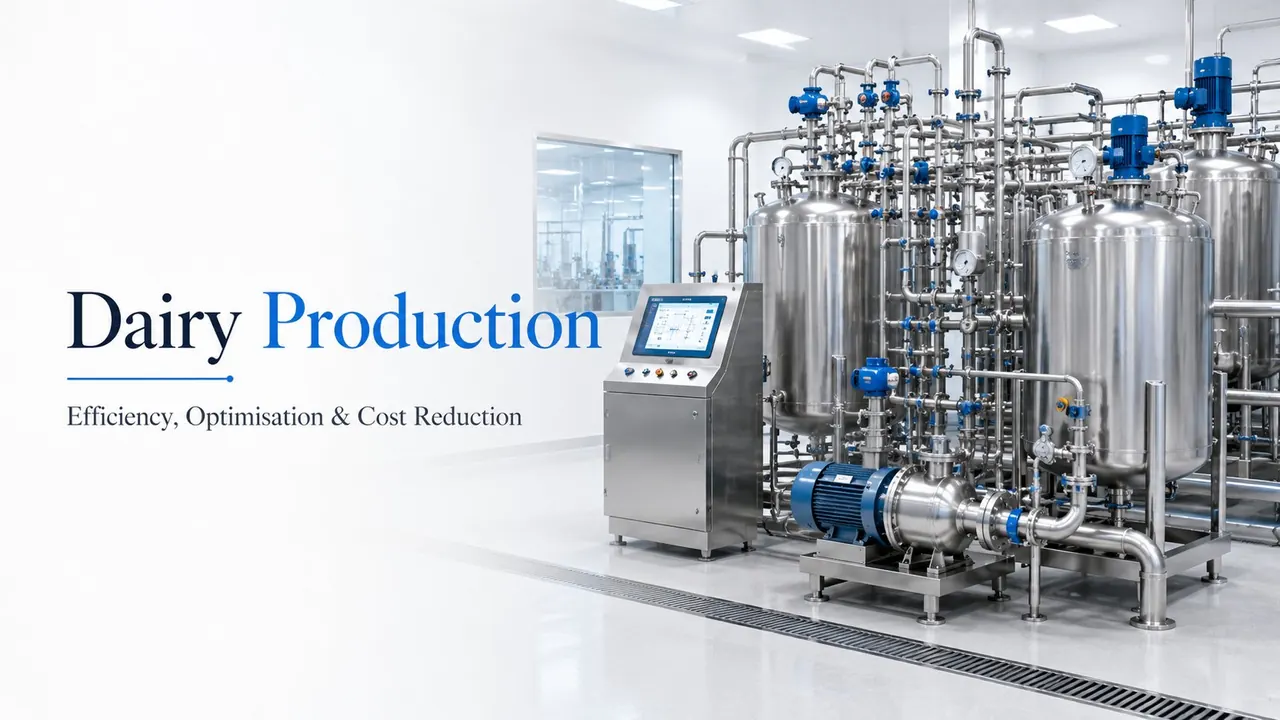
Independent dairy cost reduction and production efficiency reviews — structured opportunity assessment covering yield, energy, separator and CIP performance, materials, packaging, labour and OEE.
Watson Dairy Consulting brings 50 years of dairy plant experience and a supplier-neutral viewpoint. We identify, quantify and prioritise the savings; you decide what to implement.
Where Cost Reduction Usually Lives
Every dairy plant has cost hidden somewhere — the question is where, how much, and what investment unlocks it. After 50 years of looking at dairy operations, we find the savings concentrate in four places, in roughly this order of typical size:
Yield Improvement
Milk in vs product out. Separator performance, CIP losses, line losses, fines in whey. Typically 1–3% of cost of goods sold recoverable on a mature plant.
Energy Reduction
Steam, electricity, refrigeration. Heat recovery gaps, evaporator economy, compressed air leaks, lighting/HVAC at off-shift. 5–15% reduction is common.
CIP & Utilities
Chemical use, water consumption, effluent loading. Better cycle design rather than shorter cycles. 20–40% chemical reduction is achievable without compromising hygiene.
Labour & OEE
Bottleneck analysis, shift pattern optimisation, planned vs unplanned stoppage, changeover times. Often 5–10% OEE improvement on the constraining line.
Yield Improvement — Where the Biggest Hidden Costs Live
Yield is the single largest cost lever on most dairy plants. A 1% yield improvement on a plant turning over £30 million is £300,000 a year, every year. Yet yield losses are often hidden because they don't appear as a separate line in management accounts — they show up as "lower than expected output" with no clear attribution.
Milk separator optimisation
Separators are the single biggest yield risk in a dairy plant. A separator can account for up to 25% of dairy fat losses if not running optimally — and the symptoms aren't always obvious to operators who see the same numbers every day.
If your separator is not optimised you will be paying:
- Fat losses to skim — the headline loss, the easiest to measure, the most expensive when it drifts
- Out-of-specification skimmed milk and skimmed milk powder — downstream rejection, blending costs, customer complaints
- Increased wastewater volume from extra rinsing and CIP
- Increased wastewater organic load (BOD/COD) driving up effluent treatment costs
- Increased cleaning times and CIP chemical use from inadequate routine flushing
- Higher maintenance costs from bowl imbalance and bearing wear
- Higher energy costs from running the separator harder than necessary
Simple monitoring and adjustment protocols, plus operator training focused on what the numbers mean rather than just what they are, can transform separator performance. In one recent case, repositioning a turbidity meter and changing the start/stop protocol moved a plant from operator-timed switching (and the milk loss that goes with it) to instrument-driven switching that saved several thousand litres of milk a week.
For more on separator optimisation and operator training, see our milk separator page.
CIP losses and line losses
Product loss at the product/water and water/product interface during start-up and shutdown is one of the most preventable yield losses in dairy. Volumes vary by line and product, but milk plants routinely lose hundreds of litres per changeover that could be recovered with better instrumentation (in-line conductivity, turbidity), better procedures, or both. Multiply by frequency and the annual number is often six figures.
Fines and whey-protein loss
On cheese and cottage cheese plants, fines lost to whey represent direct yield loss. Most plants accept 1–3% as inevitable; many can recover 1–2 percentage points with curd-handling discipline, better screen design or membrane recovery from the whey stream. The capital case depends on volume but the operating margin is usually compelling.
A structured 3–5 day on-site review usually identifies enough recoverable margin to substantially exceed the cost of the review in its first year of implementation. Schedule a call with Watson Dairy Consulting →
Energy Reduction
Dairy plants are energy-intensive: steam for pasteurisation and evaporation, electricity for refrigeration and motors, compressed air for valves and fillers. Energy bills have risen sharply in recent years, and the savings available from systematic review have grown with them.
Heat recovery and evaporator economy
Many plants have heat-recovery loops that worked when installed but have degraded over years — fouled regenerators, undersized after capacity expansion, or simply switched off after a maintenance shutdown and never restarted. Each can be a six-figure annual cost. Evaporator steam economy is similar — a TVR evaporator that should be hitting a steam economy of 4.5 may be running at 3.5 because of a thermocompressor nozzle that hasn't been inspected for years.
Compressed air and refrigeration
A 5 mm compressed-air leak running 24/7 costs around £3,000 a year in electricity at current UK prices. Most plants have multiple such leaks they haven't audited. Refrigeration plant set-points are often legacy choices from commissioning — tightening discharge pressure and head pressure where the heat load supports it is a low-cost no-risk gain.
CIP and Utilities
CIP is the single biggest user of chemicals, hot water and effluent capacity on most dairy plants. It's also the area most resistant to optimisation, because cleaning failures are catastrophic and operators rightly prefer "more" over "less".
The right answer is better cycle design rather than shorter cycles. Single-use versus recovered solutions, optimal temperature/concentration ratios, dwell time tuning, removal of unnecessary intermediate rinses, and proper validation. Plants we have worked with have cut CIP chemical use by 20–40% with no measurable change in cleaning outcomes — the savings came from removing waste, not from skipping steps. For a full discussion see our CIP training page.
Materials, Packaging and Procurement
- Packaging gauge and design — many dairy products carry more packaging than they need; lightweighting (down-gauging films, board grammage, bottle weight) saves materials, transport and end-of-life cost
- Supplier consolidation and rebate review — for plants with multiple suppliers of similar inputs, consolidation often unlocks 2–5% savings
- Specification rationalisation — many dairy plants are buying premium specifications they don't need; we help review against what the process actually requires
- Recycled-content optimisation — particularly relevant under the UK Plastic Packaging Tax, where designed-in recycled content can remove the tax burden entirely on plastic components
Labour, OEE and Process Flow
Labour cost reduction in dairy rarely means fewer people — it usually means the same people producing more reliably. The wins are in:
- Bottleneck analysis — what is actually constraining the line, and what does it cost to relieve it?
- Changeover time reduction — SMED-style review of size/flavour/product changeovers
- Planned vs unplanned stoppage analysis — reducing breakdowns through proper PPM and operator-led care
- Shift pattern review — matching staffing to demand patterns rather than legacy roster
- Operator capability — better-trained operators make fewer judgement errors that cost money
How We Run a Cost Reduction Review
1. Brief & Scope
Discussion to agree what's in and out, what success looks like, what data is available, and who in the team will be the day-to-day contact during the review.
2. Plant Walk & Data Review
On-site tour, observation of normal operating shifts, review of last 12 months of production data, energy bills, yield records, OEE data and CIP records.
3. Opportunity List
Quantified, prioritised list of identified savings, with estimated capital cost (where applicable), payback, and confidence rating. Risks called out explicitly.
4. Implementation Support
Optional - some clients implement themselves with the report alone, others want hands-on support through specification, supplier engagement, operator training and verification.
We are independent of all equipment suppliers and chemical vendors. The opportunity list will not steer you toward a particular brand because we have a relationship with them — we don't, and we won't.
Frequently Asked Questions
How much can we expect to save from a dairy cost reduction review?
Typical findings range from 1 to 3 percent of cost of goods sold from yield improvement alone, with further gains in energy (5 to 15 percent reduction is common) and CIP chemicals and water (often 20 to 40 percent). The total opportunity depends on the plant's starting point, but on a mid-sized dairy plant the identified annual savings usually substantially exceed the cost of the review.
How long does a cost reduction review take?
A focused review of a single area (separator, CIP, energy, yield) is typically 2 to 4 days on site plus a written report. A full plant review covering yield, energy, CIP, OEE and packaging is typically 1 to 2 weeks on site plus the written report. We agree the scope and deliverables before starting so the brief is clear.
Do you implement the savings, or just identify them?
Either. Some clients want the opportunity list and quantification only — their team implements. Others want hands-on support through implementation, particularly where it involves operator training, supplier specification, or persuading senior management to release capital. We work whichever way suits.
What sectors and plant types do you cover?
All major dairy sectors — liquid milk, butter and AMF, cheese (hard, soft, processed), yogurt and fermented products, milk powder and infant formula, whey processing, ice cream and frozen desserts. Plant sizes range from artisan-scale through to multi-line industrial sites processing more than a million litres a day.
What is your fee model?
Day rate plus expenses, agreed upfront against a scoped brief. No success fees or percentage-of-savings arrangements — these create the wrong incentives. We are paid for independent technical opinion, not for finding things to recommend. Travel from Aberdeen, Scotland.
Can our internal team do this without external help?
Often yes, in principle. The reason most plants benefit from an external review anyway is that internal staff are too close to current operating habits to spot them as choices rather than as "the way we do it". A fresh, experienced set of eyes is often what catches the 1 to 3 percent that has been sitting there for years.
Further reading: John Watson publishes articles on dairy industry topics on LinkedIn — from infant formula safety and milk supply to plant design, yield improvement and dairy commodity outlook. Browse all articles by John Watson on LinkedIn →
See our related dairy factory benchmarking, process optimisation, supply chain evaluation, CIP training and milk separator pages, or browse all consultancy services.
John Watson
Office: +44 1224 861 507
Mobile: +44 7931 776 499
jw@dairyconsultant.co.uk
We are a longstanding member of the Society of Dairy Technology
and have Fellowship of the Institute of Food Science and Technology.



Contact Details
John Watson
Office: +44 1224 861 507
Mobile: +44 7931 776 499
jw@dairyconsultant.co.uk
What Our Clients Say
We are a longstanding member of the Society of Dairy Technology
and have Fellowship of the Institute of Food Science and Technology.
Locations

Services
Enquiry Form

