
Milk Price Forecasting
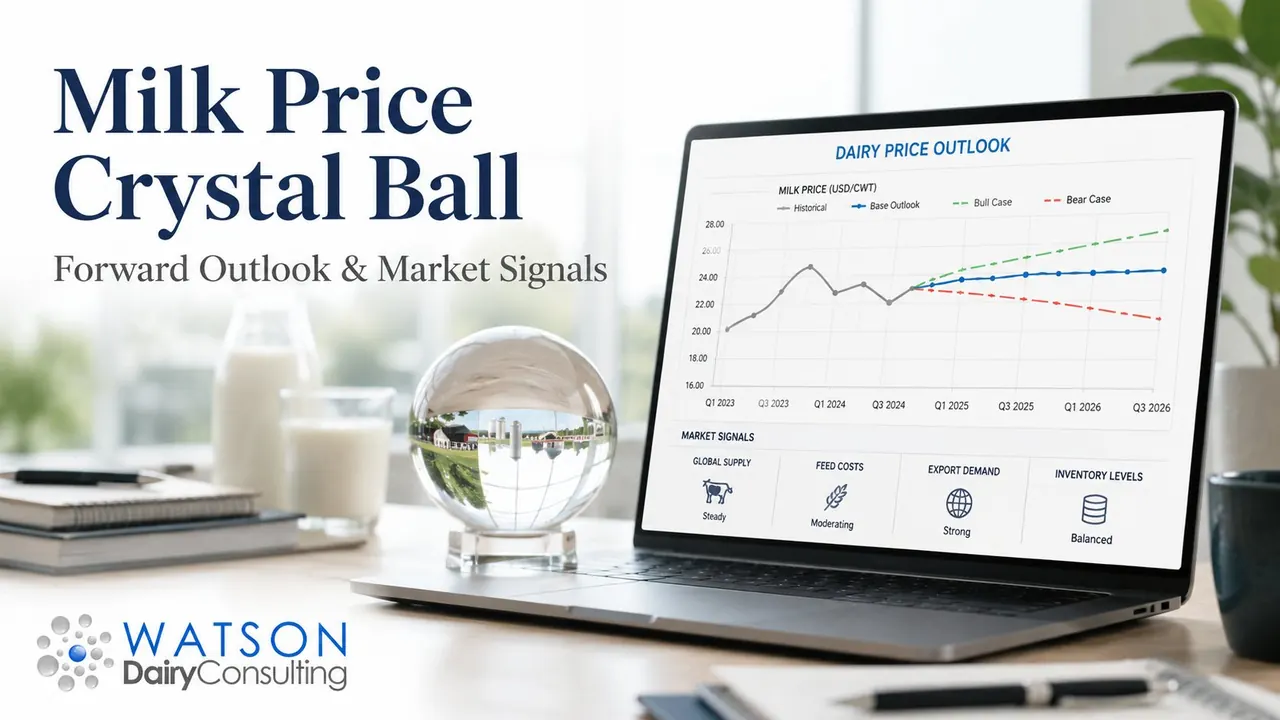
Independent dairy commodity and milk price forecasting — GDT, UK and EU farm-gate milk price, butter, SMP, WMP, cheese and whey, with scenario analysis for budgeting, procurement and strategic planning.
Watson Dairy Consulting provides forecasts that identify the most likely range, the drivers that matter and the early signals that show which scenario is unfolding — not magic numbers that pretend to predict the unpredictable.
Why Independent Dairy Forecasting Matters
Dairy commodity prices have been more volatile in recent years than in any period since the 1970s. Brexit, Covid, the Ukraine war, the European energy crisis and the post-pandemic feed-input spike have all moved dairy prices by 30 to 80% in single seasons. Businesses that survived those years did so by being prepared for multiple scenarios — not by having a perfect forecast.
The dairy industry has plenty of forecasts available. The problem is that most come from organisations with a commercial interest in the outcome: processors want farmers to expect lower prices, farmers want higher, traders want volatility, retailers want stability. Genuine independence is rare and valuable, and that is what we provide.
What We Forecast
UK & EU Farm-Gate Milk Price
Forward outlook on the milk price processors pay to producers, including A+B pricing structures, cost-of-production formulas, seasonal patterns and regional differentials.
GDT & Global Trade
Global Dairy Trade auction outlook, New Zealand, EU and US export prices, Chinese and Middle Eastern demand signals and the freight, FX and tariff factors that move them.
Commodity Products
SMP, WMP, butter, AMF, cheddar, mozzarella, sweet and acid whey - both the spot and forward outlook, with structural drivers and short-term signals identified separately.
Scenario Analysis
Base case, bull case, bear case - with explicit identification of which assumptions drive the outcome and what early signals indicate which scenario is playing out.
The Drivers We Track
Global milk supply
The big three export regions — New Zealand, EU and US — produce most of the milk that moves in international trade. Their production trajectories, set by herd size, productivity, feed quality and weather, dominate the global supply-side outlook. Australia, Argentina, Belarus and a handful of others add marginal but sometimes decisive flexibility. We track government statistics, processor reports, satellite-derived grass growth, and weather forecasts that affect feed and production.
Feed costs
Feed is typically 35 to 55% of dairy farm cost in intensive systems and 15 to 30% in grass-based systems. Corn, soybean meal, wheat and oilseed prices drive feed cost, and that drives the farm break-even point and ultimately influences supply discipline. Sudden moves in grain markets — like the Black Sea disruption in 2022 — have substantial downstream effects on dairy prices, often with a 6 to 12 month lag.
Export demand
Chinese WMP and infant formula imports drove the 2013-14 price spike. The post-2014 slowdown is still rippling through global pricing. Middle Eastern, South-East Asian, Mexican and African demand are increasingly important. We track buying patterns, tender outcomes, stock-building behaviour and central bank FX positioning in the major importing economies.
Inventory levels
EU and US public and private stocks of butter, SMP and cheese set a floor under prices when low and a ceiling when high. SDA (Storage Development Aid) and inventory reporting are tracked. New Zealand season-end stocks are a particularly informative signal for the year ahead.
Currency & freight
GBP/USD, EUR/USD and the New Zealand dollar all move dairy prices in different directions depending on whether you are a buyer or seller. Freight rates — both bulk and container — are a non-trivial part of landed cost on long-haul dairy trade and have moved 200 to 400% in single years recently. We integrate FX and freight into commodity forecasts.
Regulatory & political signals
Trade policy, sustainability regulation, animal welfare legislation, labour rules and tax policy all affect dairy supply and demand. The EU farm-to-fork strategy, methane regulations, US Farm Bill cycles, and post-Brexit UK trade policy are all live drivers worth tracking.
One-off briefs typically take 1 to 2 weeks. Monthly or quarterly outlook retainers available for clients who need ongoing input. Schedule a call with Watson Dairy Consulting →
How We Deliver Forecasts
1. Brief & Scope
Discussion to understand the decision the forecast is supporting (budget, contract, capex, hedging input), the time horizon, the relevant products and the format the output needs to be in.
2. Data & Drivers
Pull together the data, identify the dominant drivers for the chosen horizon and products, set the base case and the scenario assumptions.
3. Forecast & Scenarios
Base case, bull case, bear case - with quantified ranges and explicit confidence rating. The narrative explaining each scenario is as important as the numbers.
4. Briefing & Update
Walk through with the executive or board team. Optional follow-up reviews at agreed intervals as data evolves and assumptions need updating.
What Forecasting Can And Cannot Do
What it can do: identify the most likely range, the drivers that matter most, the scenarios that would push prices significantly higher or lower, and the early signals that suggest which scenario is unfolding. It can also tell you which assumptions are conservative and which are stretching, so you can sense-check forecast inputs against your own commercial view.
What it cannot do: tell you the price 18 months out with high accuracy. Anyone claiming that capability should be treated with caution. Commodity markets are not predictable in a precise-numbers sense — what good forecasting delivers is being prepared for the range of outcomes that are actually plausible, and able to react quickly when the early signals shift.
A Note on Hedging
We provide independent analysis and forecasts that inform hedging decisions. We are not authorised to advise on or arrange financial transactions — hedging via futures (CME Class III milk, EEX SMP, butter, whey, NZX WMP), options or OTC instruments is a regulated activity that should be discussed with an FCA-authorised provider or equivalent in your jurisdiction. We work alongside clients' hedging counterparties to ensure the technical and market view feeding the hedging decision is sound.
Who Uses Our Forecasts
- Dairy manufacturers — annual budgeting, milk procurement planning, customer contract negotiation, capex appraisal
- Retailers — long-term private label dairy supply contracts and category margin planning
- Processors with formula-priced milk contracts — understanding the price evolution embedded in their cost base
- Investors and PE funds — assessing dairy targets' margin sustainability under different price scenarios
- Lenders — credit risk assessment of dairy borrowers, covenant sensitivity testing
- Trade buyers and sellers — timing inventory build, contract negotiation, hedge sizing
- Insurance underwriters — pricing dairy-sector commodity risk products
Frequently Asked Questions
What does milk price forecasting cover?
Forward outlook on UK and EU farm-gate milk price, GDT trade index, major dairy commodities (SMP, WMP, butter, cheese, whey) and the underlying drivers — global milk supply, feed costs, export demand, currency, regulation and inventory levels. Output is a base-case forecast with bull and bear scenarios and explicit identification of the assumptions that move the outcome.
How accurate are dairy commodity forecasts?
No one forecasts commodity prices with high accuracy — anyone claiming they can should be treated with caution. What good forecasting does is identify the most likely range, the key drivers, the scenarios that would push prices up or down, and the early signals that suggest which scenario is playing out. The value is in being prepared for what happens, not in being right about which scenario.
Do you advise on hedging?
We provide independent analysis and forecasts that inform hedging decisions, but we are not authorised to advise on or arrange financial transactions. Hedging via futures, options or OTC instruments is a regulated activity that should be discussed with an FCA-authorised provider. We work alongside clients' hedging counterparties to ensure the technical and market view feeding hedging decisions is sound.
What forecast horizon do you cover?
Standard horizons are short term (next 3 months — high confidence based on near-term signals), medium term (3 to 12 months — scenario-based) and long term (1 to 3 years — directional with structural drivers). Beyond 3 years, forecasts become trend statements rather than price points. We tailor the horizon to the client's decision — budgeting, contract negotiation, capex appraisal or strategic planning each need different time frames.
Who uses dairy commodity forecasting?
Dairy manufacturers planning annual budgets and procurement, retailers negotiating long-term supply contracts, processors with milk price formulas linked to commodities, investors evaluating dairy assets, lenders assessing credit risk on dairy borrowers, and trade buyers and sellers timing inventory or contract decisions. Each gets a tailored brief rather than a generic report.
What is your fee model for forecasting?
Day rate plus expenses for one-off briefs, or retainer arrangements for ongoing monthly or quarterly outlook reports. No commission, no success fees, no contingent arrangements. The value of independent forecasting is exactly that — independent of any commercial interest in a particular outcome.
Further reading: John Watson publishes articles on dairy industry topics on LinkedIn — from infant formula safety and milk supply to plant design, yield improvement and dairy commodity outlook. Browse all articles by John Watson on LinkedIn →
See our related dairy market research, cost reduction reviews, due diligence, investment advice and acquisitions & disposals pages, or browse all consultancy services.
John Watson
Office: +44 1224 861 507
Mobile: +44 7931 776 499
jw@dairyconsultant.co.uk
We are a longstanding member of the Society of Dairy Technology
and have Fellowship of the Institute of Food Science and Technology.



Contact Details
John Watson
Office: +44 1224 861 507
Mobile: +44 7931 776 499
jw@dairyconsultant.co.uk
What Our Clients Say
We are a longstanding member of the Society of Dairy Technology
and have Fellowship of the Institute of Food Science and Technology.
Locations

Services
Enquiry Form

