
UHT Milk Processing
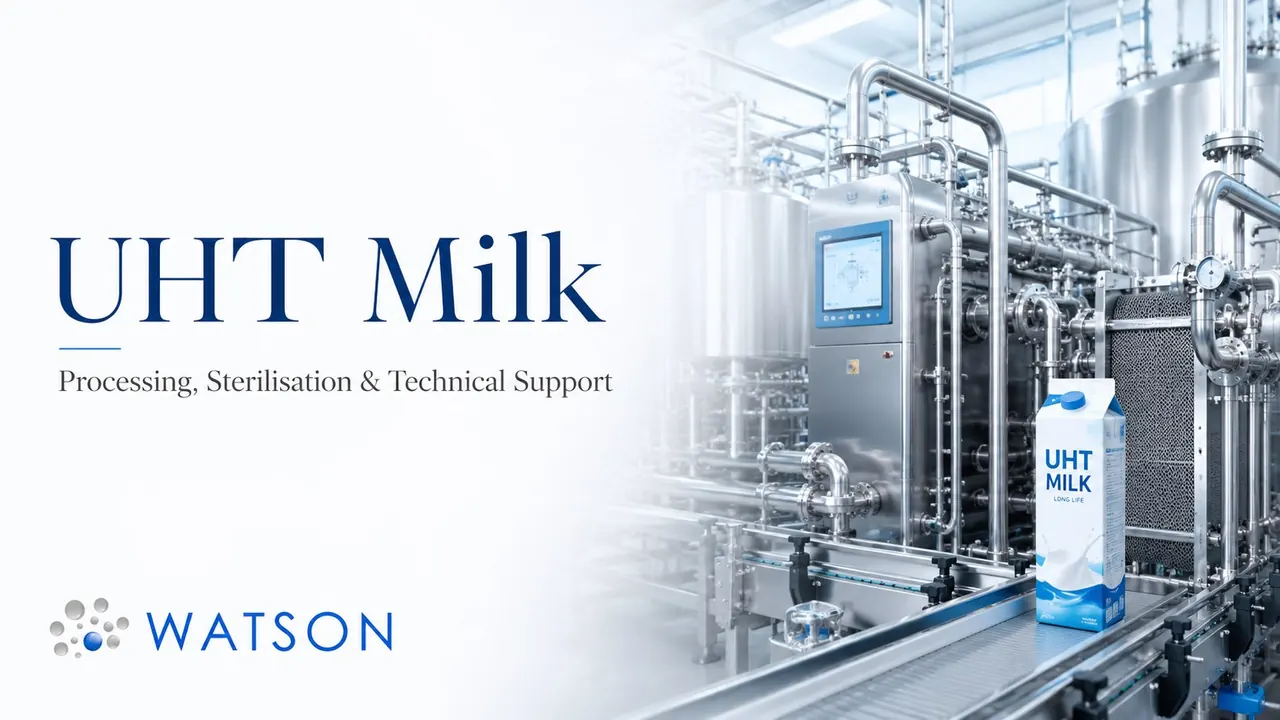
Independent UHT milk and aseptic processing consultancy — heating method selection, capex and operating economics, shelf-life troubleshooting, aseptic packaging specification, and critical considerations for infant formula and other high-value UHT applications.
UHT is a deceptively simple-sounding technology with a great deal of detail behind the headline temperature. Watson Dairy Consulting works with manufacturers planning new UHT capacity, brands considering UHT for new products, and existing operators troubleshooting shelf-life or quality problems.
What UHT Actually Delivers
UHT (ultra heat treatment) sterilises liquid products by heating them to around 135 to 150 degrees C for a few seconds, then aseptically packaging into containers that are themselves sterile. The result is commercially sterile product that can be stored at ambient temperature for 6 to 12 months — sometimes longer. UHT is most often associated with long-life milk, but the same technology is used for cream, soya, juice, soup, infant formula, dairy alternatives, and a growing range of formulated beverages.
The principle is simple. Holding a product at high temperature for a few seconds delivers the same lethality to bacterial spores as holding it at lower temperature for much longer, but with significantly less heat damage to flavour, colour, vitamins and proteins. The challenge is engineering that delivers the right time-temperature combination consistently across millions of litres a year, while also handling fouling, hygiene, packaging interfaces, and the demands of a 12-month shelf life.
Direct vs Indirect Heating
The first major design decision in any UHT project is whether to use direct or indirect heating. Each has clear strengths and clear limitations — the right choice depends on the product, the market positioning, and the capex envelope.
Direct heating (steam injection or steam infusion)
The product is heated by mixing it directly with culinary-grade steam. This achieves the target temperature almost instantly, then the product is flash-cooled under vacuum to remove the added water and equalise the dilution. Total time at high temperature is very short.
Steam injection introduces steam through a nozzle into a flowing product stream. Steam infusion sprays product into a chamber filled with steam. Both achieve similar thermal effects but with different fouling characteristics and different demands on the culinary steam quality.
Advantages: Lowest heat damage of any UHT method. Cleaner flavour, less cooked taste, better colour retention, lower whey protein denaturation. Preferred for premium products and for flavour-critical applications.
Limitations: Requires culinary-grade steam — a significant capex and operating cost item. Higher equipment complexity. Vacuum flash cooling requires careful control. More demanding to clean and validate.
Indirect heating (plate, tubular or scraped surface)
The product is heated through a stainless-steel partition by hot water, steam or thermal oil on the other side. There is no direct contact between steam and product. Heat-up and cool-down are slower than direct methods, so the total heat load (the combined time-temperature exposure) is higher.
Plate heat exchangers give excellent heat recovery and low capex but foul more easily and are limited to relatively clean, low-viscosity products. Tubular heat exchangers (tube-in-tube, tube-in-shell or multi-tube) handle higher fouling products and viscous products but have lower heat recovery. Scraped surface heat exchangers are used for highly viscous products or products with particulates — rotating scrapers prevent fouling on the heat transfer surface.
Advantages: No culinary steam required. Lower capex than direct. Simpler to operate. Wider product range. Better heat recovery (lower utility cost).
Limitations: Higher heat damage to product. More cooked flavour. Greater fouling tendency — runs are typically shorter before CIP. Some loss of vitamins and proteins compared to direct heating.
Heat Treatment Design — F0, B and C Values
UHT heat treatment is normally specified using three engineering values: F0 for lethality, B* for spore inactivation effectiveness, and C* for chemical change (heat damage). A good UHT design delivers the F0 needed for product safety, sufficient B* for spore destruction, and the lowest C* compatible with those requirements.
F0 (lethality)
F0 is the equivalent time in minutes at 121.1 degrees C that delivers the same lethality as the actual heat treatment. For UHT milk, typical F0 values are between 5 and 15 minutes equivalent — sufficient to destroy heat-resistant spore-formers including Bacillus stearothermophilus and Clostridium species.
B* and C*
B* is a measure of the lethality delivered relative to a reference UHT process, expressed as a unitless value. C* is the corresponding chemical damage (cooked flavour, browning, vitamin loss, whey protein denaturation). A B* of 1.0 represents a process equivalent to 9 seconds at 135 degrees C; a C* of 1.0 represents 30 seconds at 135 degrees C.
A well-designed UHT process maximises B* while minimising C*. Direct heating typically achieves a B*/C* ratio of around 3 to 4; indirect heating typically 1 to 2. The difference shows in product quality.
Most premature UHT spoilage traces back to raw milk quality, holding tube residence time, pack integrity or storage temperature. A structured review of the process and the data identifies which - and the fix is usually well-targeted rather than expensive. Schedule a call with Watson Dairy Consulting →
Shelf-Life Problems and Their Causes
Most premature UHT spoilage traces back to one of four root causes. Diagnosing which one is the key to a fix that lasts.
Raw milk quality and heat-stable enzymes
Psychrotrophic bacteria (Pseudomonas, Acinetobacter, Flavobacterium and related species) grow in raw milk held at chilled storage temperatures. They produce heat-stable proteases and lipases that survive UHT processing intact. Over storage, these enzymes degrade casein (causing age gelation) and milk fat (causing rancidity).
The fix is upstream: shorter storage at the farm and at the plant before processing, lower storage temperatures, and a tight raw milk specification on total bacterial count and psychrotrophic count. Some manufacturers also use bactofugation or microfiltration to reduce the spore and enzyme load before UHT.
Spore survival
Very heat-resistant spore-formers — principally Bacillus sporothermodurans and certain Clostridium species — can survive UHT processing at the standard time-temperature combinations. If raw milk has an unusually high spore load, even a properly designed UHT process can let some through. Bactofugation, microfiltration or pre-heating regimes can reduce spore load.
Pack integrity
A microscopic pinhole in an aseptic carton or a weak seal lets air, moisture and bacteria into the pack. The product spoils, often with visible distension and off-flavours. Pack integrity testing — both online (pinhole detection, seal integrity sensors) and offline (incubation testing, dye penetration) — is essential.
Storage temperature
UHT shelf life is specified for defined storage conditions. Ambient storage in a UK warehouse is very different from storage in a Middle Eastern distribution centre or unconditioned retail in a tropical climate. Higher storage temperatures accelerate every chemical change in the product: browning, gelation, sediment formation, rancidity, and flavour deterioration. Specifications and shelf-life claims must match real-world conditions.
Aseptic Packaging Selection
The packaging is half the system. The best heat treatment in the world will not deliver shelf-life if the packaging cannot protect the product from light, oxygen and microbial contamination over months of ambient storage.
Aseptic Carton (Tetra-type)
The dominant format for long-life UHT. Multilayer construction with paperboard, polyethylene and a thin aluminium foil layer that provides near-perfect light and oxygen barrier. Suitable for 6 to 12 month shelf life, recyclable in most modern collection systems.
Aseptic PET Bottle
Used for premium positioning and shorter shelf-life ESL products. Barrier PET (multilayer or coated) extends shelf life but does not match foil-laminate carton barrier. Higher production cost than carton but better consumer perception in some markets.
HDPE Bottle
Used in some markets for UHT milk where pack rigidity is valued and shelf life requirements are moderate. Limited barrier without surface treatment or coating.
Aseptic Pouches & Sachets
Lower cost format, used widely in emerging markets and for foodservice or institutional supply. Pack integrity testing is particularly important because the high surface-to-volume ratio increases barrier sensitivity.
Packaging-related quality risks
The packaging interface introduces specific risks that are not always anticipated when the process is being designed:
- Ink migration — printing inks on the outside of carton packs can migrate through the carton walls into the product. Mineral oil-based inks (MOSH and MOAH) and photoinitiators such as ITX have been involved in well-publicised contamination incidents. Specifying low-migration inks and full barrier construction is essential
- Seal integrity — weak longitudinal or transverse seals can pass online tests at production but fail during distribution. Mechanical stress, temperature cycling and pressure differentials during distribution all challenge seals
- Hydrogen peroxide residues — sterilising H2O2 used to sterilise pack surfaces must be removed by drying before product contact. Residual peroxide can cause off-flavours and contaminate product
- Fat migration into the polyethylene layer — for high-fat products, lipophilic compounds can migrate into pack walls over storage, causing both pack and product changes
Infant Formula UHT — The Most Demanding Application
Liquid ready-to-feed infant formula in Tetra-type aseptic cartons is widely considered the most demanding UHT application in the dairy industry. Every aspect of the process and packaging has to be specified for that combination of risks.
The consumer is the most vulnerable possible — newborn and premature infants. Shelf life requirements are demanding — typically 6 to 12 months at ambient. The product carries fat (which can separate, oxidise or undergo lipolysis), milk and added proteins (which can age-gel, denature, or undergo Maillard browning), vitamins (which can degrade), and added nutrients including LCPUFAs (which are highly oxidation-sensitive).
The packaging has to provide complete barrier protection against light, oxygen, ink migration, microbial ingress and pack-to-product migration over months. The process has to deliver commercial sterility with absolute reliability and minimum heat damage. The supplier base for both ingredients and packaging has to be of pharmaceutical-grade quality. There is no room for any aspect of the system being adequate-but-not-best.
For more detail on infant formula manufacturing including dry-blend, wet-mix and UHT ready-to-feed routes, see our infant formula milk powder page.
What We Provide
- UHT capex and feasibility studies — technology selection, supplier evaluation, capacity sizing, layout, operating cost modelling for greenfield and expansion projects
- Shelf-life troubleshooting — root cause analysis on age gelation, sedimentation, rancidity, off-flavours, pack integrity issues and premature spoilage
- Process optimisation — balancing F0, B* and C* for product quality, yield, energy consumption and run length between CIPs
- Aseptic packaging selection — matching packaging to product, shelf life, distribution route and brand positioning
- Infant formula UHT — specialist input on ready-to-feed formula manufacturing covering process, packaging, ingredient and quality system design
- Regulatory and labelling — ensuring composition, heat treatment claims, shelf life, storage instructions and labelling align with target market requirements
- Supplier-neutral equipment selection — comparing Tetra Pak, GEA, SIG, JBT, IPI, Krones and other vendor offerings on a like-for-like basis
Frequently Asked Questions
What temperature is UHT milk processed at?
UHT (ultra heat treatment) typically heats the product to around 135 to 150 degrees C and holds it for only a few seconds — commonly 2 to 5 seconds — to achieve commercial sterility. The exact time and temperature combination should be established for the specific product based on its viscosity, taste, colour, fouling tendency and intended shelf life. The objective is to deliver the F0 (lethality) value required to destroy heat-resistant spores while minimising heat damage to flavour, colour and nutritional quality.
What is the difference between direct and indirect UHT?
Direct methods (steam injection or steam infusion) mix culinary steam directly with the product to heat it almost instantly, then flash-cool it under vacuum to remove the added water. This gives less heat damage and a fresher flavour but requires culinary-grade steam. Indirect methods (plate, tubular or scraped surface heat exchangers) heat the product through a metal partition — no culinary steam is needed, but the slower heating creates a higher heat load and more potential for cooked flavour and equipment fouling. Plate exchangers are the most cost-effective; tubulars handle higher fouling products; scraped surface is used for viscous or particulate products.
Why does UHT milk sometimes taste cooked?
The cooked flavour comes from chemical changes during high-temperature heating — primarily Maillard reactions between lactose and milk proteins, denaturation of whey proteins, and the formation of sulphur compounds from beta-lactoglobulin. The flavour is generally greater with indirect heating (which subjects the product to a higher heat load) than with direct methods, and it can increase during storage, particularly at higher ambient temperatures. Selecting the right heating method, holding time and temperature combination minimises the effect.
How long is the shelf life of UHT milk?
UHT milk in a good aseptic carton can typically be stored at ambient temperature for 6 to 12 months. The actual shelf life depends on raw milk quality, the heat treatment delivered, the packaging barrier, the storage temperature, and the residual enzyme activity in the product. Higher storage temperatures shorten shelf life and accelerate changes such as sediment formation, browning, and age gelation. Tropical storage conditions need a different specification from temperate storage.
What causes UHT milk to spoil or gel during storage?
The main causes are heat-stable enzymes (proteases and lipases) produced by psychrotrophic bacteria in poor-quality raw milk — these survive UHT processing and cause age gelation, bitterness and rancidity over storage; survival of highly heat-resistant spores in milk that had a high spore load before processing; and loss of pack integrity, where a pinhole or weak seal lets air and bacteria into the sterile pack. Most premature spoilage traces back to raw milk quality, holding tube residence time, pack integrity, or storage temperature.
What packaging is used for UHT milk?
The dominant format is the multilayer aseptic carton (Tetra-type), where a thin aluminium foil layer provides a near-perfect barrier against light and oxygen for long shelf life. Plastic bottles (HDPE or PET) and aseptic pouches or sachets are also used. The right choice depends on barrier requirements, target shelf life, distribution and export route, filling speed, cost and brand positioning. Premium ESL (extended shelf life) products may use barrier PET; long-haul export typically needs full carton barrier.
What is the most demanding UHT application?
Liquid ready-to-feed infant formula in Tetra-type cartons is widely considered the most demanding UHT application. The consumer is the most vulnerable possible (newborns and premature infants), shelf life and ambient stability requirements are demanding, the product carries fat (which can separate or oxidise), proteins (which can age-gel or denature), vitamins (which can degrade), and the packaging has to provide barrier protection against light, oxygen and contamination over months. Every aspect of the process and packaging has to be specified for that combination of risks.
Related Downloads
Reference documents and worked examples (PDF):
- UHT milk HACCP flow diagram (PDF)
HACCP flow diagram for UHT milk processing covering pre-heating, sterilisation, aseptic filling and packaging.
Further reading: John Watson publishes articles on dairy industry topics on LinkedIn — from infant formula safety and milk supply to plant design, yield improvement and dairy commodity outlook. Browse all articles by John Watson on LinkedIn →
See our related infant formula milk powder, membrane filtration, filling lines, factory design, due diligence and expert witness pages, or browse all consultancy services.
John Watson
Office: +44 1224 861 507
Mobile: +44 7931 776 499
jw@dairyconsultant.co.uk
We are a longstanding member of the Society of Dairy Technology
and have Fellowship of the Institute of Food Science and Technology.



Contact Details
John Watson
Office: +44 1224 861 507
Mobile: +44 7931 776 499
jw@dairyconsultant.co.uk
What Our Clients Say
We are a longstanding member of the Society of Dairy Technology
and have Fellowship of the Institute of Food Science and Technology.
Locations

Services
Enquiry Form

