
CIP Training | Cleaning In Place
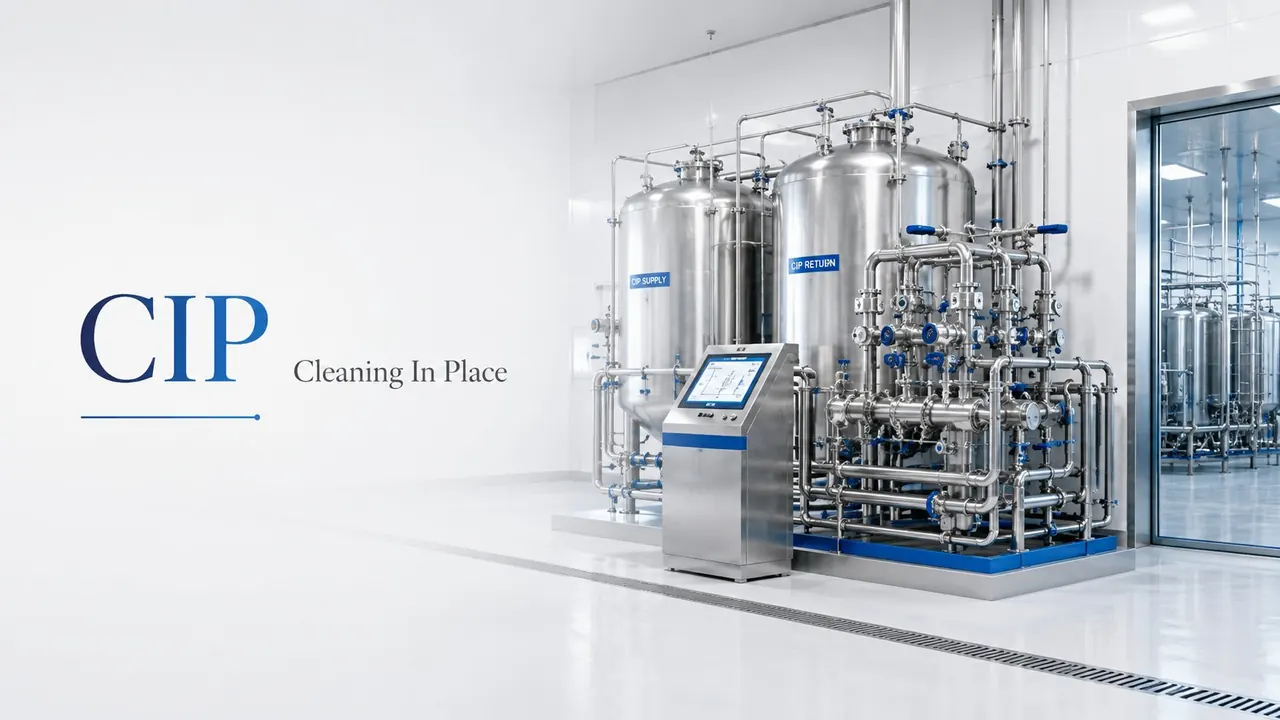
CIP (Cleaning In Place) training for dairy operators — tank CIP, pipeline CIP, evaporator CIP, chemistry, validation, fouling control and structured troubleshooting.
Watson Dairy Consulting treats CIP as a discipline in its own right, not an afterthought. Operators who understand the chemistry, the mechanical principles and the verification methods produce consistently better outcomes than operators following a recipe card.
Tank and Pipeline CIP

CIP cycle for tanks and pipelines: supply, return, valve clusters, spray devices and verification.
Evaporator CIP

Falling-film evaporator on CIP: pre-rinse, alkali, intermediate, acid, final rinse and validation points.
The Four Pillars of CIP
Every CIP cycle — whether on a small balance tank or a multi-effect evaporator — is built from four variables that have to be balanced together. Change one without considering the others and you typically degrade the result.
Time
Contact time of chemical with surface. Too short and chemistry can't do its work; too long wastes resource and risks gasket degradation.
Temperature
Higher temperatures accelerate chemical reactions but consume energy and can damage surfaces. Each chemistry has an optimum window.
Concentration
Stronger isn't always better - excess caustic causes its own deposition problems. The right concentration depends on soil type and dwell time.
Mechanical Action
Turbulent flow in pipelines, spray-device coverage in tanks. Without mechanical action, chemistry alone cannot remove soil from surfaces.
Pipeline CIP
Pipeline CIP works because turbulent flow at velocity above approximately 1.5 m/s creates the mechanical action needed to lift soil off the inside of the pipe wall. Below that velocity, soil stays where it is and chemistry alone won't reach it efficiently. Operators need to understand: pipe size determines the flow rate needed to maintain velocity, dead legs and instrument tees need particular attention, and recirculation through pumps and valves must not be allowed to bypass critical sections.
Pipeline CIP common issues
- Velocity below threshold — usually because someone changed pipe sizes during a modification, or the CIP pump can't deliver to a larger system that's been added since
- Dead legs longer than 6 pipe diameters — standard rule, regularly broken in retrofits
- Pulse cleaning needed for difficult cases such as long pipe runs with valve clusters
- Air pockets at high points creating zones where CIP solution never makes contact
Tank CIP
Tank CIP cannot rely on flow velocity through the vessel — the geometry is wrong for it. Mechanical action instead comes from spray devices: static spray balls, rotating jet heads, or rotary impingement cleaners. Each has different coverage characteristics, different chemical and water consumption, and different verification methods.
Spray device selection
- Static spray balls — cheap, no moving parts, low maintenance, but high flow and chemical demand. Good for clean-down of low-fouling tanks.
- Rotating jet heads — medium flow, defined impingement pattern, suitable for most dairy tanks including fouled cheese vats.
- Rotary impingement cleaners — lowest water and chemical consumption, highest impingement energy, used for difficult cleans like protein concentrate storage and high-fat dairy products.
Tank CIP verification
Coverage verification by riboflavin (visible under UV after CIP) confirms spray reach. ATP testing of internal surfaces post-CIP confirms organic soil removal. Visual inspection at maintenance points catches drift before it becomes a recall.
Evaporator CIP
Evaporators are the most demanding CIP application in a dairy plant. They run at high temperature with high solids, residence times are long, and fouling can be extensive. Evaporator CIP cycles are correspondingly more complex — longer, hotter, stronger chemistry, often with a boil-out phase. The geometry is also unforgiving: falling-film tubes need uniform wetting, the vapour separator has surfaces difficult to spray, and the product/CIP interface at start and end of cycle has to be managed carefully to avoid product loss or CIP contamination.
A well-trained evaporator operator understands not just how to start a CIP cycle, but why each step matters — and what to do when something doesn't look right.
CIP Chemistry — What Each Chemical Does
- Sodium hydroxide (caustic, NaOH) at 1.0–2.0% removes protein and fat through saponification and hydrolysis. Hot caustic is the workhorse of dairy CIP. Excess caustic at high temperature deposits as carbonate scale — one of the most common causes of milk-stone build-up.
- Nitric acid (HNO₃) at 0.5–1.0% removes calcium and mineral deposits. Always after a caustic wash, never before — acid on top of fresh protein soil creates a hard deposit that's very difficult to remove.
- Phosphoric acid — alternative to nitric, gentler on stainless steel but less aggressive on milk-stone. Used in some plants and required for some products.
- Sodium hypochlorite — for terminal disinfection in some plants, though declining in dairy use due to chlorinated by-product concerns.
- Peracetic acid (PAA) — modern terminal disinfectant, broad spectrum, low residue. Increasingly the standard for final-stage sanitisation.
- Surfactants and chelating agents — added to formulated CIP products to improve wetting, soil suspension and water-hardness tolerance.
Milk-Stone — Why It Happens and How to Stop It
Milk-stone is the cumulative deposit of mineral and protein soil that wasn't fully removed by routine CIP. Once established, it's hard, adherent and an active reservoir for biofilm. Diagnosis is usually straightforward: a hard, chalky-to-grey deposit that doesn't wipe off with a finger. The standard treatment is a strong acid wash — but the better answer is to stop creating it.
Root causes are usually one or more of:
- Acid wash temperature too low (below 60°C the kinetics are too slow)
- Acid concentration too dilute (below 0.5% won't dissolve set milk-stone)
- Acid contact time too short (less than 10 minutes recirculated)
- Acid wash being skipped on shorter production cycles to save time
- Water hardness above 200 mg/L CaCO₃ with no chelating agent in the CIP formulation
- Excessive caustic temperature carbonating with CO₂ from the air during recirculation
CIP Validation
A CIP cycle that "passes" by completing on schedule is not necessarily a CIP cycle that worked. Validation is the discipline of confirming, by independent measurement, that cleaning actually happened.
Visual Inspection
Of representative surfaces during maintenance windows. The cheapest and often most revealing check.
ATP Testing
Swab measurement of residual organic soil. Quantitative, fast, repeatable. Good early warning of degrading performance.
Riboflavin Testing
Coverage verification for tank spray devices. UV-visible after dosing, washing, draining and inspection.
Microbiological Swab
The ultimate verification - cultured swab of post-CIP surfaces. Slow turnaround but definitive.
How We Deliver CIP Training
Training is delivered on-site, against the plant's actual CIP set, real chemistry, real soiling profiles and real flow rates. We combine classroom sessions on chemistry and engineering principles with hands-on review of the plant's actual CIP cycles — reading control logs, inspecting spray devices, sampling chemical concentrations, and walking the system. Operators leave with the ability to diagnose poor cleaning from data, adjust cycles when conditions change, and verify that what they think happened actually happened.
Frequently Asked Questions
What does CIP training cover?
The four pillars of CIP — time, temperature, chemical concentration and mechanical action — applied across tank CIP, pipeline CIP, heat exchanger CIP and evaporator CIP. Plus chemistry of alkali and acid washes, milk-stone control, biofilm risk, CIP validation, common faults and how to diagnose poor cleaning outcomes from CIP records.
What is the difference between tank CIP and pipeline CIP?
Pipeline CIP relies on turbulent flow velocity (typically above 1.5 m/s) to provide mechanical action across the inside of the pipe. Tank CIP cannot achieve that velocity inside a large vessel, so it relies instead on spray devices — static spray balls, rotating jet heads or rotary impingement cleaners — to deliver mechanical action to every internal surface. Different chemistry, different flow patterns, different verification methods.
Why is evaporator CIP different from other dairy CIP?
Evaporators run at extreme conditions — high temperatures, high solids, long residence times — and fouling can be severe. Evaporator CIP typically uses stronger chemistry, longer contact times and may need a boil-out phase that other dairy CIP doesn't. The geometry is also unforgiving — falling-film tubes need uniform wetting, the vapour separator has surfaces difficult to reach, and product/CIP interface management at start and end of cycle is critical.
How is CIP validated?
By a combination of visual inspection (representative surfaces), ATP swab testing for residual organic soil, microbiological swab for residual organisms, riboflavin coverage testing for spray ball reach in tanks, conductivity and temperature monitoring during the cycle, and trend review of CIP records over time. We help build a CIP validation framework that matches the plant's risk profile and regulatory environment.
How do you reduce CIP chemical and water use without compromising cleaning?
Through better cycle design rather than just shorter cycles. Single-use vs recovered solutions, pre-rinse efficiency, optimal temperature and concentration ratios, dwell time tuning, and reducing the number of unnecessary intermediate rinses. We've helped plants cut CIP chemical use by 20 to 40% without measurable change in cleaning outcomes — the gains come from removing waste, not skipping steps.
Further reading: John Watson publishes articles on dairy industry topics on LinkedIn — from infant formula safety and milk supply to plant design, yield improvement and dairy commodity outlook. Browse all articles by John Watson on LinkedIn →
See our related milk reception training, pasteuriser training, evaporator training and spray dryer training pages, or browse all dairy training programmes.
John Watson
Office: +44 1224 861 507
Mobile: +44 7931 776 499
jw@dairyconsultant.co.uk
We are a longstanding member of the Society of Dairy Technology
and have Fellowship of the Institute of Food Science and Technology.



Contact Details
John Watson
Office: +44 1224 861 507
Mobile: +44 7931 776 499
jw@dairyconsultant.co.uk
What Our Clients Say
We are a longstanding member of the Society of Dairy Technology
and have Fellowship of the Institute of Food Science and Technology.
Locations

Services
Enquiry Form

