
Spray Dryer Crack Testing & Inspection
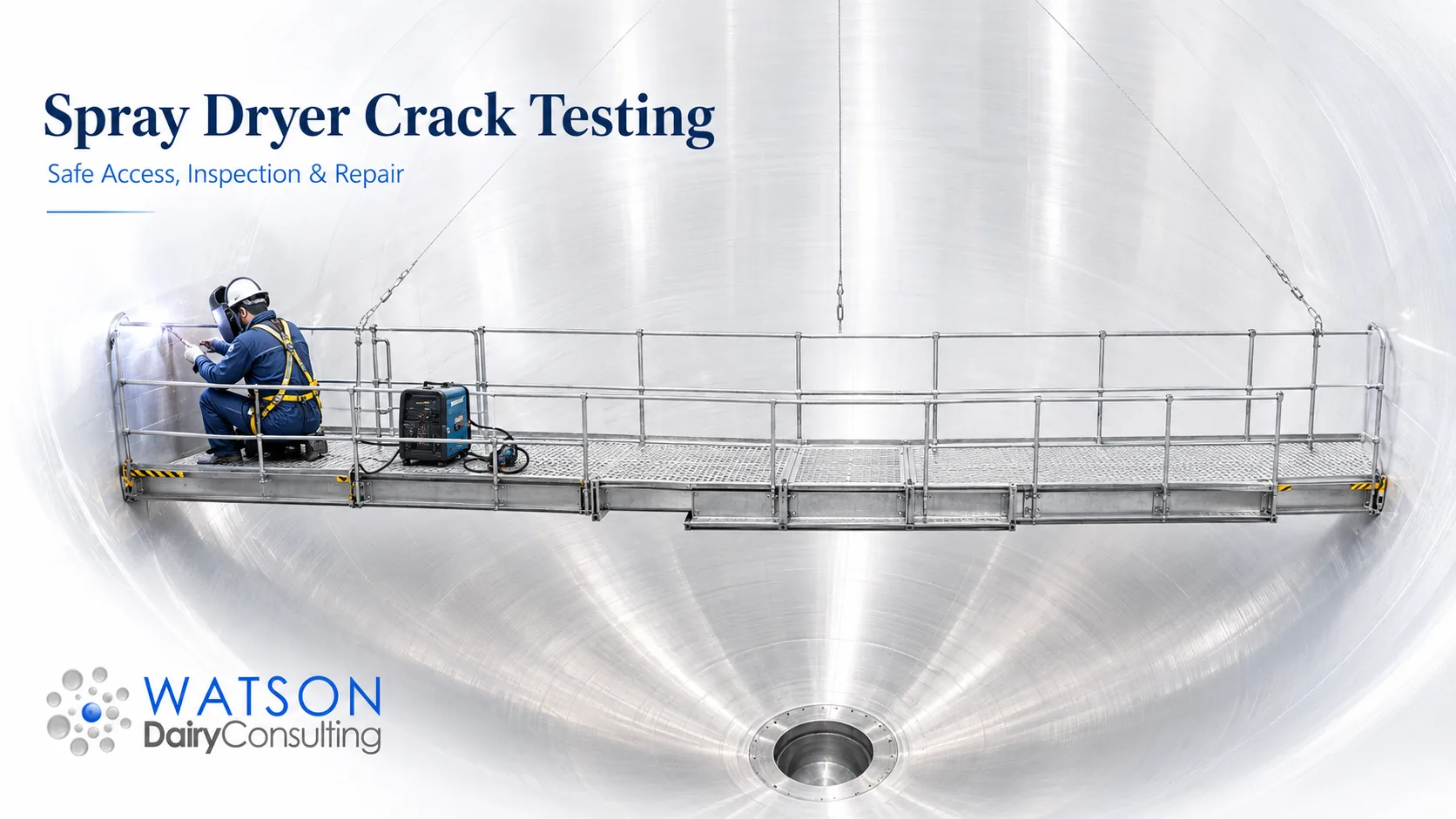
Independent spray dryer crack testing and inspection — weld and chamber integrity checks, NDT method selection, inspection planning and witnessing for milk powder, whey powder and infant formula plants.
Cracks in a spray drying chamber are not only a maintenance issue. They affect safety, hygiene and product integrity, so finding them early — and testing the right places, the right way — matters.
We can also manage the inspection for you — vetting and selecting the test contractor, benchmarking cost, scheduling around your shutdown, and overseeing the results and any repairs.
What Is Spray Dryer Crack Testing?
Spray dryer crack testing is the targeted inspection of a drying chamber, cone and ducting for cracks — concentrating on welds and high-stress points — using close visual inspection together with non-destructive testing (NDT) such as dye penetrant, eddy current or ultrasonic testing. The aim is to find cracks early, before they cause an air leak, a hygiene problem, product contamination or a safety incident.
Why Spray Dryers Crack
A spray drying chamber is a large stainless steel fabrication, usually in austenitic grades such as 304 or 316, made up of welded plate, a conical base, stiffening rings, supports and many penetrations. It spends its working life being heated and cooled — on start-up, on shutdown, and on every hot and cold CIP cycle. That repeated thermal movement is the root of most spray dryer cracking.
Cracks usually begin where stress concentrates rather than in the middle of a clean plate: at welds, at stiffener and support attachments, at the cone-to-cylinder junction, and around nozzle, atomiser, sight-glass and CIP penetrations. The common mechanisms are:
- Thermal fatigue — repeated expansion and contraction working a weld or fixed point until it cracks.
- Chloride stress corrosion cracking — austenitic stainless steel is vulnerable to chloride attack, particularly at welds, heat-affected zones and in crevices where CIP chemicals or chlorides concentrate.
- Localised overheating from stuck deposits — where powder sticks and bakes onto a hot wall it can self-heat, driving that patch of steel to high temperature. This leaves a dark heat-tint discolouration with a chromium-depleted, corrosion-prone layer beneath it — a preferential site for pitting, which then acts as a crack starter. Self-heating of deposits is also the dominant ignition cause in dairy dryer fires, so these hot spots matter for safety as well as integrity.
- Vibration and pressure pulses — from fans, atomisers and process upsets, fatiguing fixings and welds over time.
- Weld and fabrication defects — original lack of fusion, undercut or poor profile that act as crack starters under service loads.
Where Cracks Form in a Spray Dryer
Inspection effort should be focused where cracks are most likely and where the consequences are highest, rather than spread evenly over the whole chamber.
Roof & Air Disperser
The hot air inlet, air disperser and roof welds see the highest temperatures and the sharpest thermal gradients on start-up — a classic site for thermal-fatigue cracking.
Chamber Wall Welds & Stiffeners
Vertical and circumferential plate welds, and the attachments for external stiffening rings and supports, where restraint concentrates thermal stress.
Cone & Cone-to-Cylinder Weld
The change of geometry at the cone junction is a high-stress transition, and the cone also carries powder flow, deposits and cleaning loads.
Penetrations & Fittings
Atomiser and nozzle ports, CIP nozzle mounts, sight glasses, lights, instruments and door or manhole frames — each penetration is a local stress raiser.
Ducting, Cyclones & Filters
Hot air and powder-laden ducting, cyclone bodies and bag filter housings, where erosion, vibration and thermal movement combine.
Fluid Bed & Plenum
Integrated and external fluid bed plenums, perforated plates and their welds, which are subject to vibration and thermal cycling.
Reading the Chamber After Cleaning
Once the chamber is cleaned and dry, the bare steel itself shows where to concentrate the crack testing. The sign to look for is discolouration that will not wash off — heat tint, also called temper colour.
- Dark patches on the bare metal — stainless develops a heat-tint film when it is driven above roughly 400°C, and the colour deepens with temperature: straw and gold, through brown and blue, to grey or black at the hottest. A dark patch that remains after cleaning marks a spot where powder stuck, sat and self-heated, running the wall well above its normal product-contact temperature.
- Why it points to cracking — beneath the tint the steel is chromium-depleted and has lost corrosion resistance, so that exact patch is where pitting, and then cracking, is most likely to begin. Heat-tinted areas should be treated as priority zones for dye-penetrant and close visual inspection, not as a cosmetic mark.
- Heat tint versus charred residue — distinguish discolouration on the metal (heat tint, the real flag) from charred product baked on top of it. Both mark a hot spot, but only heat tint on the steel means the wall itself overheated. Severe, sustained overheating can also sensitise the steel — chromium-carbide precipitation at the grain boundaries — a more permanent loss of corrosion resistance.
The recognised guide for grading this discolouration on hygienic austenitic stainless is AWS D18.2, which scores heat tint against a colour scale; the same chromium-depleted oxide is what you are reading on an in-service wall. A recurring dark patch is therefore two warnings at once — a self-heating and fire risk to investigate, and a map of where the next crack is likely to appear. Controlling the deposits behind it, and the fines and deposit behaviour that drive them, is part of keeping both in check.
Why Crack Testing Matters
A crack in a spray dryer is rarely just a structural question. In a dairy powder plant it touches four things at once:
| Concern | Why a crack matters |
|---|---|
| Fire & explosion safety | Cracks and crevices trap powder that can self-heat and smoulder — the dominant ignition cause in dairy dryer fires — and a crack can also become an uncontrolled air leak. Dairy powders are combustible dusts, so chamber integrity has to be considered alongside deposit control, fire detection and explosion protection. |
| Product integrity | A crack through to the insulation or outer cladding can open a path for foreign material, insulation fibres or moisture to reach product — a serious contamination route, especially for infant formula. |
| Microbiological hygiene | Cracks and weld defects create crevices and dead spots that are difficult to clean and can harbour bacteria such as Cronobacter or Salmonella in a high-care powder environment. |
| Structural integrity | Left unchecked, cracks propagate, leak and can eventually cause component failure, unplanned downtime and expensive emergency repair. |
Crack Testing & Inspection Methods (NDT)
Crack testing in a spray dryer normally combines detailed visual inspection with one or more non-destructive testing (NDT) methods, chosen to suit the location, the access and the type of defect expected.
| Method | What it finds | Notes for spray dryers |
|---|---|---|
| Visual (VT) | Surface cracks, deposits, distortion, corrosion, weld condition | The foundation of every inspection. Internal man-entry is a confined-space task; borescope or remote visual reaches inaccessible ducting and cyclones. |
| Dye penetrant (PT) | Fine surface-breaking cracks in welds and plate | The standard method for stainless welds. Surface must be clean; chemicals must be food-compatible and fully removed, as this is a product-contact surface. |
| Eddy current (ET) | Surface and near-surface cracks in non-magnetic stainless | Useful for rapid weld and surface screening on austenitic stainless steel. |
| Ultrasonic (UT) | Sub-surface and volumetric weld defects, wall thickness | Checks weld bodies and remaining wall thickness where erosion or corrosion is suspected. |
| Magnetic particle (MT) | Surface cracks in ferromagnetic steel | Generally not applicable — spray dryer chambers are non-magnetic austenitic stainless steel. |
Practical point: the method matters less than testing the right places. A focused dye-penetrant check of the high-stress welds, backed by thorough visual inspection and a clear record of what was tested and found, is worth more than a broad, undocumented sweep.
Safety First: Working Inside the Chamber
Crack and pinhole inspection nearly always means someone climbing inside the chamber — or the dryer running close by while work goes on. That puts the work under two regimes an NDT scope alone can miss: the chamber is a confined space, and in service it is a potential explosive atmosphere. People are seriously hurt in two distinct ways — entrapment and mechanical injury during entry, and ignition of a combustible powder cloud.
Before anyone enters: isolate, lock off, lock open
- Treat it as a permit-required confined space. Entry only under a permit, with an attendant stationed outside and a rescue plan — never a quick look inside.
- Positively isolate and lock off every energy source — main supply and exhaust fans, atomiser drive, feed pumps, heater or burner, steam and compressed air. Locked off at source, not just switched off at the panel.
- Secure the access door or manway open so it cannot close. A running fan creates a pressure difference that can pull the door shut and hold it — trapping a person inside, in heat and darkness, unable to push it open against the airflow. The door is locked open and an attendant is posted for exactly this reason.
- Make the atmosphere safe to enter — let hot surfaces cool, ventilate, and test before entry.
Isolate and lock off the fan and atomiser drive, secure the door in the open position, and post an attendant before anyone enters. This is the single most important line on this page.
Ignition sources: why a spray dryer is a special case
A spray dryer deliberately creates exactly what an explosion needs — a cloud of fine combustible powder suspended in hot air. Milk and most food powders are combustible dusts. Staying safe is about removing ignition sources and never letting deposits accumulate. The ones inspection and maintenance most often miss:
| Ignition source | Mechanism | Control |
|---|---|---|
| Static electricity (earthing & bonding) | Atomisation and particle friction continuously strip charge off the powder. An isolated, unearthed conductor — a part left unbonded after maintenance, or a person's own body — collects that charge and releases it as a spark. Individual discharges are usually too weak to ignite, but have been implicated in real explosions. | Every conductive part bonded together and to a verified earth; continuity re-checked after any strip-down; operators earthed through conductive footwear and flooring; humidity not allowed to fall too low. BS EN 60079-32, under DSEAR. |
| Atomiser bearing wear (rotary) | The wheel spins at roughly 5,000–25,000 rpm. Worn spindle bearings overheat by friction and let the wheel run out of balance — frictional sparks, and at worst loss of a balanced high-speed wheel. Mechanical sparks can carry far more energy than is needed to ignite a powder cloud. | Bearing temperature and vibration monitoring; act on rising readings; scheduled bearing replacement; never run a noisy or vibrating atomiser on. |
| Deposits and charred “cinders” | Powder bakes onto the wall, roof and around the atomiser. Thick deposits self-heat and smoulder; glowing charred fragments break free and are carried into the powder cloud as ready-made ignition sources. | Clean to a defined schedule; inspect ports and use thermal checks for build-up and hot spots; CO monitoring to catch smouldering early. |
| Blocked or worn nozzles (pressure dryers) | A partly blocked or worn nozzle sprays unevenly, wets the wall and grows deposits — feeding the charring mechanism above — and disturbs the temperature profile. | Routine nozzle inspection and replacement; do not run on blocked or worn tips. |
This is a competent-person risk assessment, not a checklist. The moment crack testing involves entering the chamber, or running the dryer alongside inspection, it falls under confined-space and DSEAR duties. Ignition-source control and entry isolation must be assessed for your specific plant by a competent person — see our spray dryer operation and safety page for the wider picture.
Safety note. This guidance is general and provided for awareness only; it is not a substitute for a site-specific risk assessment by a competent person under the Confined Spaces Regulations 1997 and DSEAR. To the fullest extent permitted by law, Watson Dairy Consulting and John Watson accept no liability for any loss, damage or injury arising from use of or reliance on this page. Nothing in this notice excludes or limits any liability that cannot lawfully be excluded.
When to Inspect
- Planned shutdowns — as part of a documented integrity programme, with frequency set by the dryer's age, duty and history.
- After any incident — fire, overheat, scorching, a burst or any unusual deposit or smell event.
- After modification or repair — any cutting, welding or rework changes the stress pattern and must be re-inspected.
- At factory acceptance testing (FAT) — weld inspection of a new or rebuilt dryer before it is signed off and commissioned.
- When cleaning or quality problems appear — persistent CIP issues, contamination findings or unexplained foreign material.
Repair and Re-Validation
Finding a crack is only half the job. A repair to a spray dryer is also a food-hygiene operation: weld repairs should be made to a hygienic standard, ground flush and smooth, the surface re-passivated, and the repaired weld re-tested by dye penetrant or another suitable method before the dryer returns to service. Each inspection and repair should be recorded against a weld or zone map so that condition can be trended over the life of the dryer.
Managed Crack Testing — Tester Selection, Scheduling & Oversight
Many plants do not have the spare time or the in-house NDT expertise to find the right inspection contractor, confirm they are competent, and judge whether the results and any repairs are sound — especially inside a tight shutdown window. Watson Dairy Consulting can manage the whole crack-testing exercise on your behalf, independently of any testing contractor or fabricator.
Tester Selection & Vetting
Identify and vet inspection contractors on competence, NDT certification (such as ISO 9712 / PCN), food-industry experience, insurance and track record — not on price alone.
Cost Benchmarking
Obtain and compare quotations so you pay a fair rate for the right scope of work, with no padding and no unnecessary testing.
Scheduling & Access
Book the work into your shutdown dates and co-ordinate access, confined-space entry and permits so the inspection does not overrun the window.
On-Site Supervision
Attend to witness the inspection and confirm that the correct welds and high-stress areas are tested to the agreed scope.
Independent Evaluation
Review and interpret the findings independently of the contractor, giving you an unbiased view of what was found and what it means.
Repair Oversight
Where repairs are needed, oversee that they are carried out to a hygienic standard, re-tested and properly documented before the dryer returns to service.
Why independence matters: because Watson Dairy Consulting does not carry out the testing itself, the assessment of the contractor, the results and the repairs is genuinely independent — there is no incentive to find more work or to sign off sub-standard work. For infant formula plants in particular, where the hygiene bar is highest and the margin for error smallest, getting the right tester and holding the schedule is critical — and independent oversight protects both the timetable and the product.
Selected References
- Beever, P.F. (1985). Fire and explosion hazards in the spray drying of milk. International Journal of Food Science & Technology, 20(5), 637–646.
- Beever, P.F. (1984). Spontaneous ignition of milk powders in a spray-drying plant. Journal of the Society of Dairy Technology, 37(3), 68–71.
- Chong, L.V. & Chen, X.D. (1999). A mathematical model of the self-heating of spray-dried food powders containing fat, protein, sugar and moisture. Chemical Engineering Science, 54(19), 4165–4178.
- American Welding Society. AWS D18.2, Guide to Weld Discoloration Levels on Inside of Austenitic Stainless Steel Tube.
- Health and Safety Executive. Safe work in confined spaces. Confined Spaces Regulations 1997. Approved Code of Practice, Regulations and guidance (L101).
- Health and Safety Executive. Dangerous Substances and Explosive Atmospheres Regulations 2002. Approved Code of Practice and guidance (L138).
- BS EN 60079-32-1, Explosive atmospheres – Electrostatic hazards, guidance; and BS EN 1127-1, Explosive atmospheres – Explosion prevention and protection.
Spray Dryer Crack Testing FAQs
What is spray dryer crack testing?
How are cracks detected in a spray dryer?
Why do spray dryer chambers crack?
Are cracks in a spray dryer an explosion risk?
How often should a spray dryer be inspected for cracks?
Can dye penetrant testing be used on stainless steel spray dryers?
Why do spray dryer cracks matter for infant formula?
Can Watson Dairy Consulting arrange and manage the crack testing for us?
What do dark or discoloured patches in a spray dryer mean?
Is it safe to go inside a spray dryer chamber?
How does static electricity cause a spray dryer explosion?
Related pages: Tank & Silo Crack & Pinhole Testing · Spray Dryer Fines · Milk Spray Dryers · Infant Formula & Milk Powder · Evaporator Training · Dairy Factory Design
Need a spray dryer crack inspection or integrity review? Watson Dairy Consulting provides independent inspection planning, NDT scope specification, inspection witnessing and integrity advice for dairy spray dryers — independent of any fabricator or inspection contractor. Please contact us to discuss your requirements.
Discuss Your Spray Dryer InspectionFurther reading: John Watson publishes articles on dairy industry topics on LinkedIn — from infant formula safety and milk supply to plant design, yield improvement and dairy commodity outlook. Browse all articles by John Watson on LinkedIn →
John Watson
Office: +44 1224 861 507
Mobile: +44 7931 776 499
jw@dairyconsultant.co.uk
We are a longstanding member of the Society of Dairy Technology
and have Fellowship of the Institute of Food Science and Technology.



Contact Details
John Watson
Office: +44 1224 861 507
Mobile: +44 7931 776 499
jw@dairyconsultant.co.uk
What Our Clients Say
We are a longstanding member of the Society of Dairy Technology
and have Fellowship of the Institute of Food Science and Technology.
Locations

Services
Enquiry Form

