
Pasteuriser Integrity & Leak Testing
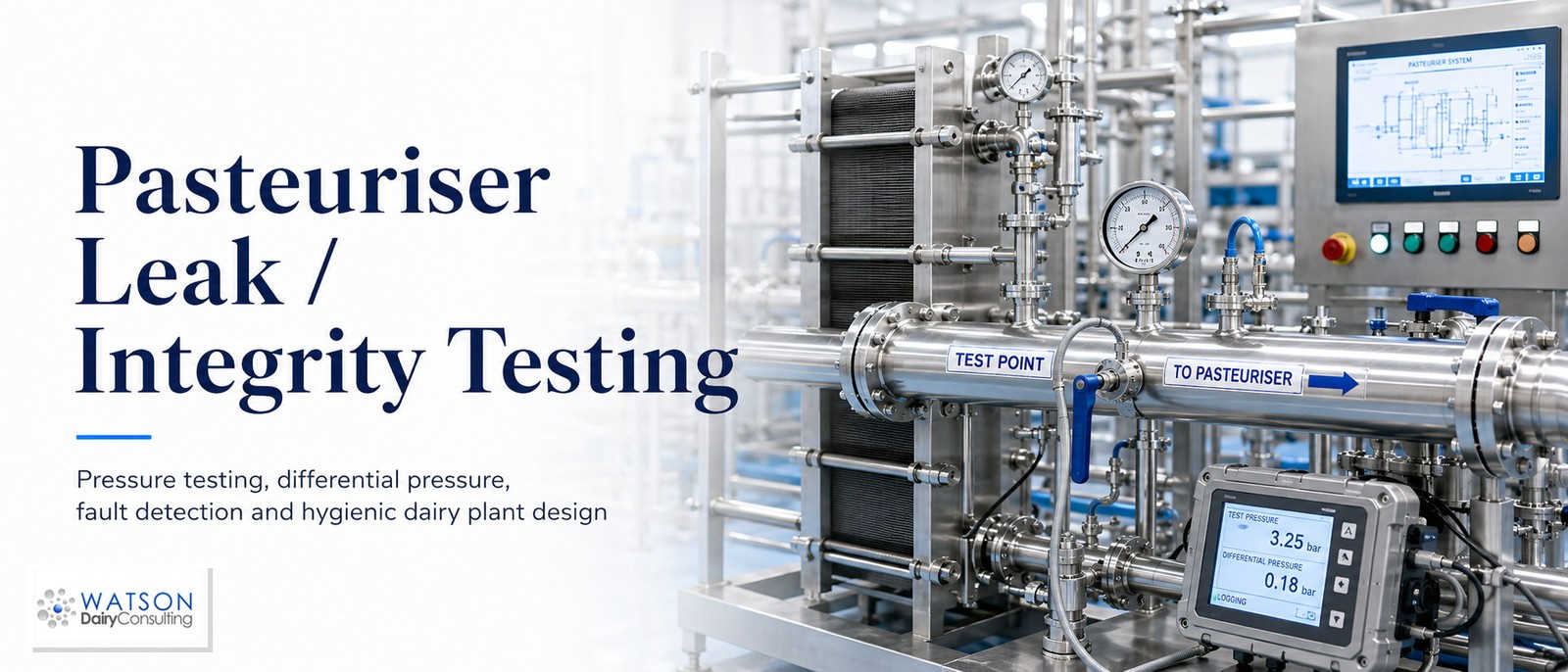
A pasteuriser can hold every particle for the full legal time and still poison people — if its heat-exchanger plates leak. Integrity (leak) testing is the check that finds the cracks, pinholes and failed gaskets that let raw milk, or the heating and cooling medium, cross into the pasteurised stream. It is a core part of any dairy preventative-maintenance and food-safety programme, and a standard customer-audit requirement.
This page explains what integrity testing is and why it matters, the regulatory pressure-differential control that backs it up, the test methods compared (helium and hydrogen tracer gas, water and conductivity methods, ultrasonic location and dye penetrant), how often to test, and how to choose between them. Every regulatory and technical claim is referenced.
Why this is safety-critical. A through-plate leak contaminates already-pasteurised product with raw milk or service media. The cost is not just discarded product — it is a potential product recall and the reputational damage that follows. The figures and methods here are referenced general guidance, not a validated test procedure; integrity testing must be carried out and interpreted by a competent inspection specialist for your specific plant.
What Integrity / Leak Testing Is — and Why It Matters
A plate (or tubular) heat exchanger works by running two fluids on opposite sides of thin stainless-steel plates so heat passes between them. In a pasteuriser the critical pairing is the regeneration section, where hot, already-pasteurised milk preheats cold, incoming raw milk across the plate — saving energy but placing raw and pasteurised product on opposite faces of the same sheet of steel.[3] If that plate develops a through-thickness crack, a pinhole, or a gasket fails, the two streams mix. Patent and textbook descriptions are blunt about the consequence: a leak means the pasteurised product is contaminated with raw milk (or coolant), and the contaminated product must be discarded along with the cost of finding and fixing the fault.[3]
Integrity testing exists to find those defects before they reach product — ideally at micron scale, while still a hairline, long before they become a leak large enough to fail a phosphatase test or, worse, reach a consumer. It is the engineering counterpart to the alkaline phosphatase (ALP) product test: ALP catches raw-milk carry-over after the event; integrity testing prevents it.[11]
The Regulatory Backstop: Regenerator Pressure Differential
Regulators do not rely on the plates never failing. They require the pasteuriser to be plumbed so that any leak runs the safe way — pasteurised into raw, never raw into pasteurised. This is done by holding the pasteurised side of the regenerator at a higher pressure than the raw side.
In the US, the Grade “A” Pasteurized Milk Ordinance requires the pasteurised milk in the regenerator to be at least 1 psi higher than the raw milk, so that a pinhole leak in the thin plates pushes pasteurised product toward the raw side rather than the reverse.[1][3] The differential is maintained by the timing pump in simple systems, or by a differential-pressure controller and back-pressure regulator in more complex ones, with any raw-side booster pump interlocked so it can only run when the pasteurised side is the higher pressure.[1] Canada’s CFIA sets the working figure at at least 2 psi (14 kPa) — the 1 psi required differential plus 1 psi to cover sensor imprecision — maintained during forward flow, divert and shutdown, with the pressure-differential recorder-controller inter-wired to the flow-diversion device so the plant diverts if the differential is lost, and the controller checked at installation and at least every six months.[2] The regeneration section and these controls must follow 3-A Sanitary Standards.[4]
US versus UK/EU — a genuine regulatory difference. The US PMO is prescriptive: it writes the engineering controls into law — the regenerator pressure differential, a differential-pressure recorder-controller and a differential-pressure switch that de-energises the pumps and shuts the plant down if the differential is lost, the flow-diversion interlocks, sealed settings, and routine official instrument checks.[1] UK and EU law is outcome-based: Regulation (EC) 853/2004 fixes the result — pasteurise to the standard and return a negative phosphatase test — while Regulation (EC) 852/2004 requires the operator to control the process under HACCP, with the detailed engineering controls drawn from industry good-hygiene-practice guides, 3-A and EHEDG rather than itemised in the statute.[11][13] The practical engineering is the same on both sides — every well-run pasteuriser holds the pasteurised side above the raw side and diverts on loss of differential — but the US mandates and officially inspects those additional controls explicitly, whereas UK/EU leaves them to the operator’s HACCP system to deliver the required outcome.
But pressure differential only limits the consequence of a leak — it does not find the crack. A plate can be leaking pasteurised-to-raw (wasting product and signalling imminent failure) for a long time before anyone notices. That is why physical integrity testing is a separate, scheduled requirement.
The Test Methods Compared
Integrity testing of plate heat exchangers is done by tracer gas or by water/pressure methods; published overviews list helium leak detection and differential electrolytic (conductivity) analysis as the principal approaches.[10] The main options:
| Method | How it works | Detects | Notes |
|---|---|---|---|
| Helium tracer gas + mass-spectrometer (MSLD) | Helium (or a helium/nitrogen mix) is introduced to one side of the plate pack; a mass-spectrometer leak detector on the other side senses any that crosses through a defect | Through-thickness cracks, pinholes, gasket leaks — very high sensitivity | Non-destructive, no residue (CIP-removed), inert and non-toxic; the defective plate can be pinpointed. Helium cost/availability is the main drawback[5][6] |
| Hydrogen / nitrogen forming-gas | Hydrogen carried in an inert nitrogen mix is circulated; a sensor detects hydrogen crossing the plates | Micron-level cracks; can also flag plates/gaskets nearing failure | Hydrogen is cheaper and more available than helium; high sensitivity[9] |
| Water / pressure-differential (pressurised water or conductivity) | Pressurised water or saline is applied across the pack; a leak shows as a flow, pressure or conductivity change — no plate-pack opening needed | Small leaks and microcracks (below ~30 µm) | No tracer gas; fast (some run in ~15 min after CIP); some systems stay permanently connected for daily or on-demand testing[7][8] |
| Ultrasonic acoustic location | After a leak is detected, ultrasonic equipment locates the exact defective plate or tube | Position of a known defect | Supplementary to a detection method, not a stand-alone test[5] |
| Dye penetrant (food-safe fluorescent) | Dye is applied and surface-breaking defects show under UV light | Surface cracks | Used mainly on tanks and vessels rather than plate packs |
The gas-tracer methods (helium, hydrogen) give the highest sensitivity to the finest cracks; the water/conductivity methods trade a little sensitivity for speed, no gas handling, and the ability to test routinely after every clean. Several of these systems are independently validated — one widely used water-based test, for example, has been assessed by an independent food research association.[7]
How Often — and When — to Test
There is no single global statutory interval for physical integrity testing the way there is for holding time, but the accepted practice and audit expectation is clear:
| Trigger | Action | Source |
|---|---|---|
| Routine schedule | Helium/gas integrity test commonly carried out annually to satisfy regulation and customer-audit requirements | Industry practice[12] |
| After any plate-pack work | Re-test after re-gasketing, plate replacement or any pack opening | Preventative-maintenance practice[5] |
| Frequent / continuous option | Water-based systems allow testing after every CIP (daily / on-demand) | Industry practice[8] |
| Pressure-differential controller | Verified at installation and at least every six months | CFIA[2] |
In practice a sensible regime is an annual high-sensitivity gas test, a re-test after any maintenance that opens the pack, the six-monthly pressure-differential controller check, and — on higher-risk or high-value lines — a rapid water-based check built into the daily CIP cycle.
Choosing and Interpreting a Test
The right method depends on what you are protecting and how often you need assurance. For the deepest assurance on a critical pasteuriser, a helium or hydrogen mass-detection test finds the finest cracks. For frequent, low-downtime reassurance between major tests, a water-based system that runs after CIP is hard to beat. A test that can pinpoint the failed plate (gas methods, or gas plus ultrasonic location) saves hours over one that only tells you a leak exists somewhere in the pack.
A positive result means: isolate and locate the defective plate, re-gasket or replace it, and re-test to confirm the pack is sound before returning to production. Because a leak compromises the same raw-to-pasteurised barrier that the phosphatase test polices, a failed integrity test should be treated as a food-safety event, not a maintenance footnote — and the corresponding product reviewed. This is precisely the kind of independent, vendor-neutral judgement an experienced dairy engineer adds: which method fits the plant, how to read the result, and how it connects to the wider pasteurisation controls covered on our pasteurisation holding time page.
Watson Dairy Consulting can review your integrity-testing regime, regenerator pressure controls and preventative-maintenance schedule, and advise — free of any test-equipment sales agenda — on the method and frequency that actually fit your plant and your customers’ audits. Ask us to review your pasteuriser integrity programme →
Frequently Asked Questions
What is pasteuriser integrity / leak testing?
It is a check that finds cracks, pinholes and gasket failures in the heat-exchanger plates of a pasteuriser, which could let raw milk or the heating/cooling medium leak into the pasteurised product. It is done by tracer gas (helium or hydrogen) or by water/pressure methods, usually without opening the plate pack.[5][10]
Why is a leak in the plates dangerous?
In the regeneration section, raw and pasteurised milk run on opposite sides of the same thin plate. A through-plate leak lets raw milk cross into already-pasteurised product, undoing the pasteurisation and risking a recall.[3]
What is the regenerator pressure differential?
Regulations require the pasteurised side of the regenerator to be held at higher pressure than the raw side — at least 1 psi in the US PMO, and at least 2 psi (14 kPa) in Canada — so that any leak pushes pasteurised product toward raw, never raw into pasteurised.[1][2] It limits the consequence of a leak but does not detect the crack, which is why physical integrity testing is still needed.
Helium or water-based testing — which is better?
Gas methods (helium or hydrogen with mass detection) give the highest sensitivity to the finest cracks and can pinpoint the failed plate. Water-based methods trade a little sensitivity for speed, no gas handling, and the ability to test after every CIP. Many plants use an annual gas test plus routine water-based checks.[6][8]
How often should a pasteuriser be integrity tested?
A high-sensitivity gas test is commonly performed annually and after any plate-pack work, with the regenerator pressure-differential controller verified at least every six months; water-based systems allow daily testing after CIP.[2][8][12]
How does integrity testing relate to the phosphatase test?
They police the same risk from opposite ends. Integrity testing prevents raw-to-pasteurised cross-contamination by finding the defect; the alkaline phosphatase test detects it after the fact in the finished product.[3]
References
- FDA — Grade “A” Pasteurized Milk Ordinance (PMO). Regenerator requirement: pasteurised milk maintained at least 1 psi higher than raw milk; differential maintained by timing pump or differential-pressure controller with back-pressure regulator; raw-side booster pump interlocked to the pressure differential.
- Canadian Food Inspection Agency — Dairy processing: critical process test procedures, and HHST/ESL controls. At least 2 psi (14 kPa) pressure differential (1 psi required plus 1 psi sensor allowance) maintained in forward flow, divert and shutdown; pressure-differential recorder-controller inter-wired with the flow-diversion device; verified at installation and at least every six months.
- Dairy Science and Technology eBook (University of Guelph) — regenerator pressure-differential principle; pinhole-leak cross-contamination of pasteurised with raw milk; energy regeneration across plates.
- 3-A Sanitary Standards — design, installation and operation of regeneration sections and heat-exchanger controls (as referenced in dairy processing codes of practice).
- Pasteuriser and heat-exchanger integrity-testing specialists — industry technical literature on helium tracer-gas with mass-spectrometer leak detection, pressurised saline conductivity-differential testing, and ultrasonic acoustic location of the defective plate or tube.
- Commercial integrity-testing technical literature — helium/nitrogen tracer-gas leak detection (dynamic-flow, vacuum-enhanced) for micro-cracks and pinholes; non-destructive and residue-free.
- Industry technical literature — non-destructive water-based leak-detection testing for pasteurisers and plate heat exchangers without opening the plate pack; rapid, and independently validated by a recognised food research association.
- Industry technical literature — automatic, non-invasive water leak testing for plate heat exchangers performed after CIP (~15 minutes); detects microcracks below ~30 µm; can remain permanently connected for daily testing.
- Industry technical literature — hydrogen/nitrogen forming-gas integrity testing for gasketed plate heat exchangers; micron-level crack and material-fatigue detection.
- ScienceDirect — Pasteurizers overview — plate-heat-exchanger integrity methods include differential electrolytic analysis and helium leak detection.
- Regulation (EC) 853/2004; EFSA Journal 2021;19(4):e06576 — pasteurisation and the alkaline phosphatase test as confirmation that pasteurised product has not been recontaminated with raw milk (the cross-contamination integrity testing prevents).
- Industry inspection practice — helium integrity testing typically carried out annually to maintain compliance with regulation and customer-audit requirements.
- Regulation (EC) 852/2004 on the hygiene of foodstuffs — requires food business operators to put in place and maintain HACCP-based procedures, and permits the use of industry guides to good hygiene practice to demonstrate compliance. This is the basis of the UK/EU outcome-based approach, in which the detailed pasteuriser engineering controls are the operator’s HACCP responsibility rather than itemised in statute as in the US PMO.
Further reading. More technical articles by John Watson are published on LinkedIn: Watson Dairy Consulting articles →
See our related pasteurisation holding time, pasteuriser training, UHT & aseptic processing, membrane filtration, CIP training and dairy factory design pages, or browse all consultancy services.
John Watson
Office: +44 1224 861 507
Mobile: +44 7931 776 499
jw@dairyconsultant.co.uk
We are a longstanding member of the Society of Dairy Technology
and have Fellowship of the Institute of Food Science and Technology.



Contact Details
John Watson
Office: +44 1224 861 507
Mobile: +44 7931 776 499
jw@dairyconsultant.co.uk
What Our Clients Say
We are a longstanding member of the Society of Dairy Technology
and have Fellowship of the Institute of Food Science and Technology.
Locations

Services
Enquiry Form

