
Blow Moulding Feasibility Study
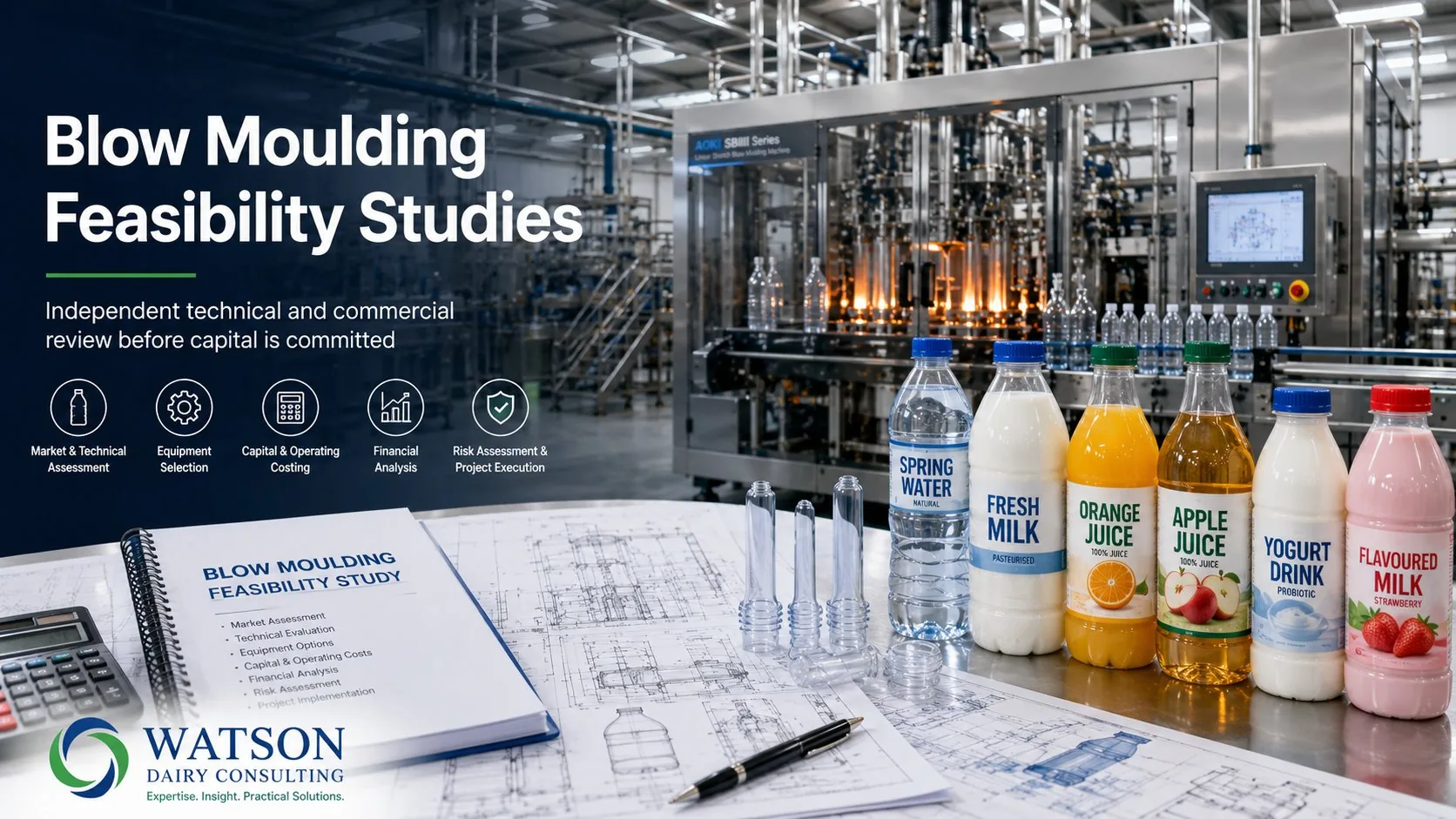
An independent blow moulding feasibility study answers one question honestly: should you bring PET bottle blow moulding in-house, or keep buying bottles?
Watson Dairy Consulting models the make-or-buy economics on your actual volumes — CapEx, OpEx, resin, compressed air and utility load, line integration, cost-per-case and payback — with no equipment to sell and no commission riding on the answer. The recommendation does not change with the conclusion.
What a Blow Moulding Feasibility Study Decides
For beverage, dairy and liquid food plants, the bottle is often one of the largest single line items in the cost of a finished case — and it is usually bought in from a converter, complete with that converter's margin and the freight cost of moving bottles or preforms around the country. Bringing stretch blow moulding in-house can remove both. It can also introduce capital cost, a heavy compressed-air load, changeover complexity and a new dependency on the blower's uptime feeding your filler.
The feasibility study weighs those against each other on your numbers, not on a vendor's brochure. It is the difference between a decision made on evidence and a decision made on a sales pitch.
What the Study Covers
CapEx
Stretch blow moulders, high-pressure compressors, chillers, preform handling and conveying, moulds and changeover tooling, installation and integration. Scoped to one-step, two-step or inline configurations.
OpEx & Resin
Resin is the dominant operating cost in PET bottle production — commonly 70–80% of OpEx — so resin price, preform weight and lightweighting potential are modelled alongside labour, maintenance and scrap.
Compressed Air & Utilities
The cost line plants most often underestimate. High-pressure air demand, compressor sizing, pressure strategy and electrical load assessed explicitly — not bolted on at the end.
Line Integration
How the blower feeds the filler, footprint and layout, preform storage versus direct-to-fill, and the operational risk of tying bottle supply to a single in-house asset.
Two-Stage vs Single-Stage
Injection stretch blow moulding versus single-stage and inline systems, compared against your SKU spread, volumes, flexibility needs and available space.
Cost-per-Case & ROI
The honest payback: cost-per-case before and after, capital recovery, total cost of ownership and the sensitivities that move the answer either way.
This is where in-house projects most often surprise their owners. Industry analysis puts compressed air at roughly 35–40% of a PET blowing plant's total energy bill, with high-volume stretch blow moulders carrying thousands of horsepower of installed high-pressure compressors and energy costs that can run into seven figures a year on a busy line. Sizing, pressure strategy and pneumatic-circuit design change that number materially — so it is modelled up front, not discovered afterwards.
When In-House Blow Moulding Does Not Pay
An independent study is just as willing to tell you to keep buying bottles. In-house blow moulding tends not to pay when volumes are too low to absorb the capital and fixed cost, when you run so many bottle formats that changeovers wreck utilisation, when the site has no space or compressed-air headroom, or when a converter is close enough that inbound freight is already cheap. The value here is an honest answer — not a business case reverse-engineered to justify a purchase.
Our independently curated directory of blow moulding equipment and PET preform suppliers lists machinery makers and bottle and preform converters worldwide, by region and scale — a neutral starting point for a make-or-buy shortlist. Listing is free and is not an endorsement.
Why Independent Matters Here Specifically
The blow moulding feasibility space is crowded with two kinds of analysis you should be wary of. Equipment makers and integrators produce feasibility analyses that, unsurprisingly, tend to conclude you should buy equipment. At the other end, generic "project report" mills sell templated, anonymous feasibility documents stamped with your sector name. Neither is the same as an independent, named expert modelling your specific operation and standing behind the recommendation.
Watson Dairy Consulting is led by John Watson, an independent dairy and food process consultant with around 50 years of plant experience spanning factory design, process lines and packaging integration — including PET bottling line work. The judgement is independent of any equipment manufacturer, ingredient supplier or converter, which is precisely what a make-or-buy decision of this size needs. See where we have worked.
A focused single-line study typically runs 3 to 5 weeks, producing a structured, board-ready deliverable suitable for investor, lender or capital-committee review.
Frequently Asked Questions
Is it worth blow moulding our own PET bottles in-house?
It depends on volume, the number of bottle formats you run, your utility costs and your available footprint. For a single-format, high-volume line the economics are often strong, because you stop buying bottles at a converter's margin and stop shipping air around the country in empty preforms or finished bottles. For low volumes or a wide spread of bottle sizes, the equipment utilisation and changeover cost can wipe the saving out. A feasibility study quantifies the specific case rather than relying on a rule of thumb.
What saving can we expect from bringing blow moulding in-house?
Equipment integrators commonly cite a cost-per-case reduction of around 25% for suitable high-volume lines, mostly from eliminating converter margin and inbound bottle freight. That figure is a marketing headline, not a promise — the real number depends on your resin price, energy cost, line utilisation and freight position. The point of an independent study is to model your actual numbers and give you the honest payback, including the cases where it is smaller than the headline or does not pay at all.
Two-stage (ISBM) or single-stage inline — which suits us?
Two-stage injection stretch blow moulding buys or moulds preforms separately, stores them, then reheats and blows on demand — flexible across formats and good where you run many SKUs. Single-stage and inline direct-to-fill systems blow bottles straight into the filler, cutting handling and storage but tying the blower's availability directly to the line. The right answer turns on your SKU spread, volumes, floor space and how much you value flexibility versus lowest unit cost. The study compares both against your operation.
How much compressed air and energy does blow moulding need?
More than most people expect, and it is the cost line that catches plants out. Industry analysis puts compressed air at roughly 35–40% of a PET blowing plant's total energy bill, with high-volume stretch blow moulders carrying thousands of horsepower of installed high-pressure compressors. Sizing, pressure strategy and pneumatic-circuit design materially change the running cost, so compressed air is modelled explicitly in any credible feasibility study rather than treated as a utility afterthought.
When does in-house blow moulding NOT make sense?
Typically when volumes are too low to absorb the capital and fixed cost, when you run so many bottle formats that changeovers destroy utilisation, when your site has no space or compressed-air headroom, or when a converter sits close enough that inbound freight is already cheap. A good feasibility study is just as willing to recommend continuing to buy bottles as it is to recommend investing.
What does the feasibility study deliver?
A structured, board-ready report: the make-or-buy economics modelled on your volumes, a CapEx estimate for blowers, compressors, chillers, conveying and moulds, an OpEx model including resin, energy, labour, maintenance and scrap, a compressed-air and utility load assessment, a two-stage versus single-stage comparison, a cost-per-case and payback analysis, and a clear recommendation with the assumptions and sensitivities laid out. RFI/RFP support for equipment selection can be included.
What is your fee model?
Day rate plus expenses, agreed against a scoped brief. No retainers, no commissions, no equipment kickbacks and no contingent fees. The recommendation does not change with the answer, which is the whole point of independence.
Further reading: John Watson publishes articles on dairy and food industry topics on LinkedIn — from plant design and yield improvement to packaging and process economics. Browse all articles by John Watson on LinkedIn →
See our related feasibility studies & business planning, factory design, due diligence, where we have worked pages, or browse all consultancy services.
John Watson
Office: +44 1224 861 507
Mobile: +44 7931 776 499
jw@dairyconsultant.co.uk
We are a longstanding member of the Society of Dairy Technology
and have Fellowship of the Institute of Food Science and Technology.



Contact Details
John Watson
Office: +44 1224 861 507
Mobile: +44 7931 776 499
jw@dairyconsultant.co.uk
What Our Clients Say
We are a longstanding member of the Society of Dairy Technology
and have Fellowship of the Institute of Food Science and Technology.
Locations

Services
Enquiry Form

