
Dairy Investment Advice
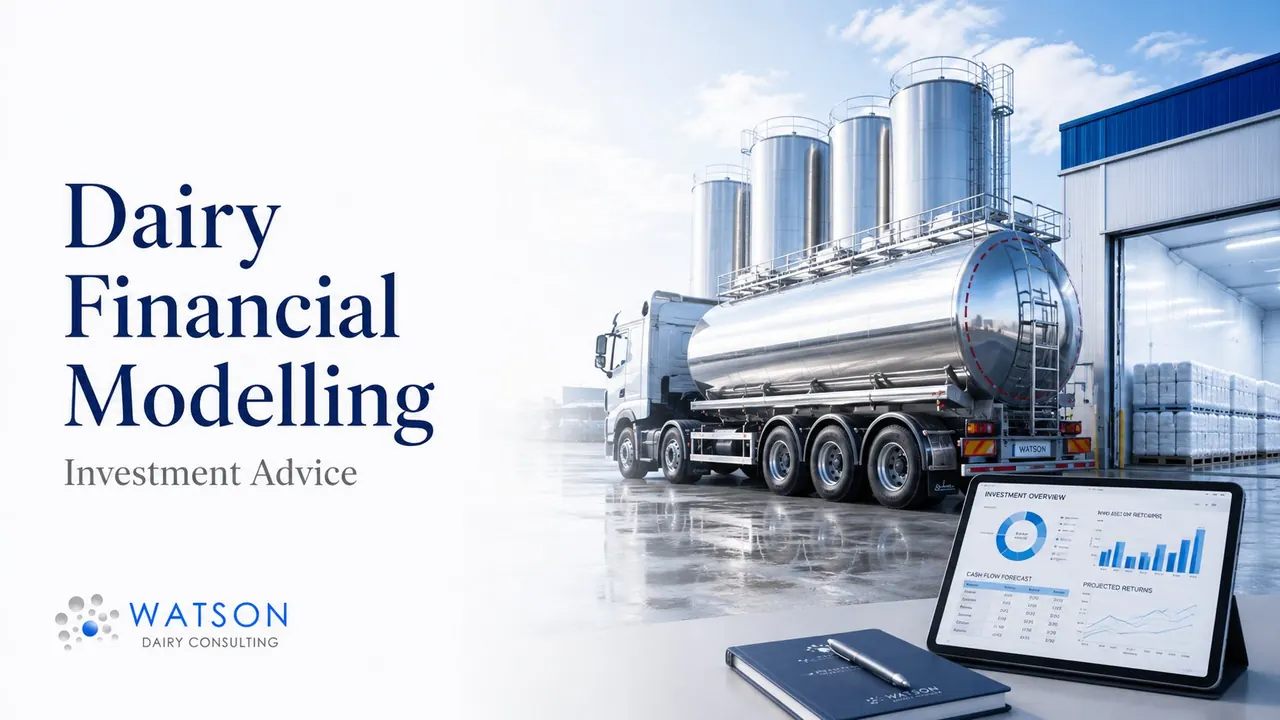
Independent dairy investment advice for private equity, family offices, lenders and strategic investors — technical due diligence, commercial review, market positioning, capex realism and supply chain risk on dairy acquisitions, expansions and greenfield projects.
Watson Dairy Consulting brings 50 years of operational dairy experience to the investment process. Independent of all suppliers and operators, paid for opinion not for outcomes, focused on what the data actually shows.
Why Independent Investment Advice Matters in Dairy
Sound investment advice in dairy is about understanding risk and return, not asset value. Dairy is a low-margin business with high operational complexity: a typical plant runs at 5–12% EBITDA margin and depends on a milk supply where a 1–2 pence per litre swing moves the whole P&L. The risks that determine whether an investment performs — fragile margins, customer concentration, deferred capex, food safety exposure, over-stated capacity — sit beneath the headline numbers and are not visible in the accounts alone. Get the operational and risk assessment wrong at the investment stage and the financial model never recovers.
Generalist due diligence providers can read accounts and benchmark KPIs. What they often cannot do is walk a plant, look at a falling-film evaporator and tell you whether it has 5 more years of useful life or 18 months, listen to a CIP cycle and know whether the chemistry is right, or look at a yield log and identify which percentage points are recoverable and which are structural. That kind of judgement is what we bring to the investment process.
What We Cover
Plant Condition & Capex
Equipment condition assessment, remaining useful life, deferred maintenance, capex required to maintain current production, capex required to deliver the business plan.
Operational Efficiency
Yield benchmarking vs sector, OEE, energy and CIP consumption, labour productivity, quality KPIs, and the gap between current performance and best-in-class.
Commercial & Market
Product mix margins, customer concentration, channel strategy, brand strength, contract pricing structure and market positioning vs competitors.
Supply Chain & Risk
Milk supply security, supplier financial health, single-source dependencies, regulatory exposure, sustainability/Scope 3 readiness and operational risk register.
Who We Work For
- Private equity funds — buy-side and vendor due diligence on dairy targets, portfolio operational reviews, exit preparation
- Family offices and sovereign wealth funds — direct investment in dairy assets, particularly in emerging markets where in-house dairy expertise is limited
- Strategic trade buyers — technical and commercial evaluation of acquisition targets in adjacent segments or new geographies
- Lenders — technical credit assessment, monitoring of dairy borrowers, covenant testing on operational metrics
- Investment banks — technical input into sell-side mandates, vendor due diligence packs, management presentations
- Management teams — MBO support, capital raise preparation, refinancing
- Founders — exit preparation, sale process support, post-sale earnout monitoring
Plant Condition and Capex Realism
The largest unwelcome surprises after a dairy acquisition typically come from one of two places: capex that was deferred under previous ownership and is now coming due, or capex required to deliver the business plan that the seller didn't quantify. Both are diagnosable with proper technical due diligence at the deal stage.
What we assess on the plant
- Critical equipment condition — evaporators, spray dryers, separators, pasteurisers, cheese vats, fermentation tanks, packaging lines — with realistic remaining life estimates
- Deferred maintenance — what should have been spent and wasn't, and what that means for capex in years 1–3
- Compliance and regulatory headroom — can the plant pass a customer audit today, can it support new product categories the business plan requires, will it meet impending regulatory changes (effluent, energy, food safety)?
- Capacity headroom — is the stated capacity real, what's the actual bottleneck, what does it cost to unlock the next tier of throughput
- Hidden expansion constraints — effluent treatment, utilities, site, planning — that limit the headline expansion potential the seller is presenting
Operational Efficiency Benchmarking
A target running 1.5 percentage points below sector-average yield isn't necessarily a bad investment — it can be a good one if the gap is closeable. The question is whether the yield gap is structural (wrong equipment, wrong product mix, wrong supply chain) or operational (recoverable with management, training, capex). We diagnose the difference.
Same logic applies to OEE, energy consumption per litre processed, CIP chemical use per CIP cycle, labour productivity and quality KPIs. Each benchmark is one data point; the value is in understanding which gaps are real opportunities and which are baked in.
Compressed due diligence on a defined scope is what we are built for. Site visit and headline findings within a week, full report against the bid timeline. Schedule a call with Watson Dairy Consulting →
Commercial and Market Positioning
The technical view has to be triangulated against the commercial reality. We work with deal teams on:
- Product mix margin analysis — which SKUs make money, which subsidise others, and what the mix looks like post-deal
- Customer concentration and contract terms — pricing mechanism, contract length, change-of-control clauses, customer relationships that are personal vs institutional
- Channel strategy — retail, foodservice, ingredient, export, DTC; the mix and the trajectory
- Brand strength — for branded businesses, the gap between brand equity and the actual price premium the brand commands
- Competitive positioning — vs other plants in the same segment, vs imports, vs adjacent categories that could disrupt
- Pricing structure exposure — cost-plus, fixed, indexed; and what happens to margin when milk prices move
Supply Chain and Risk Assessment
For dairy investors, the supply chain is often the most overlooked risk in due diligence. We cover:
- Milk supply security — supplier concentration, contract structure, regional risk, segregation discipline for premium streams
- Single-source dependencies — cultures, enzymes, specialist packaging, qualified second sources, switching cost
- Supplier financial health — for critical suppliers, financial review beyond standard credit checks
- Regulatory exposure — impending changes in food safety, environmental, labour, animal welfare and trade rules that affect the target
- Sustainability and Scope 3 — carbon footprint at farm gate, retailer requirements, financing covenant implications, decarbonisation capex path
- Operational risk register — documented and prioritised, suitable for investment committee discussion
For a deeper treatment of supply chain specifically see our dairy supply chain evaluation page.
How We Engage
1. Scoping Call
Confidential discussion to understand the deal context, timeline, what's already been done, what gaps need filling. NDA in place before any target-specific information exchanged.
2. Desk Review
Information memorandum, data room contents, financial model, capex plan, customer contracts, audit reports, regulatory correspondence and management presentations.
3. Site Visits & Management Sessions
Plant walk, management interviews, operator-level conversations where access allows, supplier visits where critical. Triangulates the data room narrative with reality.
4. Report & Investment Committee Support
Written report with quantified risks and opportunities, headline findings memo for IC, optional Q&A support through the investment committee process and post-deal handover.
Independence as the Value Proposition
The reason we are paid is independence. We are not a contractor angling for the post-deal capex work, not an equipment supplier looking for an order, not a strategic adviser who will keep getting paid if the deal proceeds. The opinion is the same whether the deal goes ahead or not, and we will tell you when not to do a deal as clearly as when to proceed.
That independence is also the reason we don't take success fees, commissions or deal-contingent arrangements. The technical view has to be the same on a buy-side mandate where the fund wants to do the deal and on a vendor mandate where the seller wants to maximise price. Same data, same analysis, same conclusion.
Frequently Asked Questions
What does dairy investment advice involve?
Independent technical and commercial advisory for investors evaluating dairy acquisitions, expansions or greenfield projects. We assess plant condition and capability, capex requirements, yield and operational efficiency, supply chain risk, market positioning, management quality and sustainability/Scope 3 exposure. Output is a board-ready report with quantified risks, opportunities and a clear independent view on the investment thesis.
Who do you provide investment advice to?
Private equity funds, family offices, sovereign wealth and pension funds, strategic trade buyers, lenders doing credit assessment, and investment bankers preparing buy-side or sell-side mandates. Also management teams considering MBOs or capital raises, and founders preparing for exit. We are independent of all equipment suppliers and dairy operators — the advice is yours, not the deal's.
How long does dairy investment due diligence take?
A focused commercial or technical review for a single-site target is typically 2 to 4 weeks including site visit and report. A full vendor or buy-side due diligence on a multi-site dairy business is typically 4 to 8 weeks. Timelines are agreed against the deal process and we can compress where required for competitive bid situations.
Do you cover greenfield and expansion projects as well as acquisitions?
Yes. For greenfield projects we assess the technical design, capex realism, operating economics, supply chain feasibility and market positioning before significant capital is committed. For expansion projects within existing operations we evaluate whether the proposed investment will deliver the projected returns and whether less-expensive alternatives have been properly considered.
What sectors and geographies do you cover?
All dairy sectors — liquid milk, cheese, yogurt and fermented products, butter and AMF, milk powder, infant formula, whey processing, ice cream and frozen desserts. Geographically, the active portfolio over recent years has covered the UK, Ireland, EU, Middle East, North Africa, South Asia and the Americas. Recent engagement on UK and EU targets dominates but we work globally where the technical brief justifies it.
What is your fee model for investment advice?
Day rate plus expenses, agreed upfront against a scoped brief. No success fees, no commission, no deal-contingent arrangements. We are paid for independent technical and commercial opinion — the value is independence, and that requires the same view regardless of whether the deal proceeds. Strict NDA and confidentiality clauses are standard.
Further reading: John Watson publishes articles on dairy industry topics on LinkedIn — from infant formula safety and milk supply to plant design, yield improvement and dairy commodity outlook. Browse all articles by John Watson on LinkedIn →
See our related dairy due diligence, financial modelling & budgets, project financing, supply chain evaluation, dairy benchmarking and acquisitions & disposals pages, or browse all consultancy services.
John Watson
Office: +44 1224 861 507
Mobile: +44 7931 776 499
jw@dairyconsultant.co.uk
We are a longstanding member of the Society of Dairy Technology
and have Fellowship of the Institute of Food Science and Technology.



Contact Details
John Watson
Office: +44 1224 861 507
Mobile: +44 7931 776 499
jw@dairyconsultant.co.uk
What Our Clients Say
We are a longstanding member of the Society of Dairy Technology
and have Fellowship of the Institute of Food Science and Technology.
Locations

Services
Enquiry Form

