
Evaporator Steam Economy Calculator
Watson Dairy Training Academy
Develop practical understanding of evaporator operation and steam economy.
Evaporation is the largest single energy user on a milk powder plant. Removing water from milk before the spray dryer is far cheaper than evaporating it in the dryer — but how cheaply depends entirely on how the latent heat in the vapour is reused. That is what steam economy measures.
This guide explains steam economy, compares multi-effect evaporators, thermal vapour recompression (TVR) and mechanical vapour recompression (MVR), and provides a calculator that works out your water evaporation rate, energy use and running cost — on your own duty and your own energy rates.
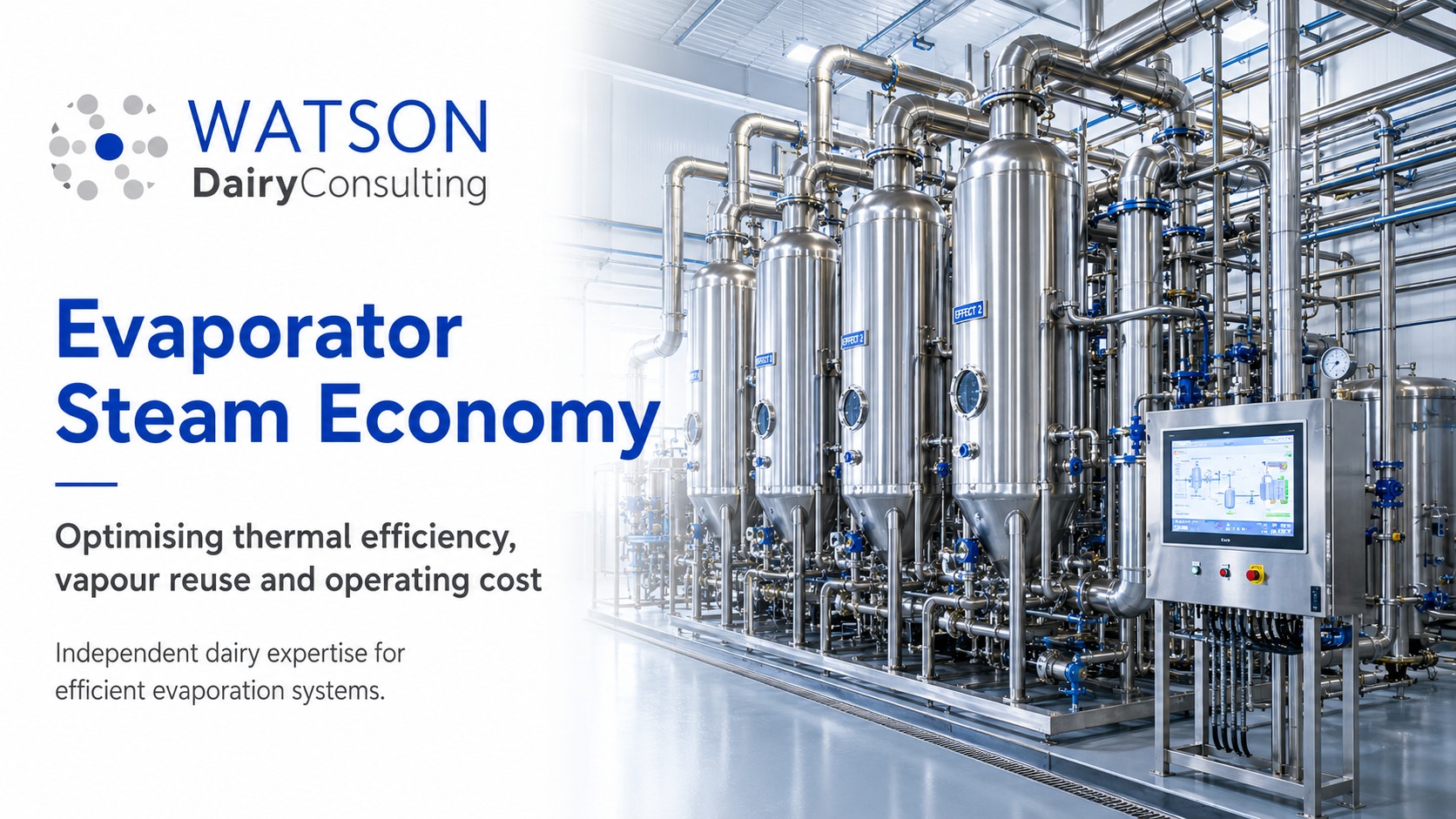
What Steam Economy Means
Steam economy is the simplest measure of how efficiently an evaporator uses energy. It is defined as the mass of water evaporated for each unit mass of live steam consumed:
A single-effect evaporator has a steam economy slightly below 1.0 — it takes roughly 1 kg of steam to evaporate 1 kg of water, because some energy is lost heating the feed to boiling point and to ambient losses. The whole art of evaporator design is reusing the latent heat held in the vapour boiled off the product, instead of throwing it away in the condenser. There are three established ways to do that, and they are the three options in the calculator below.
The Calculator
Enter your feed rate, the total solids of the feed and the concentrated product, then choose the evaporator configuration. The calculator returns the water evaporation duty (an exact mass balance), the indicative steam or electricity consumption, and — using your own energy rates — the running cost. A side-by-side comparison of all three technologies on the same duty is shown beneath.
Evaporator Steam Economy & Running Cost Calculator
Water evaporation duty, energy use and running cost for multi-effect, TVR and MVR evaporators.
Results
Running cost (your rates)
Compare configurations (same duty & rates)
| Configuration | Economy | Energy use | £/year |
|---|
Economy figures are typical published ranges; actual performance depends on the specific evaporator design, feed and vapour temperatures, boiling-point elevation, preheat configuration and condensate recovery. Annual cost is energy plus cooling/make-up water at the rates you enter. MVR is costed on the electricity rate and a reduced water allowance (it has little condenser duty); all steam-based options use the steam rate and your full water figure.
How the numbers are produced. Water evaporated = feed × (1 − feed solids ÷ product solids) — an exact mass balance. Steam economy is taken from published typical ranges by configuration (or your entered value); steam consumption = water evaporated ÷ steam economy. MVR consumption uses the specific electrical energy you enter (kWh per tonne water). Energy cost uses your steam or electricity rate; water cost = cooling/make-up water use (m³ per tonne evaporated) × tonnes evaporated × your water rate, with MVR given a reduced water allowance. All rates are yours to set. Indicative screening tool only — not a quotation, budget or design. Real evaporator performance and cost depend on the specific design, feed and vapour temperatures, boiling-point elevation, preheat train, condensate recovery, boiler efficiency and current energy and water prices, all of which must be confirmed for any actual project.
The Three Ways to Reuse Vapour Energy
1. Multiple effects
In a multiple-effect evaporator, the vapour boiled off in the first effect is used as the heating medium for the second effect, whose vapour heats the third, and so on. Each effect operates at a progressively lower pressure and temperature so that the vapour from the effect before is hot enough to drive boiling. The practical result, as the Tetra Pak Dairy Processing Handbook puts it, is that the live steam required is approximately the total water evaporated divided by the number of effects.[1]
Steam economy therefore improves with each effect added, but with diminishing returns and rising capital cost. Published typical figures:[2][3]
| Number of effects | Typical steam economy (kg water / kg steam) | Notes |
|---|---|---|
| 1 (single effect) | 0.8–0.95 | Only used for very small duties or where steam is effectively free |
| 2 | 1.6–1.9 | Roughly halves steam use versus single effect |
| 3 | 2.4–2.7 | Common threshold for continuous production |
| 4 | 3.0–3.4 | |
| 5 | 3.8–4.2 | Traditional dairy powder plant configuration |
| 6–7 | 4.5–5.5 | Diminishing returns; capital and complexity rise |
2. Thermal vapour recompression (TVR)
A TVR system adds a steam-jet ejector (a thermocompressor) that uses high-pressure motive steam to entrain and recompress part of the low-pressure vapour from an effect, raising its pressure and temperature so it can be reused as heating steam. It has no moving parts and is robust and inexpensive. A thermocompressor typically improves steam economy by roughly the equivalent of adding one effect, and in highly integrated modern dairy systems with full preheat trains the gain can be considerably greater — Tetra Pak cites a five-effect evaporator with thermocompressor needing only about 0.09 kg of steam per kg of water evaporated.[1] Because the achievable gain depends heavily on the specific design, the calculator treats TVR conservatively as approximately one extra effect; enter your known economy for a precise figure.
3. Mechanical vapour recompression (MVR)
MVR replaces live steam almost entirely. A high-speed electric blower (or compressor) takes the vapour boiled off the product, compresses it through a small temperature lift — typically around 5–10 °C — and returns it as the heating medium for the same evaporator. The cycle is an open-cycle heat pump, and at the small temperature lifts used in dairy it achieves a very high coefficient of performance, often close to 50.[4] Live steam is used only for start-up and balancing.
Because MVR runs on electricity rather than steam, its energy is expressed in kWh per tonne of water evaporated rather than as a steam economy. Dairy MVR evaporators typically use in the order of 8–15 kWh per tonne of water at low temperature lift.[4] MVR has become the standard choice for new greenfield milk powder plants: New Zealand alone has over 100 MVR blowers on milk evaporators, and one early installation showed 5.8 GWh of electricity displacing 49 GWh of coal for the same duty.[4] Whether MVR or steam works out cheaper at a given site depends entirely on the local ratio between electricity and steam prices — which is exactly why the calculator above uses your own rates.
The right answer depends on your steam and electricity prices, plant utilisation, existing boiler capacity and product mix — not on a rule of thumb. An independent energy study models your specific case. Talk to Watson Dairy Consulting →
Why Boiling-Point Elevation Matters
One reason real economy never quite reaches the simple "water evaporated divided by number of effects" ideal is boiling-point elevation (BPE). Dissolved solids raise the temperature at which a solution boils above that of pure water at the same pressure. As milk is concentrated, its BPE rises, eating into the temperature difference available to drive heat transfer in each effect. The effect is small in the early effects on dilute feed but becomes significant in the final effects on high-solids concentrate — which is one reason finishing duties are often handled differently from the bulk of the evaporation, and why running an effect too close to saturation can cause instability. Accurate design accounts for BPE effect by effect; this calculator does not, which is one of several reasons it is a screening tool rather than a design.
Worked Example
Take 20,000 kg/h of whole milk at 12% total solids, concentrated to 48% before the dryer:
- Water to evaporate = 20,000 × (1 − 12/48) = 15,000 kg/h
- Concentrated product = 20,000 − 15,000 = 5,000 kg/h at 48% solids
- Concentration ratio = 48 / 12 = 4.0×
- 6-effect at economy ~4.4: steam ≈ 15,000 / 4.4 ≈ 3,400 kg/h
- MVR at 12 kWh/tonne: ≈ 15 × 12 ≈ 180 kW of electrical power, no live steam
Whether the 3,400 kg/h of steam or the 180 kW of electricity costs less is entirely a function of your local energy prices — the comparison the calculator makes for you.
Related page: Spray Dryer Fines: Causes & Recovery — concentrating feed to higher solids in the evaporator also reduces fines in the dryer; this page explains the link, recovery and emissions.
References
- Tetra Pak. Dairy Processing Handbook — Evaporators. States that the live steam required is approximately the total water evaporated divided by the number of effects, and gives the five-effect-with-thermocompressor figure of about 0.09 kg steam per kg water. dairyprocessinghandbook.tetrapak.com.
- American Institute of Chemical Engineers (AIChE) (2018). The Essentials of Continuous Evaporation, Chemical Engineering Progress. Gives single-effect steam economy of 0.75–0.95 kg water/kg steam and the multiple-effect relationship. aiche.org.
- University of Guelph. Dairy Science and Technology eBook — Evaporation and Dehydration. Covers falling-film multiple-effect operation and economy. books.lib.uoguelph.ca.
- EECA (Energy Efficiency and Conservation Authority, New Zealand) (2019). MVR (Mechanical Vapour Recompression) Systems for Evaporation, Distillation and Drying. Documents dairy MVR coefficient of performance near 50 at low temperature lift, the New Zealand dairy MVR fleet, and the Anchor Products case displacing 49 GWh of coal with 5.8 GWh of electricity. genless.govt.nz.
John Watson
Office: +44 1224 861 507
Mobile: +44 7931 776 499
jw@dairyconsultant.co.uk
We are a longstanding member of the Society of Dairy Technology
and have Fellowship of the Institute of Food Science and Technology.



Contact Details
John Watson
Office: +44 1224 861 507
Mobile: +44 7931 776 499
jw@dairyconsultant.co.uk
What Our Clients Say
We are a longstanding member of the Society of Dairy Technology
and have Fellowship of the Institute of Food Science and Technology.
Locations

Services
Enquiry Form

