
Pasteurisation Holding Time
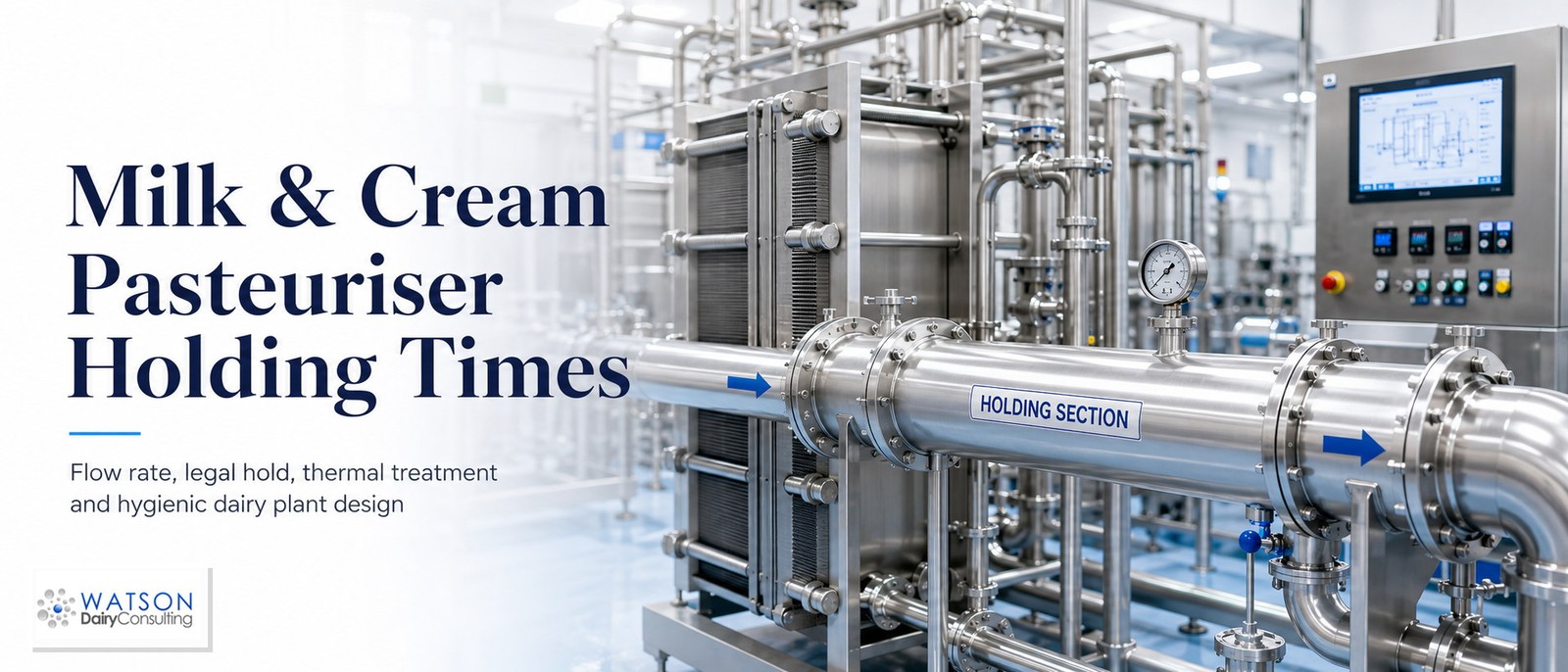
Holding time is the single most safety-critical number in pasteurisation — and it is a legal requirement. It is the time the fastest-moving particle of product spends in the holding tube at or above the pasteurisation temperature. If that fastest particle is held for less than the legal minimum, part of the product is under-pasteurised even when the average looks correct.
This guide explains what holding time is, the legal time–temperature combinations in the UK, EU and US, how holding time is validated (the salt conductivity test, the thermal method, calculation, and the alkaline phosphatase confirmation), and how often it must be tested. Every regulatory figure is referenced to a primary source, and there is an interactive holding-time calculator below.
Legal note. Pasteurisation is a legally defined process and an official food-safety control. The figures here are referenced to primary regulation and recognised methods, but they are general guidance, not a validated process design. Any holding-tube installation must be validated and signed off by a competent heat-treatment authority for your specific product, plant and jurisdiction. Always confirm the current wording of the regulation that applies to you.
What “Holding Time” Means — and Why It Is a Legal Requirement
Pasteurisation kills the pathogens of public-health concern in milk by holding the product at a defined temperature for a defined time. The benchmark high-temperature short-time (HTST) process — at least 72 °C for at least 15 seconds — delivers at least a 5-log reduction of Coxiella burnetii, the most heat-resistant non-spore-forming pathogen in milk.[10] The temperature half of that pair is continuously measured and controlled. The time half is set by the holding tube: a length of pipe sized so that product entering at the pasteurisation temperature cannot reach the end — and the cooling section — before the required holding time has elapsed.
The law is explicit that this applies to every particle of product, not the average. The US Grade “A” Pasteurized Milk Ordinance requires the holding tube to be designed to hold “every particle of milk or milk product for at least the time required”.[4] EU and UK law defines pasteurisation as a heat treatment that produces a negative alkaline phosphatase reaction immediately afterwards.[1][11] Holding time is therefore a documented Critical Control Point in any dairy HACCP plan, and getting it wrong is not a quality slip — it is a failure to meet a legal food-safety standard.
The Physics: Why the Fastest Particle Decides It
Product does not move through a pipe at a single speed. Across the bore there is a velocity profile, and the fastest streamline always travels faster than the mean. Because the holding tube must protect the least-heated product, the legal holding time is the time taken by the fastest particle — not the average residence time.
- Laminar flow (Reynolds number below ~2,100): the profile is parabolic and the centre-line velocity is exactly twice the mean. The fastest particle is held for only half the average time — so a tube sized on average flow would under-hold half the product.[8]
- Turbulent flow (high Reynolds number): the profile is much flatter. The fastest particle still leads the mean, but only by roughly 1.33× near the transition, falling to about 1.25× at high Reynolds numbers. Because the ratio varies, turbulent designs should be confirmed by a validator.
The Reynolds number (Re = ρvD/μ) tells you which regime you are in, and therefore which max-to-mean factor to apply. For pasteuriser holding-tube validation the conservative convention is to treat flow as laminar (factor 2.0) unless the Reynolds number is clearly above 4,000, because the 2,100–4,000 band is transitional and unreliable. Our companion dairy pipe sizing and Reynolds number page covers the velocity and Reynolds-number side in detail; the calculator below applies the holding-time factors directly.
The Legal Time–Temperature Combinations
Pasteurisation conditions are fixed in law. The headline combinations, with their primary sources, are:
| Process | Minimum condition | Jurisdiction & source |
|---|---|---|
| HTST (high-temperature short-time) | ≥ 72 °C for ≥ 15 s | EU & UK[1][11]; US PMO: 161 °F (71.7 °C) / 15 s[4] |
| LTLT / batch (low-temperature long-time) | ≥ 63 °C for ≥ 30 min | EU & UK[1]; US PMO: 145 °F (63 °C) / 30 min[4] |
| Equivalent combinations | any time–temperature of equivalent lethal effect, giving a negative alkaline phosphatase reaction | EU & UK[1]; assessed by a pasteurisation index (15 s at 72 °C = 1 unit, z = 8 °C)[9] |
| High fat / high solids (US) | +5 °F above the minimum (e.g. 166 °F / 15 s) where fat ≥ 10% or total solids ≥ 18% | US PMO[4] |
| HHST / UHT (separate categories) | higher temperature, shorter time (e.g. UHT ≥ 135 °C; US 280 °F / 138 °C for ≥ 2 s) | US PMO[4] |
The reason “equivalent combinations” are allowed at all is that lethality can be integrated across the time–temperature profile. The most common unit is P*: a hold of 15 s at 72 °C is defined as one unit, a z-value of 8 °C is assumed, and a compliant process must achieve P* of at least one.[9] Whatever the combination, the product must give a negative alkaline phosphatase test immediately after treatment — for cows’ milk a measured activity of ≤ 350 milliunits per litre (mU/L) by the ISO 11816-1 reference method.[1][2][6]
Interactive Holding-Time Calculator
Enter the maximum flow, the product viscosity and density at holding temperature, the holding-tube length and your required holding time. The table screens each standard pipe size, applies the correct fastest-particle factor for the flow regime, and shows the actual holding time and whether it passes. Size on the maximum flow — that gives the shortest, worst-case holding time.
Pasteuriser Holding-Time Calculator
Fastest-particle holding time across standard pipe sizes, with pass / fail against your required time.
Holding-time by pipe size
| Pipe | ID (mm) | Mean v | Re | Regime | Fastest v | Hold (s) | Result |
|---|
Formula basis: mean velocity = flow ÷ area ÷ 3.6 (area = πd²/4); Reynolds number = density × velocity × diameter ÷ viscosity (viscosity entered in cP, converted to Pa·s); fastest-particle factor = 2.0 when Re ≤ 4,000 (laminar, conservative), 1.33 at Re 4,000 falling linearly to 1.25 at Re ≥ 20,000 (turbulent); holding time = tube length ÷ fastest-particle velocity. Velocities are shown in m/s and holding time in seconds. Default internal diameters follow DIN 11850 — edit each bore to your actual tube. Milk viscosity and density defaults at holding temperature follow Bakshi & Smith.[12] Screening aid only — a holding tube must be validated for the actual product by a competent heat-treatment authority before it is relied on.
How Holding Time Is Validated: The Tests
Holding time is controlled continuously by in-line instruments and confirmed periodically by direct tests and by a product test. The four that matter:
1. In-line controls (continuous, mandatory)
Every compliant continuous pasteuriser runs three legal safeguards every second: a continuous recording thermometer (the chart is a legal record), an indicating thermometer, and a flow-diversion device (FDD) that automatically diverts product back to the raw side if the temperature falls below the minimum. Flow — and therefore holding time — is fixed by a timing (metering) pump or homogeniser with a sealed speed setting; the seal is a regulatory control because changing the pump speed changes the holding time.[4]
2. The salt conductivity test (the reference method for holding time)
The internationally recognised direct method injects a slug of saturated salt (sodium chloride) solution at the holding-tube inlet; conductivity probes at the inlet and outlet detect it, and the time between them is the holding time of the fastest particle.[5][7] The test is run on water at pasteurisation temperature, repeated six or more times until successive results agree within 0.5 s; the average is the holding time (the fastest reading is used if results will not settle).[5]
3. The thermal (thermocouple) method
An alternative places thermocouples at the start and end of the holding section and times a deliberate heat pulse through the tube. It is non-intrusive and can be performed during production, which makes it useful for periodic verification without a water run.
4. The calculation method — and where the salt test fails
For aseptic and higher-heat shorter-time (HHST) systems the salt test is not sensitive enough, and holding time is instead calculated from the tube dimensions, the flow rate and the flow regime, assuming the fastest particle travels at twice the mean in laminar flow.[4] This calculation is also essential for viscous products. The salt test is run on water; because milk products are more viscous than water, the fastest particle of a viscous product can be held for less time than the water test predicts. In one study, a tube sized for 26 s by the salt test held condensed skim-milk for only about 17 s and cream for about 23 s, while whole milk and chocolate milk matched within about a second.[8] The conclusion is firm: the salt test is adequate for milk, but cream, concentrate and ice-cream mix must be sized by calculating the fastest-particle velocity in laminar flow[8] — which is what the calculator above does.
5. The alkaline phosphatase (ALP) test — product confirmation
The phosphatase test is the legal confirmation that pasteurisation was adequate. Alkaline phosphatase is a natural milk enzyme that is inactivated by correct HTST treatment, and its inactivation requires slightly more heat than killing the target pathogens — so a negative ALP result confirms both that the heat treatment was sufficient and that the product was not recontaminated with raw milk afterwards.[3] For cows’ milk, negative means a measured activity of ≤ 350 mU/L by ISO 11816-1 (commonly the fluorimetric Fluorophos method).[2][6] Two cautions a validator must allow for: ALP can reactivate in high-fat products such as cream during storage, masking a residual result;[3] and activity differs by species — raw ovine milk runs about three times higher and caprine about five times lower than bovine.[3]
6. Heat-exchanger integrity — the helium leak test (complementary, not a holding-time measurement)
A pasteuriser can hold every particle long enough and still produce unsafe product if the heat-exchanger plates leak — letting raw milk cross into the pasteurised stream through a hairline crack, pinhole or failed gasket. The recognised non-destructive check for this is the helium (or helium/nitrogen) tracer-gas test: helium is introduced to one side of the plate pack and a mass-spectrometer leak detector on the other side picks up any that passes through a through-thickness defect.[13] Helium is used because it is inert, non-toxic, non-flammable, barely present in air (about 5 ppm) and small enough to pass through the finest crack, so the test catches pinholes and micro-cracks that a pressure-hold test can miss — with no residue and minimal downtime.[13] This is an integrity / cross-contamination control, complementary to the holding-time measurement above: it is the engineering counterpart to the alkaline phosphatase product check, which flags raw-milk carry-over after the event rather than preventing it. For the methods compared, the regenerator pressure-differential control and testing frequency, see our dedicated pasteuriser integrity & leak testing page.
How Often Must It Be Tested? The Legal View
Testing frequency is set by a mix of continuous control and periodic verification. The clearest published schedule is the Canadian Food Inspection Agency’s; the US PMO and EU/UK frameworks apply equivalent principles.
| Check | Frequency | Source |
|---|---|---|
| Temperature recording & flow diversion | Continuous, every second of production; charts retained as records | US PMO[4] |
| Holding-time test (salt / thermal / calculation) | At installation; annually thereafter; whenever the timing-pump speed seal is broken; after any change affecting flow or holding (a different-duty pump, a changed or refitted impeller, motor, drive belt or pulley, a reduction in heat-exchanger plates, or the holding tube); and whenever a capacity check indicates a speed-up | CFIA[5] |
| Indicating / recording thermometers & FDD | Verified at regulated intervals (US: typically every ~6 months by the regulatory inspector) | US PMO[4] |
| Alkaline phosphatase (product) | Routine operator own-check under HACCP — commonly each production run / batch — verified at official audit; risk-based rather than a single fixed figure across jurisdictions | EU / UK[1][11] |
Why a pump or impeller change forces a re-test. The holding time is set by the delivered flow rate, so anything that changes that flow changes the hold. Fitting a different-duty pump, or changing or refitting the impeller, alters the flow and therefore the holding time — and if it raises the flow it shortens the hold, which is the unsafe direction. That is why the test is deliberately run at the pump’s maximum capacity with full-size impellers, to capture the worst-case shortest hold, and why a pump or impeller change must trigger a fresh holding-time test before the line runs again. The one exception the regulators allow is a pure like-for-like consumable swap back to the exact condition tested originally — for example replacing drive belts with new belts when the original test was itself done on new belts — which does not require re-evaluation.[5]
UK position. Since EU exit, the EU hygiene rules are retained (“assimilated”) in UK law — the same 72 °C / 15 s pasteurisation standard and the same ≤ 350 mU/L phosphatase limit apply, with food business operators verifying under HACCP and the competent authority (the Food Standards Agency and local authorities) auditing.[11] The principle everywhere is the same: control the temperature and the flow continuously, prove the holding time directly when anything changes, and confirm the product by phosphatase.
Independent review of holding-time validation, flow-diversion and timing-pump controls, and pasteuriser design is exactly where an experienced dairy consultant earns its fee — on a process where the cost of getting holding time wrong is a legal and food-safety failure, not just a quality one. Ask Watson Dairy Consulting to review your pasteuriser or holding tube →
Frequently Asked Questions
What is holding time in pasteurisation?
It is the time the fastest-moving particle of product spends in the holding tube at or above the pasteurisation temperature. It must meet the legal minimum — for HTST, at least 15 seconds at at least 72 °C.[1][4]
Why the fastest particle and not the average?
Because the fastest particle receives the least heat. If it is under-held, part of the product is under-pasteurised even if the average residence time looks correct. In laminar flow the fastest particle travels at twice the mean velocity, so a tube sized on average flow would under-hold half the product.[4][8]
What is the legal pasteurisation time and temperature?
In the EU and UK: at least 72 °C for 15 seconds (HTST), or at least 63 °C for 30 minutes (batch), or any equivalent combination, such that the alkaline phosphatase test is negative immediately afterwards. In the US, the PMO specifies 161 °F (71.7 °C) for 15 seconds (HTST) or 145 °F (63 °C) for 30 minutes (batch).[1][4]
How is holding time tested?
Directly, by the salt conductivity test, which times the fastest particle through the holding tube on water at pasteurisation temperature; or by a thermal (thermocouple) method; or, for aseptic and viscous products, by calculation from the tube dimensions, flow and flow regime. The product is then confirmed by the alkaline phosphatase test.[5][7][8]
How often must holding time be tested?
At installation, annually thereafter, whenever the timing-pump speed seal is broken, and after any change affecting flow or holding time. Temperature recording and flow diversion run continuously; instruments are verified periodically (in the US, typically every six months).[4][5]
Why can’t the salt test be used for cream or concentrate?
The salt test is run on water. Because milk products are more viscous than water, the fastest particle of a viscous product can be held for less time than the water test predicts — so cream, concentrate and ice-cream mix must be sized by calculating the fastest-particle velocity in laminar flow rather than relying on the salt test.[8]
What does the alkaline phosphatase test prove?
That the heat treatment was adequate and that the pasteurised product was not recontaminated with raw milk. Phosphatase is inactivated by correct pasteurisation, requiring slightly more heat than killing the target pathogens, so a negative result — ≤ 350 mU/L for cows’ milk — confirms both.[2][3]
References
- Regulation (EC) No 853/2004, Annex III, Section IX, Chapter II — specific hygiene rules for food of animal origin: pasteurisation defined as at least 72 °C for 15 s, at least 63 °C for 30 min, or any equivalent combination giving a negative alkaline phosphatase reaction immediately after treatment.
- Commission Implementing Regulation (EU) 2019/627, Annex III, Chapter II (amending Regulation (EC) 2074/2005) — a negative alkaline phosphatase result for cows’ milk is a measured activity of ≤ 350 milliunits per litre (mU/L).
- EFSA (2021). The use of alkaline phosphatase and possible alternative testing to verify pasteurisation of raw milk, colostrum, dairy and colostrum-based products. EFSA Journal 19(4):e06576. doi:10.2903/j.efsa.2021.6576. (ALP inactivation relative to pathogens; reactivation in cream; ovine and caprine differences.)
- FDA — Grade “A” Pasteurized Milk Ordinance (PMO). HTST 161 °F (71.7 °C) for 15 s; batch 145 °F (63 °C) for 30 min; +5 °F where fat ≥ 10% or total solids ≥ 18%; holding tube must hold every particle for at least the required time; flow-diversion device and timing-pump requirements.
- Canadian Food Inspection Agency — Dairy processing: critical process test procedures. Salt (conductivity) holding-time test method, and test frequency: at installation, annually, when the speed-setting seal is broken, and after any alteration affecting holding time or flow.
- ISO 11816-1 | IDF 155-1 — Milk and milk products: determination of alkaline phosphatase activity (fluorimetric reference method).
- Lang, F. & Jordan, M. (1958). Comparison of standard methods of measuring holding time in HTST pasteurizers. Journal of Dairy Science (origin of the recognised salt conductivity holding-time method).
- Residence time of milk products in holding tubes of HTST pasteurizers. Journal of Dairy Science 51(11), 1968 — the salt (water) test over-predicts holding time for viscous products; cream, condensed skim and ice-cream mix must be sized by calculating fastest-particle velocity in laminar flow.
- Handbook of Dairy Technology (3rd ed., 2018) — pasteurisation index P* (15 s at 72 °C = 1 unit; z = 8 °C; P* ≥ 1 required); alkaline phosphatase inactivation characteristics.
- Meunier-Goddik & Sandra; and Mullan (2015) — HTST (72 °C/15 s) provides at least a 5-log reduction of Coxiella burnetii, the most heat-resistant non-spore-forming pathogen in milk (cited in Journal of Dairy Science).
- UK assimilated law — Regulation (EC) 853/2004 (as retained) with the Food Safety and Hygiene (England) Regulations 2013 and equivalent devolved regulations; Food Standards Agency dairy guidance. Same 72 °C/15 s standard and ≤ 350 mU/L phosphatase limit; verification under HACCP, audited by the competent authority.
- Bakshi, A. S. & Smith, D. E. (1984). Effect of fat content and temperature on viscosity in relation to pumping requirements of fluid milk products. Journal of Dairy Science 67(6):1157–1160. (Source for the milk viscosity figures used in the calculator defaults.)
- INDEi; Accutest International — pasteuriser and plate heat-exchanger integrity testing using a helium (or helium/nitrogen) tracer gas with mass-spectrometer leak detection, to locate through-thickness cracks, pinholes and gasket leaks that allow raw-to-pasteurised cross-contamination. An integrity / cross-contamination test, distinct from holding-time measurement.
Further reading. More technical articles by John Watson are published on LinkedIn: Watson Dairy Consulting articles →
See our related dairy pipe sizing and Reynolds number calculator, dairy factory design, process optimisation, CIP training and evaporator training pages, or browse all consultancy services.
John Watson
Office: +44 1224 861 507
Mobile: +44 7931 776 499
jw@dairyconsultant.co.uk
We are a longstanding member of the Society of Dairy Technology
and have Fellowship of the Institute of Food Science and Technology.



Contact Details
John Watson
Office: +44 1224 861 507
Mobile: +44 7931 776 499
jw@dairyconsultant.co.uk
What Our Clients Say
We are a longstanding member of the Society of Dairy Technology
and have Fellowship of the Institute of Food Science and Technology.
Locations

Services
Enquiry Form

