
Dairy Tank & Silo Integrity: Crack & Pinhole Testing

Every stainless steel tank and silo in a dairy is a pressure-free vessel doing a safety-critical job — and given time and the wrong conditions, every one of them can crack or develop a pinhole. The question is whether you find the damage on a planned inspection, or when product is on the floor, a batch is contaminated, or a silo is structurally compromised.
This guide explains, with references, why dairy storage and process tanks and silos crack and form pinholes — chloride stress corrosion cracking, pitting, fatigue, corrosion under insulation and weld faults — and the inspection and non-destructive testing (NDT) methods that find that damage early. It is written for plant, engineering and quality managers who have to decide what to inspect, how, and how often.
Why Tank and Silo Integrity Matters in Dairy
In a dairy, a crack or pinhole is never just a metallurgical curiosity — it is a hygiene, product and, on large silos, a structural problem.
- A pinhole is a two-way contamination route. It does not only let product leak out. Between batches it lets wash water, CIP chemicals, condensate, insulation moisture and unfiltered air leak in, contaminating the next fill and creating a path for spoilage organisms and pathogens into a surface that is supposed to be sealed.
- Cracks and crevices harbour bacteria. Hygienic design standards require product-contact surfaces to be smooth and free of pits, folds and crevices — 3-A specifies a finish of 0.8 µm Ra or better — precisely because rough or cracked surfaces shelter organisms that survive cleaning and disinfection.[1] A crack defeats that, and a surface that looks clean can still hold viable bacteria.
- Lost product and lost time. A weeping weld or pinhole means rejected batches, leak chasing during production, and unplanned downtime — usually discovered at the worst moment.
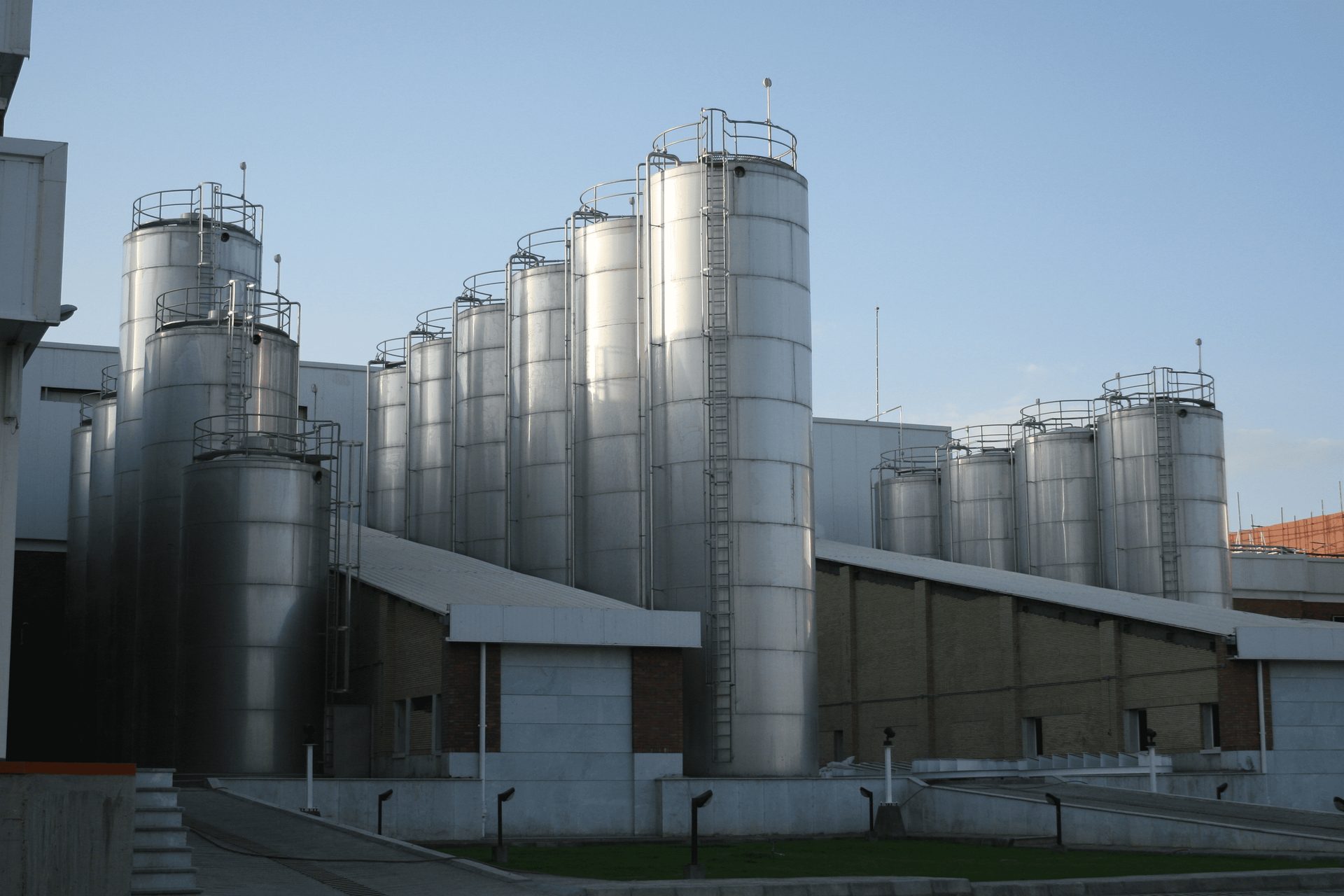
- On large silos, it is a safety issue. A vertical milk silo can hold tens of thousands of litres. Loss of wall integrity, especially combined with corrosion under insulation, is not only a hygiene failure but a structural and confined-space safety risk that must be assessed by competent persons.
How Stainless Steel Tanks and Silos Crack
Most dairy tanks and silos are austenitic stainless steel — typically 304/304L or 316/316L. These alloys are excellent for dairy duty, but they are not immune. Five mechanisms account for most of the cracking and pinholing seen in service, and they often act together.
1. Chloride stress corrosion cracking (CISCC) — the dominant mechanism
Chloride stress corrosion cracking is the single most important cracking mechanism for austenitic stainless in dairy plants. It needs three things at once: a tensile stress, chlorides, and moisture — with temperature as the accelerator. The tensile stress does not have to be applied load: the residual stress left by welding and forming is more than enough.[2]
Susceptibility rises sharply as temperature climbs above roughly 50–60 °C, and the chloride levels needed are surprisingly low. Industry guidance collated by the Materials Technology Institute records cracking failures of 304 and 316 in environments with as little as about 10 ppm chloride, because evaporation at hot or wet-and-dry surfaces concentrates a few ppm in the bulk into hundreds of ppm locally.[2] The oil-and-gas materials standard NACE MR0175/ISO 15156 sets a practical ceiling for 316L of around 60 °C once chlorides exceed about 50 ppm.[3]
That is exactly the regime a dairy creates: CIP cycles at 60–85 °C, chlorinated sanitisers and historic hypochlorite use, hard-water and product chlorides, and hot vessel walls. There is no meaningful difference between 304 and 316 in resistance to chloride SCC; 316L's molybdenum mainly helps against pitting and crevice attack. Duplex (e.g. 2205) and super-austenitic grades are far more resistant and are specified where the chloride/temperature duty is severe.[2]
2. Pitting and crevice corrosion — where cracks start
Chlorides locally break down the thin passive chromium-oxide film that protects stainless steel, producing pits. Pits matter for two reasons: a deep pit can itself become a pinhole, and — because a pit is a sharp stress raiser — it is a favourite initiation site for stress corrosion cracking. Crevices make it worse: gasket faces, lap joints, incomplete weld penetration and the underside of deposits all trap stagnant, chloride-rich liquid where the attack accelerates.[1][4]
3. Corrosion under insulation (CUI)
Insulated silos and tanks hide a particular trap. If cladding leaks and the insulation gets wet, water and any chlorides it carries concentrate against the steel beneath, out of sight, producing pitting and stress corrosion cracking that is invisible from the outside until it leaks. The EHEDG hygienic design guidance specifically warns that water ingress can build up chloride on stainless surfaces and lead to stress corrosion cracking or pitting corrosion.[4] CUI is one of the most common reasons a silo that “looked fine” suddenly weeps.
4. Fatigue cracking
Repeated stress cycles drive fatigue cracks, which initiate at stress concentrations — weld toes, nozzle and manway penetrations, agitator and mixer mountings, and support and leg connections. The cycling comes from fill-and-empty loading, agitation and vibration, and thermal expansion and contraction through CIP and production. Fatigue cracks typically start at a geometric or weld discontinuity and grow with each cycle.
5. Weld defects and sensitisation
The weld is the most common place to find trouble. Lack of fusion, undercut, porosity and crater cracks are direct defects. Beyond those, excessive heat input or slow cooling can cause sensitisation — chromium-carbide precipitation at grain boundaries in the heat-affected zone that depletes chromium locally and opens the door to intergranular corrosion and cracking. Heat tint, the straw-to-blue-to-grey oxide discolouration left by welding, marks where the surface has been oxidised and chromium-depleted, and is graded for acceptability by AWS D18.2, the standard adopted in sanitary fabrication.[5]
| Mechanism | What drives it | Where it shows up |
|---|---|---|
| Chloride SCC | Residual/weld stress + chlorides + moisture, accelerated above ~50–60 °C | Welds and heat-affected zones, hot walls, CIP-wetted areas, under deposits |
| Pitting / crevice | Chloride breakdown of the passive layer; stagnant crevices | Gasket faces, lap joints, deposit undersides, poorly drained areas |
| Corrosion under insulation | Wet insulation concentrating chloride on hidden steel | Insulated silo and tank walls beneath leaking cladding |
| Fatigue | Cyclic load, vibration, thermal cycling | Agitator mounts, nozzles, manways, supports, weld toes |
| Weld defect / sensitisation | Lack of fusion, porosity, heat tint, chromium-carbide precipitation | Weld runs and heat-affected zones |
The failure mode dictates the inspection method and the fix. Watson Dairy Consulting can review a problem vessel and tell you what is most likely happening, what to test for, and how. Get in touch about a problem tank or silo →
Pinholes: A Small Defect with a Big Dairy Cost
A pinhole is simply a through-wall defect — the end point of a pit, a fine crack, a weld flaw or localised corrosion that has finally penetrated the full wall thickness. In structural terms it is tiny. In dairy terms it is serious, because it breaches the boundary between product and the outside world in both directions, and because it is often hidden behind insulation, cladding or a support where nothing is visible until product appears on the floor or a batch fails a microbiological check. Finding pinholes — and the pits and cracks that will become pinholes — before they cost you is the whole point of a structured integrity programme.
Finding Cracks and Pinholes: Inspection and NDT Methods
No single method finds everything. A sound integrity inspection combines techniques chosen for the vessel, the suspected mechanism, and whether you are looking for surface cracks, through-wall pinholes, sub-surface flaws or wall thinning. The main tools are below.
| Method | What it finds | Notes for tanks & silos |
|---|---|---|
| Visual & borescope | Heat tint, deposits, pitting, weld condition, obvious cracks | Always first, and the most cost-effective. A trained eye on the welds and a borescope into blind areas catches a great deal. |
| Dye / liquid penetrant (PT) | Surface-breaking cracks, pinholes, porosity | Ideal for stainless (non-magnetic). A two-sided penetrant/developer method reveals through-wall pinholes in welds. To ISO 3452 / ASTM E165.[6] |
| Vacuum-box (bubble) testing | Through-wall leaks in welds and floors | Soap film plus a local vacuum of roughly −21 to −35 kPa; bubbles mark pinholes. Standard for tank-floor and shell welds.[7] |
| Ultrasonic (UT) / phased array (PAUT) | Wall thinning, sub-surface flaws, crack depth | Measures remaining wall and sizes defects; PAUT maps welds and crack depth without cutting in. |
| Eddy current (ECT) | Surface and near-surface cracks | Fast scanning of welds and walls on non-magnetic stainless. |
| Helium leak testing | The very finest leaks | Mass-spectrometer detection for leaks too small for bubble or penetrant methods. |
| Hydrostatic / pressure-decay | Gross integrity / leak rate | Where the vessel and duty allow; confirms overall tightness. |
Method choice and acceptance limits should follow recognised codes, and the work should be done by technicians certified to a recognised scheme such as ISO 9712 or ASNT SNT-TC-1A. The right answer is rarely “one test” — it is the right combination for the vessel and the risk.
Reading the Welds: Heat Tint and Discolouration
On stainless, weld discolouration is a thermometer. As the surface oxidises it runs through straw, brown, blue, then grey and black — and the darker it goes, the more the chromium-depleted oxide layer beneath has lost corrosion resistance, becoming a preferential site for pitting and crack initiation. AWS D18.2 grades these discolouration levels for sanitary work, and it is important to distinguish genuine heat tint on the metal (a real flag) from charred product residue sitting on top of it. The same principle is covered in depth in our companion guide on spray dryer crack testing and weld inspection.[5]
Standards and the Regulatory Framework
Several frameworks bear on tank and silo integrity, depending on duty and market:
- 3-A Sanitary Standards (US) and EHEDG guidelines (Europe) — hygienic design, surface finish, cleanability and the avoidance of crevices and dead areas where soil and bacteria persist.[1][4]
- ASME BPE — bioprocessing equipment design, where 316L and controlled low-Ra finishes are the hygienic default.[1]
- EN 1672-2 / EN ISO 14159 — hygiene requirements for food-processing machinery, including cleanable, crevice-free construction.
- Pressure equipment — where a vessel is pressurised (not most storage silos, but some process tanks), the Pressure Equipment Directive 2014/68/EU and periodic written-scheme examination apply.
- Storage-tank inspection practice — the principles in API 653, EEMUA 159 and the design rules of EN 14015 inform in-service inspection of large vertical tanks and silos, even though they originate outside the dairy sector.
A vertical milk silo holding tens of thousands of litres carries real structural loads, and its interior is a confined space. Integrity assessment, entry, and any cutting or hot work must be planned and carried out by competent persons under the appropriate confined-space, structural and safety controls. Nothing on this page is a substitute for that assessment.
How Watson Dairy Consulting Can Help
Many plants do not have the spare time or the in-house NDT expertise to decide what to inspect, find a competent test contractor, confirm they are doing the right tests, and judge whether the results and any repairs are sound — least of all inside a tight shutdown or CIP window. Watson Dairy Consulting manages the whole tank and silo integrity exercise on your behalf, independently of any testing contractor or fabricator.
Inspection Planning & NDT Scope
Decide which vessels to inspect and in what order, identify the likely failure mechanisms, and specify the right combination of NDT methods and acceptance criteria for each.
Contractor Selection & Benchmarking
Find, vet and benchmark a competent inspection contractor, confirm their certification, and schedule the work into your shutdown or CIP window.
Independent Evaluation
Witness the work on site and review and interpret the findings independently of the contractor, giving you an unbiased view of what was found and what it means.
Repair & Re-test Oversight
Oversee any repairs, re-welding, passivation and re-testing, and advise on material upgrade where the same failure would otherwise recur.
Why independence matters: because Watson Dairy Consulting does not carry out the testing itself, the assessment of the contractor, the results and the repairs is genuinely independent — there is no incentive to find more work or to sign off sub-standard work. For infant formula and other high-care plants, where the hygiene bar is highest and the margin for error smallest, getting the right tester and holding the schedule is critical, and independent oversight protects both the timetable and the product.
About the author. John Watson is an independent dairy processing consultant with around 50 years of experience in dairy manufacturing — including factory and tank-farm design, process plant, hygiene, troubleshooting and operator training. He was an invited expert panellist at the public session of the US National Academies of Sciences, Engineering, and Medicine committee on infant formula (2023). Connect on LinkedIn →
Frequently Asked Questions
What causes stainless steel dairy tanks and silos to crack?
Most cracking is chloride stress corrosion cracking — residual weld stress plus chlorides and moisture, accelerated by the heat of CIP — together with pitting, fatigue at mounts and nozzles, corrosion under insulation, and weld defects or sensitisation. They frequently act together, which is why diagnosis matters before repair.[2][4]
What is a pinhole and why does it matter in a dairy tank?
A pinhole is a through-wall defect — the end point of a pit, crack or weld flaw. It matters because it is a two-way route: product leaks out, and wash water, CIP chemicals, moisture and unfiltered air leak in, contaminating product and creating a path for bacteria into a surface meant to be sealed.
How do you test a dairy tank or silo for cracks and pinholes?
With a combination of methods: visual and borescope first, then dye penetrant for surface cracks and pinholes, vacuum-box bubble testing for through-wall leaks in welds and floors, ultrasonics for wall thickness and crack depth, eddy current for surface cracks, and helium leak testing for the finest leaks. The right mix depends on the vessel and the suspected mechanism.[6][7]
Can cracks and pinholes hide under insulation?
Yes — corrosion under insulation is one of the most common causes of a silo that “looked fine” suddenly leaking. Wet insulation concentrates chloride on the hidden steel and drives pitting and stress corrosion cracking out of sight, so insulated vessels need an inspection strategy that does not rely on external appearance alone.[4]
Do you carry out the testing yourselves?
No — and that is deliberate. Watson Dairy Consulting plans the inspection, specifies the NDT scope, selects and benchmarks a competent test contractor, witnesses the work, and evaluates the results and any repairs independently. Because we do not do the testing ourselves, that oversight is genuinely independent of the contractor, which matters most on infant formula and other high-care plants where supplier selection and timing are critical.
How often should tanks and silos be inspected?
There is no single correct interval — it is risk-based, driven by the vessel's age, duty, CIP regime, chloride exposure, insulation condition and history. The sensible approach is a prioritised programme that inspects the highest-risk vessels first and sets intervals from what the first inspections find, rather than a fixed calendar applied blindly. We can help you build that programme.
References
- Hygienic design guidance on product-contact surface finish and the avoidance of pits, folds and crevices that harbour bacteria, including the 3-A Sanitary Standards surface finish of 0.8 µm Ra and the role of 316/316L and controlled finishes in ASME BPE practice. See overviews of hygienic design in dairy processing and the 3-A Sanitary Standards.
- Specialty Steel Industry of North America (SSINA), Chloride Stress Corrosion Cracking, summarising Materials Technology Institute (MTI) guidelines: cracking thresholds for 304/316 as a function of temperature and chloride, failures reported with as little as ~10 ppm chloride, and the role of evaporative concentration at wet/dry and heat-rejecting surfaces. ssina.com.
- NACE MR0175 / ISO 15156, materials for use in H2S-containing environments, cited for the practical 316L limit of about 60 °C where chlorides exceed ~50 ppm; general austenitic-stainless chloride SCC susceptibility. See ISO 15156.
- EHEDG (European Hygienic Engineering & Design Group), Doc. 8 – Hygienic Equipment Design Criteria: water/insulation ingress building up chloride on stainless surfaces and leading to stress corrosion cracking or pitting corrosion; material selection guidance for chloride and temperature limits. ehedg.org.
- AWS D18.2, Guide to Weld Discoloration Levels on the Inside of Austenitic Stainless Steel Tube, the reference adopted in sanitary fabrication for acceptable heat-tint levels. American Welding Society.
- ISO 3452 (and ASTM E165), penetrant testing for surface-breaking cracks, pinholes and porosity in non-porous materials, including its use on tank and pipe welds. ISO 3452-1.
- Vacuum-box (bubble) leak testing of welds and tank floors using a soap film and a local vacuum, as described in ASME BPVC Section V and aboveground storage-tank inspection practice (API 653). See ASME codes & standards.
John Watson
Office: +44 1224 861 507
Mobile: +44 7931 776 499
jw@dairyconsultant.co.uk
We are a longstanding member of the Society of Dairy Technology
and have Fellowship of the Institute of Food Science and Technology.



Contact Details
John Watson
Office: +44 1224 861 507
Mobile: +44 7931 776 499
jw@dairyconsultant.co.uk
What Our Clients Say
We are a longstanding member of the Society of Dairy Technology
and have Fellowship of the Institute of Food Science and Technology.
Locations

Services
Enquiry Form

