
Getting Started with ISO: Document Control
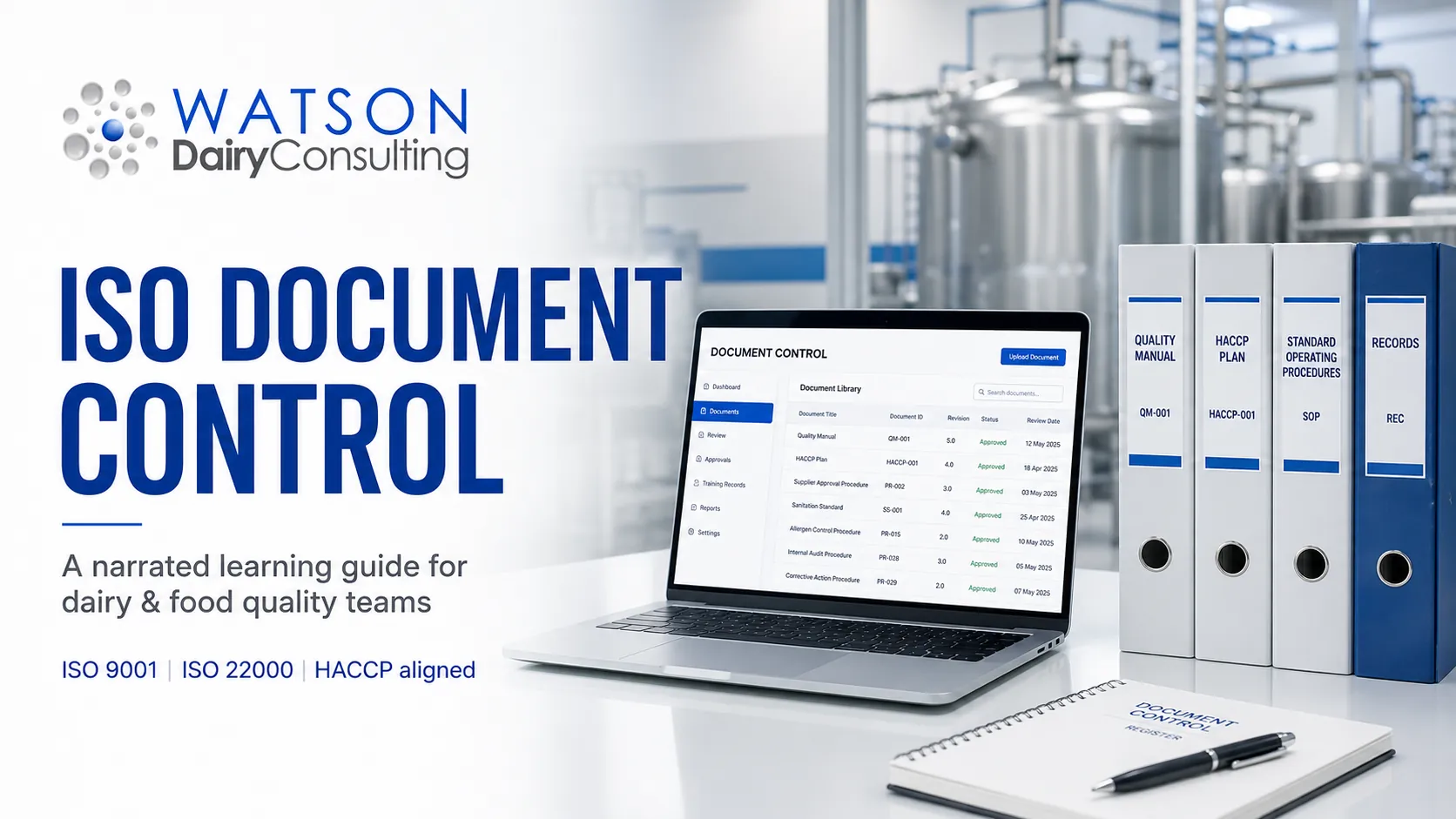
This guide takes you through getting started with an ISO quality system — and, in particular, how to set up and control your documentation, which is the single most important part of the whole exercise. You can read it, or press Listen above to have it read aloud, section by section.
- How to structure an ISO implementation — who does what.
- The three-tier documentation hierarchy and why documentation is the heart of ISO.
- What must be controlled, and how to control it.
- How to write documents people actually follow — and how much is "just right".
- How to design a document-coding system that identifies any document at a glance.
Implementation structure
A quality system is built by people, not by paperwork. Before you write a single procedure, put the right structure in place:
- Steering committee — senior ownership, with the authority to make decisions stick.
- Project team and team leaders — to carry the day-to-day work, area by area.
- Subject-matter experts — the operators and engineers who actually know how the plant runs. Don't write procedures without them.
- Allocated areas — divide the plant into manageable zones (intake, processing, packing, CIP, lab).
Communication skills are essential throughout — the system succeeds or fails on how well people talk to each other.
What ISO is — and isn't
ISO gives you a disciplined framework for quality, but it does not, by itself, deliver everything. Some issues belong to wider Total Quality Management (TQM):
- Leadership
- Team building
- Communication
- Customer service
- Strategic planning
ISO won't hand you those — it gives you the structure on which they sit. So identify and prioritise the training your managers and supervisors will need to carry them.
What is required: the documentation pyramid
Picture your documentation as a pyramid, three tiers deep — general at the top, specific at the bottom:
Documentation strategy — the heart of ISO
Documentation of the output verifies the validity of the process it came from. If you can't show how something was made, you can't prove it was made correctly.
Quality documentation, defined
If a record, drawing, specification or instruction influences whether you accept, hold or release product — it's quality documentation, and it must be controlled.
Why control documents?
The ISO 9001 quality management standard (clause 7.5) is specific. Document control ensures that:
- all documents relating to the product — its design, manufacture and maintenance — are captured, controlled and properly distributed;
- personnel always have access to the latest version, and that version reflects the true state of affairs;
- any change is promptly documented, then registered, approved, distributed and implemented;
- obsolete documents are promptly removed, or clearly marked obsolete, so nobody picks one up by mistake.
What must be controlled?
Controlled documents include: drawings; specifications; operational procedures; inspection, testing and other work instructions; the Quality Manual and its procedures; inspection and test reports and data; and the visual aids on the plant floor. If a decision rests on it, it's on this list.
Outline of the system & terminology
Terminology — words matter here:
- Procedure — describes the process.
- Work instruction — tells you how to perform the process.
- Attachment — information attached to a procedure for clarification.
Determine what to control: procedures, work instructions, forms, attachments, external documentation, prints and drawings.
Document control methods
Decentralised
- each function looks after its own documents;
- common in product-oriented systems;
- tends to produce a multitude of control schemes and inconsistent formats.
Centralised
- a functional area retains control over content;
- the common strategy of process-oriented systems;
- one scheme across the organisation — common format, style and look.
Setting up & writing effective documents
Keep the system as simple and manageable as possible — that simplicity is critical to success.
Build effective documents
- Clear, concise, user-friendly.
- Short sentences starting with a command verb.
- Present tense; make it clear who performs the task.
- Format for reading — headings and white space.
Have the right amount
Avoid too much (no overlap; don't put one process in more than one instruction) and avoid too little (the goal is consistency).
Where to keep your documents
Plan the infrastructure before you commit: use the ISO standards and specifications, prepare a blueprint, then choose your system — a word-processing setup, an existing database, packaged document-control software, or (today) a cloud-based electronic document management system with version control and audit trails.
What's best for your company? Consider company size, computer setup and availability, the number of processes, and the rate of change. You may need more than one system — e.g. one for quality-system documents and a separate one for engineering documents.
What goes into a document code?
A good code tells you everything at a glance. Reading across the row: which manual, which area, the document type, the sequence number, the revision, and any references.
| Orig. | Manual | Manual | Area | Area | Type | SOP No. | Rev | References | ||
|---|---|---|---|---|---|---|---|---|---|---|
| W | T | P | 0 | 5 | F | 0 | 1 | 9 | A | Gea0001377 |
Originator (W = Watson Dairy Consulting) · manual · plant area · document type · SOP / sequence number · revision · reference code.
The document code, decoded
Now the same idea as a worked example — each character carries meaning:
Reads, in plain English: a Watson Dairy Consulting document, Technology & Production Manual, Evaporator area, form 019, revision A — with its reference document alongside. One string, and you know exactly what you're holding.
Knowledge check
Five quick questions — click an answer to check yourself.
Where Watson Dairy Consulting can help
That's the essence of getting started with ISO — and of building documentation you can stand behind. For assistance with ISO 22000 (the Food Safety Quality Management System standard), with Total Quality Management, or with infant formula and milk powder manufacturing, Watson Dairy Consulting is here to help.
Frequently asked questions
Once your document codes are structured, the harder decisions are governance ones — who owns the system, centralised or decentralised control, and how much documentation is actually needed. See our companion page on document control governance & methodology.
Further reading: John Watson publishes articles on dairy industry topics on LinkedIn — from infant formula safety and milk supply to plant design, yield improvement and dairy commodity outlook. Browse all articles by John Watson on LinkedIn →