
Dairy Raw Material Risk Categorisation
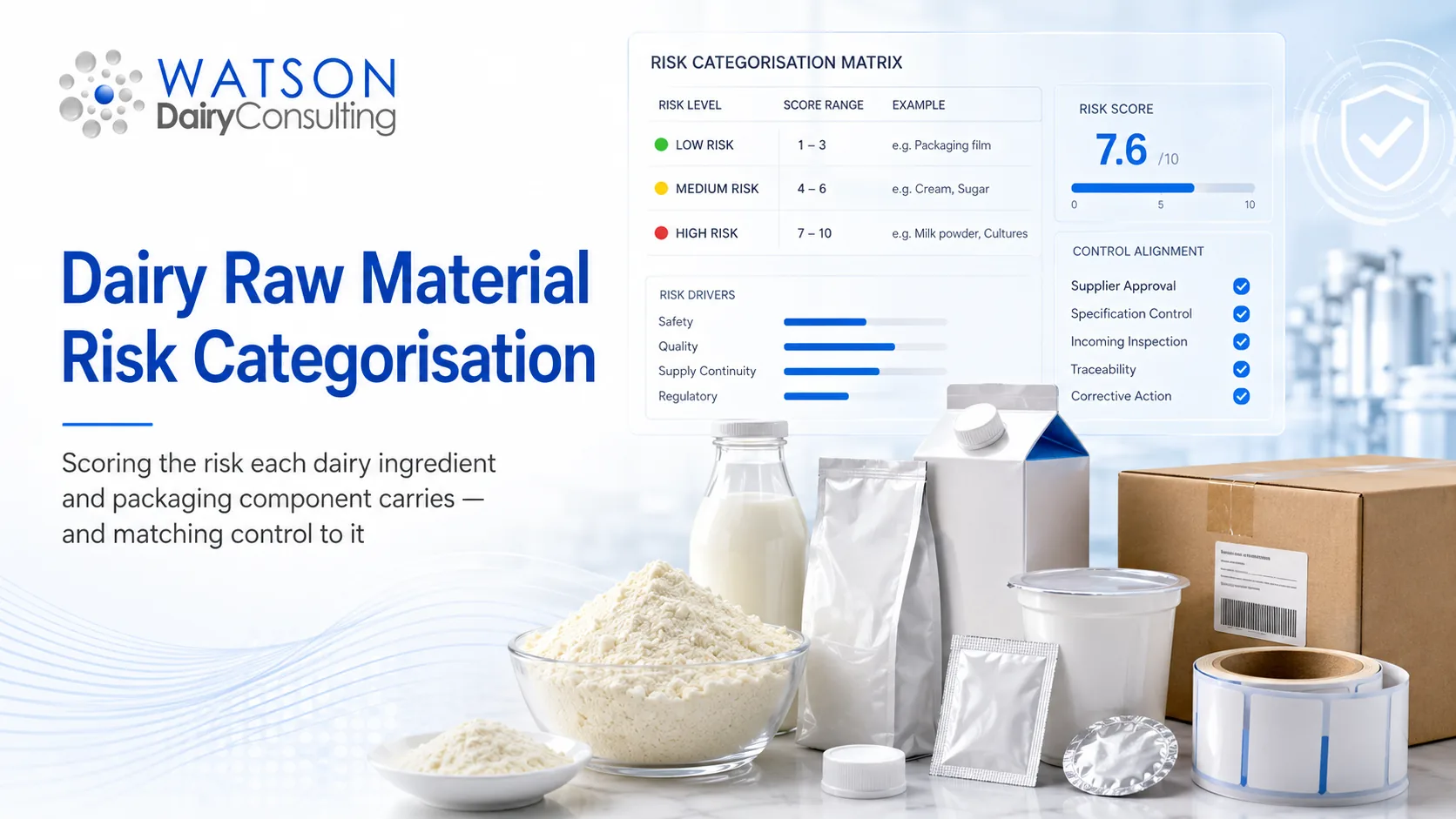
Raw material risk categorisation is how a dairy processor decides how much control each incoming material needs. Each raw material, ingredient and packaging component is scored against the risk it carries, and the level of scrutiny — specification, supplier approval, testing and traceability — is made proportionate to that score.
This guide sets out the method, with references: the factors that drive risk, the hazards to screen for, a three-tier model with a worked example, and the controls that scale with each category. Written for dairy technical and quality managers building or defending a supplier-approval and raw-material risk system.
What Raw Material Risk Categorisation Is
Most safety and quality failures in a dairy plant are inherited, not created — they arrive with an ingredient, a packaging component or a service. Categorisation is the front gate: it assures the safety, quality, legality and authenticity of every incoming material by making the level of scrutiny proportionate to the risk that material carries. A powdered ingredient going straight into a finished infant product does not warrant the same control as an outer carton that never touches the food.
The Four Factors That Set the Category
1. Probability
How likely is the relevant hazard to be present in this material, given its origin and supply route?
2. Severity
How serious is the harm if that hazard reaches the consumer?
3. Volume & Usage
How much is used, and across how many recipes? Wide exposure raises the stakes.
4. Process Influence
Will a later step (pasteurisation, drying) reduce the hazard, or does the material enter after the last kill step?
That last factor is decisive in dairy. A hazard the process will destroy is very different from one that survives to the pack — or one, such as a chemical residue or a heat-stable toxin, that no thermal step will remove.
The Legal and Standards Framework
Categorisation is not optional good practice; it sits on statutory obligations and recognised standards. In Great Britain the main reference points are:
- General food law (assimilated Regulation (EC) 178/2002) — places primary responsibility for food safety on the food business operator and requires food to be safe and traceable at all stages, including Article 18 “one step back, one step forward” traceability.[1]
- Food hygiene (assimilated Regulations (EC) 852/2004 and 853/2004) — require HACCP-based procedures and add specific hygiene rules for milk and other food of animal origin, including at the milking stage.[2]
- Codex General Principles of Food Hygiene (CXC 1-1969) — the international baseline for Good Hygiene Practices and the seven HACCP principles; revised 2020, with a CCP decision tree added in the 2022/2023 edition.[3]
- BRCGS Food Safety Issue 9 — where a customer requires certification, clause 3.5 requires a documented, risk-based supplier approval programme and a documented risk assessment for each raw material or group, explicitly including allergen and authenticity (food fraud) considerations.[4]
The message common to all of these: approval alone is not enough — you must show a documented, risk-based rationale for how each material is categorised and controlled.
Which Hazards Must Dairy Raw Materials Be Screened For?
- Microbiology — pathogens and spoilage organisms in raw milk, wet ingredients and anything entering after the kill step.
- Veterinary drug residues — antibiotics and other inhibitory substances in raw milk; a single failing intake can condemn a whole silo and disrupt starter cultures.
- Pesticides — typically via animal feed or plant-derived ingredients.
- Mycotoxins — notably aflatoxin M1, which carries over into milk when cattle consume contaminated feed; it is heat-stable and subject to statutory maximum levels.
- Heavy metals — lead, cadmium, arsenic and others, chiefly a concern for feed, water and certain minor ingredients.
- Nitrate / nitrites — relevant to water and some ingredients and additives.
- Allergens & authenticity — undeclared allergen cross-contact and food fraud / economically motivated adulteration (historically, melamine adulteration of dairy is the textbook case).
- Other contaminants & GMO status — processing contaminants, foreign material, packaging migration, and GMO declarations on feed- or plant-derived materials.
A Three-Tier Risk Model
A scoring system turns the four factors into a defensible category. Score each factor, combine, and place the material in one of three tiers — because the category, not the score, dictates the control regime.
| Category | Description | Typical dairy examples | Control level |
|---|---|---|---|
| 1 — High | High safety / quality risk. Animal-origin material not yet heat-treated, or components in direct product contact after arrival. | Raw milk; wet ingredients added after pasteurisation; primary packaging in direct contact (caps, liners, pouches, cans). | Full approval, agreed specification, certificate of analysis or intake testing, supplier audit where risk warrants, active monitoring. |
| 2 — Medium | Moderate risk; hazard partly mitigated by process, lower usage, or a more robust supply base. | Heat-treated or dried ingredients used before a further step; processing aids; secondary packaging with indirect contact. | Approval and specification, periodic verification / CoA review, reduced-frequency monitoring, review on change. |
| 3 — Low | Low risk; no product contact and negligible hazard contribution. | Outer cartons, shrink wrap, pallets, non-contact consumables. | Basic approval and specification; light-touch monitoring; escalate only if the material or its use changes. |
This three-tier structure develops the categorisation principle in Watson Dairy Consulting supply chain control procedures, where Category 1 covers the highest-risk raw and packaging materials.
Worked Example: Scoring Three Dairy Inputs
Score each factor 1 (low) to 3 (high) and sum them. A weighted scheme can be used where severity should dominate. The output is a directional category, not a predicted failure rate.
| Material | Prob. | Sev. | Vol./use | Process* | Score | Category |
|---|---|---|---|---|---|---|
| Raw milk (bulk intake) | 3 | 3 | 3 | 3 | 12 | 1 — High |
| Dried ingredient added pre-pasteurisation | 2 | 2 | 2 | 1 | 7 | 2 — Medium |
| Outer shipping carton | 1 | 1 | 1 | 1 | 4 | 3 — Low |
*Process influence scores high (3) where no downstream step reduces the hazard — e.g. a chemical residue in raw milk that thermal processing will not remove, or a component entering after the last kill step; low (1) where a robust step follows. Raw milk scores at the top on every factor and sits firmly in Category 1; the dried ingredient, buffered by a later kill step and lower usage, falls to Category 2; the carton, with no product contact, is Category 3. Each then attracts the control level from the table above.
Controls That Scale With the Category
- Documented specification agreed with the supplier, covering the parameters that matter for that material.
- Risk-based supplier approval — questionnaire, certification review and audit where risk justifies, before first use.
- Incoming verification — certificate of analysis, intake testing (e.g. rapid inhibitory-substance screening on raw milk) or positive release for the highest-risk materials.
- Traceability — one step back, one step forward, with lot-level records that support a fast, accurate withdrawal.
- Food fraud / authenticity (VACCP) assessment — targeted at materials with a known adulteration history or opaque supply routes.
- Ongoing performance monitoring — complaints, non-conformance trends and periodic re-approval, with review triggered by any change of material, supplier or threat.
Packaging and Food-Contact Materials
Packaging is easy to under-rate. Primary packaging in direct product contact — caps, liners, pouches, cans — is Category 1, because after arrival it may receive only minimal treatment (for example UV or an air blast) before it meets the food. The relevant hazards are chemical migration, physical contamination and microbiological risk on contact surfaces. Secondary and tertiary packaging that never touches the product carries far lower risk and belongs in the lower tiers.
Watson Dairy Consulting builds and reviews these for dairy processors. Discuss your requirement →
Dairy-Specific Pitfalls to Design Out
A single failing tanker of raw milk can contaminate a whole silo and knock out starter activity, and aflatoxin M1 and chemical residues are not removed by pasteurisation or drying. Control for these has to sit upstream — at feed and farm level, and at intake screening — not at a later process step.
- Inhibitory substances in raw milk — intake screening is a Category 1 control, not an optional check.
- Food fraud — dairy has a documented history of economically motivated adulteration; authenticity vulnerability belongs in the risk assessment, not just microbiology and chemistry.
- Allergen cross-contact via ingredients — undeclared allergen carry-over from a supplier is now an explicit part of raw-material risk assessment under current standards.
- Change without re-assessment — a new supplier, a reformulated ingredient or a changed use can move a material between categories; the assessment must be reviewed at least annually and on any change.
Frequently Asked Questions
What is raw material risk categorisation in dairy?
It is how a dairy processor decides how much control each incoming material needs. Each raw material and packaging component is scored against the risk it carries, and the level of control — specification, supplier approval, testing, traceability and monitoring — is made proportionate to that score.
How are dairy raw materials risk-categorised?
By weighing four factors — probability of the hazard, severity of harm, volume and breadth of usage, and whether the process will reduce the hazard — against the hazard types credibly associated with the material. A scoring system converts these into a category (commonly high, medium and low), and the category sets the control regime.
Why is raw milk treated as a high-risk material?
Raw milk is animal-origin material that has not yet been heat-treated. Credible hazards include microbial pathogens, veterinary drug residues, and heat-stable toxins such as aflatoxin M1. It is used across almost every product, and several of its hazards survive processing, so it scores at the top on every factor.
What is the difference between supply chain control and supply chain evaluation?
Control is the ongoing internal system that keeps each material at the right level of scrutiny. Evaluation is a periodic, independent review of that system and the wider supply base, including supplier audits, financial health and logistics. Control is what you run day to day; evaluation checks it is working and where the risk sits. See our dairy supply chain evaluation page.
What laws and standards govern dairy raw material control in the UK?
In Great Britain the core obligations sit in assimilated general food law (Regulation (EC) 178/2002, including Article 18 traceability), food hygiene rules (852/2004 and, for products of animal origin, 853/2004) and the HACCP principles of Codex CXC 1-1969. Where customers require certification, standards such as BRCGS Food Safety Issue 9 add a documented, risk-based supplier and raw-material approval requirement.
References
- Food Standards Agency. General Food Law (assimilated Regulation (EC) No 178/2002; food business operator responsibility and Article 18 traceability). food.gov.uk/business-guidance/general-food-law
- Assimilated Regulation (EC) No 852/2004 (hygiene of foodstuffs) and Regulation (EC) No 853/2004 (specific hygiene rules for food of animal origin). legislation.gov.uk/eur/2004/853
- FAO/WHO Codex Alimentarius. General Principles of Food Hygiene CXC 1-1969 (rev. 2020; 2022/2023 edition adds the CCP decision tree). openknowledge.fao.org
- BRCGS. Global Standard Food Safety, Issue 9 (2022) — clause 2 (HACCP), clause 3.5 (supplier & raw-material approval, incl. 3.5.1.1 documented risk assessment), clause 3.9 (traceability). brcgs.com
John Watson
Office: +44 1224 861 507
Mobile: +44 7931 776 499
jw@dairyconsultant.co.uk
We are a longstanding member of the Society of Dairy Technology
and have Fellowship of the Institute of Food Science and Technology.



Contact Details
John Watson
Office: +44 1224 861 507
Mobile: +44 7931 776 499
jw@dairyconsultant.co.uk
What Our Clients Say
We are a longstanding member of the Society of Dairy Technology
and have Fellowship of the Institute of Food Science and Technology.
Locations

Services
Enquiry Form

