
Ice Cream Production & Factory Design
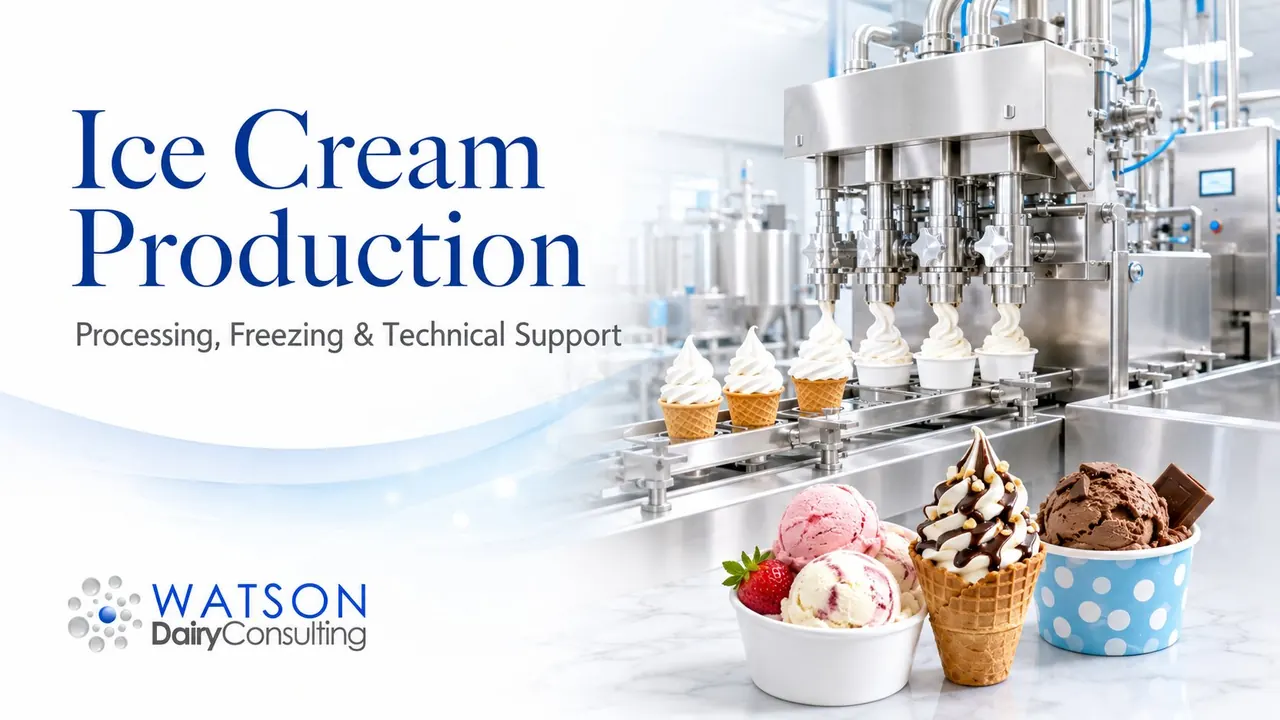
Independent ice cream production and factory design support — from recipe formulation, processing and freezing through to factory design, capacity planning and operator training, for new and established ice cream manufacturers worldwide.
Watson Dairy Consulting brings 50 years of dairy and frozen dessert manufacturing experience to ice cream projects, with practical focus on yield, texture, melt resistance and food safety.
Ice Cream — Where Profitability Lives
Ice cream is one of the most operationally complex categories in dairy. Composition rules, fat behaviour, sugar chemistry, air incorporation, ice crystal nucleation, distribution temperature control and pack format all interact to determine whether a finished product hits its specification and its margin target. Getting it right is rewarding; getting it wrong is expensive and visible to consumers within seconds of opening the pack.
The biggest profit lever in ice cream is overrun — the percentage of air incorporated during freezing. A 5% drop in overrun on a high-volume product can erase months of cost reduction work elsewhere. Recipe, ageing, homogenisation and freezer setup all influence overrun stability, and they have to be controlled as a system rather than as independent variables.
What We Cover
Recipe & Formulation
Mix design across positioning tiers - standard, premium, super-premium - with composition targets, stabiliser and emulsifier selection, fat source and protein system optimised for product specification and cost.
Processing
Pasteurisation, homogenisation, ageing, freezing and hardening - process flow, equipment selection, capacity planning and operating conditions for each unit operation.
Overrun & Texture Control
Continuous freezer setup, dasher speed, air injection control, draw temperature and how each interacts with recipe to deliver target overrun, texture and melt resistance consistently.
Factory Design
Greenfield and brownfield projects - layout, hygienic zoning, mix room, freezer hall, hardening tunnel, cold store and dispatch, sized for current volume and realistic expansion.
Food Safety & Quality
HACCP, pasteurisation validation, allergen management, microbiological standards and environmental monitoring - particularly important given ice cream's history as a food safety category.
Troubleshooting
Coarse texture, low overrun, melt resistance failure, fat destabilisation problems, heat shock issues, cold chain problems - structured root cause investigation and validated fix.
The Ice Cream Manufacturing Process
1. Mix preparation
Liquid ingredients (milk, cream, water, liquid sugars) are combined with dry ingredients (skim milk powder, sucrose, stabilisers, emulsifiers) in a mix tank with high-shear mixing. Mixing temperature is typically 40 to 60 degrees C to assist dissolution. Order of addition matters — stabilisers and emulsifiers need to disperse fully without lumping.
2. Pasteurisation
Continuous pasteurisation in a plate or tubular heat exchanger is standard for any meaningful volume. Heat treatment is more severe than for liquid milk because the mix has higher solids, higher viscosity and a higher microbial load on entry. Typical commercial conditions are 80 to 85 degrees C for 15 to 25 seconds, with regional regulations specifying the legal minimum. Heat treatment also serves to denature whey proteins for improved water binding and texture.
3. Homogenisation
Two-stage homogenisation is standard, typically 150 to 200 bar first stage and 30 to 50 bar second stage. The purpose is to reduce fat globule size to under 1 micron, increasing fat surface area dramatically and giving the protein and emulsifier system the surface they need to organise. Inadequate homogenisation gives coarse mouthfeel, fat separation in the freezer and poor melt resistance.
4. Cooling and ageing
After homogenisation the mix is cooled rapidly to 2 to 5 degrees C and held for 4 to 24 hours. During ageing the fat partially crystallises, proteins fully hydrate and stabilisers do their work. Ageing is not optional in conventional ice cream — mix that bypasses ageing produces lower overrun, coarser texture and inferior melt resistance.
5. Freezing
Continuous freezers (scraped-surface heat exchangers) freeze the mix from about 4 degrees C to a draw temperature of around minus 5 to minus 6 degrees C, while simultaneously incorporating air. The dasher (the rotating mixing element) scrapes nucleated ice from the heat-exchange surface and disperses air. Approximately half of the water in the mix freezes during this stage; the rest freezes during hardening. Overrun is set during this stage and is the largest single operational variable.
6. Filling and hardening
The semi-frozen ice cream is filled into the chosen pack format — tubs, cups, cones, sticks, bars or bulk — and immediately moved to the hardening tunnel where blast freezing takes the core temperature down to minus 25 degrees C or below as quickly as possible. Rapid hardening keeps ice crystals small and locks in the texture established during continuous freezing.
7. Cold storage and distribution
Cold storage at minus 25 degrees C or below until dispatch. Distribution and retail freezer cabinet temperature integrity is critical — any partial melt-and-refreeze cycle (heat shock) destroys ice crystal structure permanently. Quality failures often trace to cold chain failure rather than to manufacturing.
Ice cream quality problems typically stem from one or more of: recipe imbalance, ageing protocol, homogenisation pressure, freezer setup, or cold chain heat shock. We diagnose root cause and identify the right fix. Schedule a call with Watson Dairy Consulting →
Recipe and Composition
Ice cream composition has to satisfy three constraints simultaneously: regulatory minimums, the technical requirements for stable structure, and the commercial requirements for cost and consumer acceptance.
Regulatory composition
In the UK and EU, dairy ice cream must contain at least 5% milk fat and a minimum level of milk solids non-fat. Frozen dessert categories that use non-dairy fat have separate composition and labelling rules. The US, Canada, Australia and most other major markets have their own composition standards. Composition limits and labelling rules vary substantially by jurisdiction and change periodically — check the current local regulation before formulating for any specific market.
Technical composition
Beyond regulatory minimums, the recipe has to deliver stable structure. Typical commercial composition ranges:
- Fat: 6 to 18% depending on positioning — standard around 8 to 10%, premium 12 to 14%, super-premium 16% or more
- Milk solids non-fat: 8 to 12% — provides protein for emulsion, lactose for body, minerals for texture
- Sugar (sucrose plus corn syrup solids or other sugars): 14 to 17% — sweetness, freezing point depression, body
- Stabilisers: 0.2 to 0.5% — locust bean gum, guar, carrageenan, cellulose derivatives, in combination
- Emulsifiers: 0.1 to 0.3% — mono- and diglycerides, polysorbate 80 (where permitted)
- Total solids: 36 to 42% typical
Stabiliser and emulsifier selection
Stabilisers control water mobility, slow ice crystal growth during storage and improve melt resistance. Emulsifiers control fat behaviour during freezing — specifically the controlled destabilisation of fat globules that creates the air cell network and gives ice cream its body. Selection and dosing is product-specific; off-the-shelf blends are a starting point, not a finished answer.
Overrun — The Profitability Lever
Overrun is the percentage increase in volume of the finished ice cream compared with the unfrozen mix. A litre of mix at 100% overrun becomes 2 litres of ice cream; at 50% overrun it becomes 1.5 litres. Overrun directly determines cost per litre, pack density and consumer perception of richness.
Typical overrun ranges by positioning:
- Standard supermarket ice cream: 90 to 110%
- Premium: 60 to 80%
- Super-premium: 20 to 50% — denser, richer eating quality, higher cost per litre
- Soft-serve and impulse formats: 30 to 60%, often dictated by freezer characteristics rather than recipe choice
Overrun stability is what separates well-run plants from poorly-run plants. The same recipe and the same equipment can give swings of 10 to 15 percentage points if the freezer setup, mix temperature, air pressure or operator practice drift. Bringing overrun variation under control is one of the highest-leverage interventions in ice cream manufacturing.
Common Quality Problems and Their Causes
Coarse ice crystals
Insufficient or wrong stabiliser blend, freezer running too warm, slow hardening, or temperature abuse in cold chain (heat shock). Sometimes a recipe issue, often a freezer or distribution issue.
Low or unstable overrun
Mix temperature too high entering freezer, dasher speed wrong, air pressure unstable, freezer worn or fouled, or recipe lacking the proteins/emulsifiers needed for stable air cell structure.
Poor melt resistance
Inadequate fat destabilisation - wrong emulsifier system or dosing, insufficient ageing, homogenisation pressure too low, or freezer draw temperature too warm.
Gritty or sandy texture
Lactose crystallisation - usually too much MSNF in the recipe combined with slow hardening or storage temperature too warm.
Fat separation in the freezer
Homogenisation problem, recipe imbalance, or emulsifier dosing wrong - the fat is not properly stabilised before entering the freezer.
Shrinkage in the pack
Loss of air after filling - typically caused by overrun too high for the recipe to support, or by temperature cycling that lets air cells coalesce.
How We Engage
1. Brief & Scope
Discussion to understand the project - new factory, capacity expansion, recipe development, quality troubleshooting or a combination - and the specific decisions our input is supporting.
2. Plant Visit / Recipe Review
For existing plants: walk the process, review logs, observe operations. For new projects: review concept design, equipment specifications and capex estimates. For recipes: lab review and bench-scale evaluation where useful.
3. Analysis & Report
Findings, prioritised recommendations, quantified savings or capex realism, with explicit identification of what is conservative and what is stretching.
4. Implementation Support
Optional - on-site implementation support for recipe trials, freezer setup, operator training and validation of changes against measurable KPIs.
Frequently Asked Questions
What is overrun in ice cream and why does it matter?
Overrun is the percentage increase in volume of the finished ice cream compared with the unfrozen mix, caused by air incorporation during freezing. It is the single largest driver of ice cream yield economics. Standard ice cream typically runs at 90 to 110% overrun, premium at 60 to 80%, super-premium at 20 to 50%. A 5% drop in overrun on a high-volume product is a serious yield loss; getting overrun consistent is a primary operational target.
What is the minimum fat content for dairy ice cream?
In the UK and EU, ice cream must contain at least 5% milk fat to be labelled as dairy ice cream, plus a minimum level of milk solids non-fat (typically around 7.5%). Frozen dessert categories that use non-dairy fats have separate composition and labelling rules. Exact composition limits vary by jurisdiction; check the current regulation in each market before formulating.
Why does the mix need ageing before freezing?
Ageing — typically 4 to 24 hours at 2 to 5 degrees C between pasteurisation and freezing — allows the fat to partially crystallise, the proteins to hydrate fully, and emulsifiers and stabilisers to do their work. The result is better whipping, smoother texture, slower melt-down and more stable structure. Skipping ageing produces coarser ice crystals, lower overrun and inferior mouthfeel.
What causes coarse ice crystals in ice cream?
Coarse ice crystals come from one of three causes: insufficient stabiliser or wrong stabiliser blend, freezer running too warm or too slowly so crystals grow large, or temperature abuse in the cold chain that allows partial melting and re-freezing (heat shock). Diagnosis requires reviewing the recipe, freezer draw temperature and operational logs, and the cold chain from factory to consumer.
How do I improve melt-down resistance?
Melt-down resistance is driven by fat destabilisation (controlled partial coalescence during freezing), the air cell structure, the protein and stabiliser content, and the freezing rate. Adjusting the emulsifier system (mono- and diglycerides at appropriate levels), ageing time and temperature, freezer draw temperature, and homogenisation pressure typically gives substantial improvements without changing the headline composition.
What is the difference between continuous and batch freezers?
Continuous freezers (the industry standard for any meaningful volume) use scraped-surface heat exchangers and inject air continuously during freezing, producing consistent overrun and texture. Batch freezers are smaller, cheaper and suited to artisanal or premium production, where each batch is processed individually with greater recipe flexibility but less throughput. Choice depends on volume, product positioning and capex budget.
Further reading: John Watson publishes articles on dairy industry topics on LinkedIn — from infant formula safety and milk supply to plant design, yield improvement and dairy commodity outlook. Browse all articles by John Watson on LinkedIn →
See our related frozen yogurt, yoghurt production, membrane filtration, cost reduction reviews and dairy factory design pages, or browse all consultancy services.
Disclaimer: the information on this page is provided as general technical guidance. Composition limits, food safety regulations and pasteurisation standards vary by product, process, site and country, and are subject to change. They should always be confirmed against current local regulations and validated for your specific operation. Watson Dairy Consulting can provide project-specific advice.
John Watson
Office: +44 1224 861 507
Mobile: +44 7931 776 499
jw@dairyconsultant.co.uk
We are a longstanding member of the Society of Dairy Technology
and have Fellowship of the Institute of Food Science and Technology.



Contact Details
John Watson
Office: +44 1224 861 507
Mobile: +44 7931 776 499
jw@dairyconsultant.co.uk
What Our Clients Say
We are a longstanding member of the Society of Dairy Technology
and have Fellowship of the Institute of Food Science and Technology.
Locations

Services
Enquiry Form

