
Processed Cheese Manufacturing
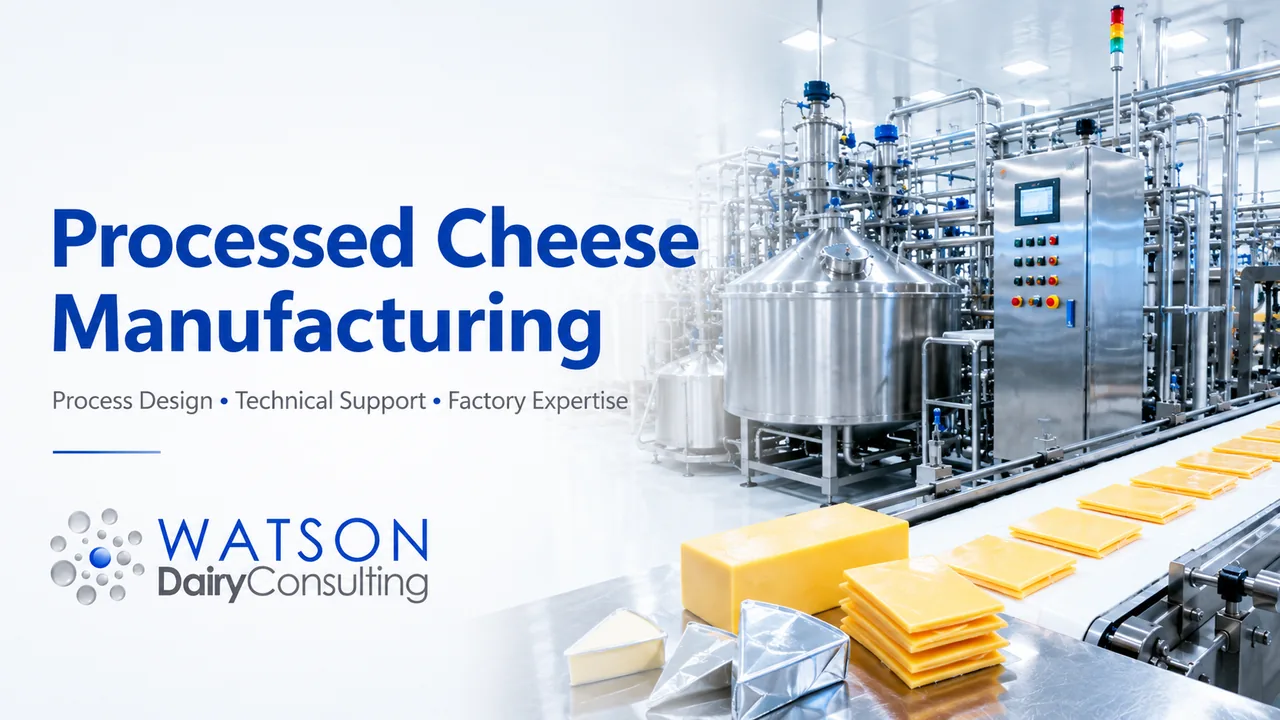
Processed cheese is made by blending one or more natural cheeses with emulsifying salts, water and other dairy ingredients, then cooking the mix under heat and shear into a smooth, stable, homogeneous melt that is hot-filled and cooled. The result keeps for months, melts evenly and slices cleanly — and it puts trim, young cheese and varying cheese grades to good use rather than waste.
The key to the whole product is the emulsifying salts. This page covers what they do, how the cook works, the main formats (block, slice, spread and sauce), and how enzyme-modified cheese (EMC) — a concentrated flavour ingredient, not a finished cheese — fits in. Figures are referenced to the sources at the foot of the page.
Watson Dairy Consulting has direct, practical recipe-development experience in spreadable processed cheese — including Philadelphia-style soft white spreads and foil-wrapped portion triangles — across a range of flavour variants. Talk to us about a spread or triangle project.
What is processed cheese?
Processed cheese is a melted and emulsified cheese product — the Codex General Standard for Food Additives describes it as a product with a very long shelf life obtained by melting and emulsifying cheese, made by heating and emulsifying mixtures of cheese, milkfat, milk protein, milk powder and water in varying amounts. It is not simply natural cheese that has been cut, grated or shredded; it is a distinct product made by a thermal, chemical and mechanical transformation of natural cheese.
It is made in four broad consistencies:
- Block / slices — firmer, lower-moisture, sliceable; sandwiches, burgers, individually wrapped slices.
- Spread — softer and higher-moisture, often longer-life; tubs, jars and triangle portions.
- Sauce / dip — pourable; nachos, ready meals and food service.
The advantages over natural cheese are practical: long, stable shelf life; uniform and controllable melt; no rind waste; portion control; and the ability to use young cheese and trim in a consistent, repeatable product.
Emulsifying salts — the heart of the process
Natural cheese will not, on its own, melt into a stable emulsion: heated alone it separates, releasing free fat and water (it “oils off”). The fix is a small addition of emulsifying salts, typically around 2–3% of the blend. Despite the name, they do not act as emulsifiers themselves — Codex itself notes this. What they do is sequester the calcium that holds the casein network together, converting insoluble calcium paracaseinate into soluble sodium paracaseinate, raising the pH slightly (typically to about 5.6–6.0) and hydrating the casein. The freed, hydrated casein then becomes the emulsifier — wrapping the free fat into stable droplets and binding the water into a smooth matrix.
The salts used are the sodium salts of phosphates, polyphosphates and citrates, or blends of them:
| Emulsifying salt | EU/GB additive | Effect in the melt |
|---|---|---|
| Trisodium citrate | E331 | Mild; gives a softer body and good flavour; common in spreads |
| Disodium / monosodium orthophosphate | E339 | Buffers pH; moderate calcium binding |
| Tetrasodium diphosphate (pyrophosphate) | E450 | Strong calcium sequestration; promotes “creaming” and firmer body |
| Pentasodium triphosphate | E451 | Strong; high creaming; used for slices and firm blocks |
| Sodium polyphosphates | E452 | Very strong; long-creaming, heat-stable, “no-melt” products |
Adjusting the salt type and blend, the cheese age mix, and the cook is how a maker dials in firmness, melt and stretch. The progressive thickening that occurs during cooking — as the casein hydrates and emulsifies — is called creaming, and controlling it is central to getting the right texture: too little and the product is loose and oily; too much and it is rubbery.
The manufacturing process
Whatever the format, the route is the same in principle: comminute, blend, cook under shear, then hot-fill and cool.
- Select and blend the natural cheese — usually a mix of young and mature cheese (the “young/old ratio”) to control flavour and creaming; trim and grade are used here, cutting waste.
- Comminute and weigh in the formula — grind or shred the cheese and add water, emulsifying salts, and any extra ingredients (butter or anhydrous milk fat, milk or whey powder, colour, salt, flavour).
- Cook under heat and shear — heat the blend to about 80–95°C (and up to roughly 130–145°C for sterilised, long-life spreads) in a jacketed or direct-steam cooker while mixing, holding for a few minutes.
- The emulsion forms — the emulsifying salts sequester calcium and peptise the casein, which emulsifies the free fat and binds the water into a smooth, stable, homogeneous melt (creaming).
- Hot-fill — block and loaf into pouches or cartons; slices via a chill-roll or a hot-melt ribbon that is cooled, slit and wrapped (individually wrapped slices); spread into tubs, jars or portions; sauce into pouches.
- Cool and set — rapid cooling sets the matrix. Shelf life is long because the product is effectively pasteurised or sterilised in-process, has reduced water activity, and is stabilised by the salts.
Plant & equipment
The cheese is first reduced on a grinder or comminuter. Cooking is done either in batch cutter-cookers — jacketed, high-speed cut-and-mix vessels (the Stephan and Blentech type) that combine shear with indirect or direct steam — or in continuous cookers using direct steam injection and scraped-surface or tubular heating for high throughput. Downstream, the format dictates the line: block lines hot-fill into film, cartons or moulds; slice lines run either a chilled casting roll (cold-pack) or a hot-melt ribbon that is cast, cooled, slit and individually wrapped; spread lines hot-fill tubs, jars and portions, often with a sterilising hold for long ambient shelf life; and sauce lines fill pouches or cans.
Processed cheese starts from natural cheese — see cheese making process & equipment. The flavour ingredient EMC is also covered alongside soft cheese & EMC, and recovering value from the whey stream is on the membrane filtration (UF / NF / RO) page.
Product formats
| Format | Typical moisture | Salt emphasis | Use |
|---|---|---|---|
| Block / loaf | ~40–44% | Citrate / phosphate blend | Sliceable; catering, sandwiches |
| Slices (IWS / stack) | ~43–47% | Phosphate / polyphosphate (high creaming) | Burgers, sandwiches; controlled melt |
| Spread | ~48–60% | Higher salt; citrate / polyphosphate | Tubs, jars, portions; often UHT for long life |
| Sauce / dip | High | Citrate / phosphate | Pourable; nachos, ready meals |
| Triangles / portions | ~50–60% | Citrate-led + polyphosphate | Foil-wrapped portions; often UHT; spreadable |
Spreadable processed cheese, triangles & flavours
The spreadable end of the category is its own discipline. Foil-wrapped triangle portions — the format made famous by La Vache Qui Rit (The Laughing Cow, France, 1921) and Dairylea — are spreadable processed cheese, hot-filled while still fluid. The molten cheese is dosed into a rotary portion-wrapping machine that forms and seals the foil around each triangle before the cheese sets; the portions are then cooled and boxed. Tubs, jars and tubes are filled from the same kind of base.
Getting a triangle right is a formulation balance: high creaming so the body holds its shape in the foil without oiling off or weeping, the right moisture and emulsifying-salt blend (often citrate-led, with polyphosphate for stability) for a clean spreadable texture, and frequently a sterilising heat treatment for long ambient shelf life. Note the distinction: true Philadelphia is a cream cheese — a fresh, acid- and cream-set cheese made without emulsifying salts — so a processed “Philadelphia-style” soft white spread emulates that mild, fresh style by the processed route (more citrate, higher fat or added cream, a gentler cook) rather than being the same product.
Flavour development is where the range is built. From a single white base, variants such as original, garlic & herb, ham, emmental, blue and smoked are created by dosing in flavour systems, cheese powders, enzyme-modified cheese for intensity, colour and particulate inclusions. The real challenge is even distribution and flavour stability in a hot, fluid matrix — and holding that flavour and texture across a long shelf life.
Ingredients beyond the cheese
Besides natural cheese and emulsifying salts, a formula commonly includes water (to set moisture and yield), butter or anhydrous milk fat (to set fat), milk, whey or buttermilk powders (protein, solids and economy), colour (annatto or paprika), salt, preservatives (such as sorbate or, in some markets, nisin), acidulants to fine-tune pH, and flavours — including enzyme-modified cheese, below. The cheese-to-non-cheese ratio is what separates a named processed cheese from a processed cheese “food” or “spread” with more added dairy and water.
Enzyme-modified cheese (EMC)
EMC is not a finished cheese — it is a concentrated cheese-flavour ingredient. A cheese or curd substrate is made into a slurry or paste with water and a little emulsifying salt, pasteurised, then incubated with added enzymes: lipases release free fatty acids (sharp, piquant, lipolytic notes) and proteases and peptidases release peptides and amino acids (savoury, brothy, mature notes). After hours to days at controlled temperature, the enzymes are heat-inactivated and the EMC is used as a paste or dried to a powder.
The point of EMC is intensity: it can carry roughly 5 to 30 times the flavour strength of the parent cheese, so a small inclusion delivers strong, consistent cheese flavour at low cost. That is exactly why it sits beside processed cheese — EMC is one of the flavour ingredients blended into processed cheese, as well as into cheese sauces, dips, snacks, seasonings and ready meals. EMC is covered further on the soft cheese & EMC page.
Standards & regulation
Processed cheese sits in an unusual regulatory position. The old Codex commodity standards for process cheese (the A-8 series, later CXS 286/287/288-1978) were revoked in 2010 after the Codex Committee on Milk and Milk Products judged them outdated and no longer used by industry. A replacement General Standard for Processed Cheese has been in development since (led by New Zealand and Uruguay) but has not been adopted, because consensus on issues such as minimum cheese content and the use of starch and gelatine has not been reached. So there is currently no adopted Codex commodity standard for processed cheese.
What does apply: processed cheese is defined and its additives regulated in the Codex General Standard for Food Additives (CXS 192-1995), food category 01.6.4. In Great Britain and the EU, the emulsifying salts are permitted food additives under retained Regulation (EC) No 1333/2008 — sodium phosphates (E339), diphosphates (E450), triphosphates (E451), polyphosphates (E452) and citrates (E331–E333) — used within set limits. Composition is measured by standard methods such as ISO 1735 (fat) and ISO 5534 (total solids) for cheese and processed cheese. Old and current standards alike specify a minimum heat treatment (for example, 70°C for 30 seconds or an equivalent combination) during manufacture.
A note on history
Industrial processed cheese was first made by Walter Gerber and Fritz Stettler in Switzerland in 1911, who used sodium citrate to make a stable, shippable Emmental melt. In the United States, James L. Kraft patented an emulsification process in 1916, which underpinned the mass market for sliced and block processed cheese. The technology has been a fixture of dairy processing ever since, precisely because it turns variable natural cheese into a uniform, long-life, functional product.
Frequently Asked Questions
What is processed cheese?
Processed cheese is a product made by blending one or more natural cheeses with emulsifying salts, water and other dairy ingredients, then cooking the mix under heat and shear into a smooth, stable emulsion that is hot-filled and cooled. It is not natural cheese that has merely been sliced or shredded; it is a distinct melted-and-emulsified product with a long shelf life and a controllable melt.
What are emulsifying salts and what do they do?
They are the sodium salts of phosphates, polyphosphates and citrates, added at around 2 to 3% of the blend. They do not emulsify directly; they sequester the calcium that binds the casein, raise the pH slightly and hydrate the casein, so the casein itself can then emulsify the free fat and bind the water into a smooth, stable matrix. Without them, heated cheese separates and oils off.
Is processed cheese real cheese?
It is made from real cheese, but it is a different product. Natural cheese is the starting material; processing melts and emulsifies it with salts and other ingredients into a new, uniform, long-life product. Depending on how much non-cheese dairy and water is added, it may be labelled processed cheese, processed cheese food or processed cheese spread.
What is the difference between processed cheese and enzyme-modified cheese (EMC)?
Processed cheese is a finished product you eat as cheese. EMC is a concentrated flavour ingredient, not a finished cheese: a cheese substrate is incubated with lipases and proteases to develop intense flavour, then used in small amounts to flavour processed cheese, sauces, snacks and ready meals. One is a product; the other is an ingredient that often goes into it.
Why does processed cheese melt smoothly and keep so long?
The emulsifying salts and the cook create a stable fat-in-protein emulsion that melts evenly and re-sets without separating. The long shelf life comes from the in-process heat treatment (pasteurisation or, for spreads, sterilisation), reduced water activity, and the stabilising effect of the salts.
How are spreadable cheese triangles made?
Cheese triangles are spreadable processed cheese, hot-filled while still molten. The fluid cheese is dosed into a rotary portion-wrapping machine that forms and seals the foil around each triangle before the cheese sets; the portions are then cooled and boxed. The recipe is balanced for high creaming so the cheese holds its shape in the foil without oiling off, and is often given a sterilising heat treatment for long ambient shelf life.
Who invented processed cheese?
Walter Gerber and Fritz Stettler made the first industrial processed cheese in Switzerland in 1911, using sodium citrate. James L. Kraft patented an emulsification process in the United States in 1916, which led to the mass market for sliced and block processed cheese.
References & Further Reading
- Fox, P.F., Guinee, T.P., Cogan, T.M. & McSweeney, P.L.H. (2017). Fundamentals of Cheese Science, 2nd ed. Springer. (Processed cheese chapter.)
- Tamime, A.Y. (ed.) (2011). Processed Cheese and Analogues. Wiley-Blackwell.
- Kapoor, R. & Metzger, L.E. (2008). Process cheese: scientific and technological aspects — a review. Comprehensive Reviews in Food Science and Food Safety, 7, 194–214.
- Caric, M. & Kalab, M. — Processed cheese products, in Fox (ed.), Cheese: Chemistry, Physics and Microbiology.
- Buňka, F. et al. — microstructure and texture of model processed cheese; emulsifying-salt blends and creaming. Journal of Dairy Science.
- Kilcawley, K.N., Wilkinson, M.G. & Fox, P.F. (1998). Enzyme-modified cheese. International Dairy Journal, 8, 1–10.
- Codex Alimentarius — General Standard for Food Additives (CXS 192-1995), food category 01.6.4 Processed cheese; revocation of CXS 286/287/288-1978 (2010).
- Retained Regulation (EC) No 1333/2008 on food additives — permitted emulsifying salts (E339, E331–E333, E450–E452).
Further reading: John Watson publishes articles on dairy industry topics on LinkedIn. Browse all articles by John Watson on LinkedIn →
John Watson
Office: +44 1224 861 507
Mobile: +44 7931 776 499
jw@dairyconsultant.co.uk
We are a longstanding member of the Society of Dairy Technology
and have Fellowship of the Institute of Food Science and Technology.



Contact Details
John Watson
Office: +44 1224 861 507
Mobile: +44 7931 776 499
jw@dairyconsultant.co.uk
What Our Clients Say
We are a longstanding member of the Society of Dairy Technology
and have Fellowship of the Institute of Food Science and Technology.
Locations

Services
Enquiry Form

