
Milk Powder Production
The milk powder production process explained — from raw milk reception and fat standardisation, through heat treatment, evaporation and spray drying, to atomisation, agglomeration and packing.
Watson Dairy Consulting provides independent milk powder process expertise, spray dryer and evaporator training, powder factory design and process optimisation for manufacturers worldwide, including hot-climate and developing markets.
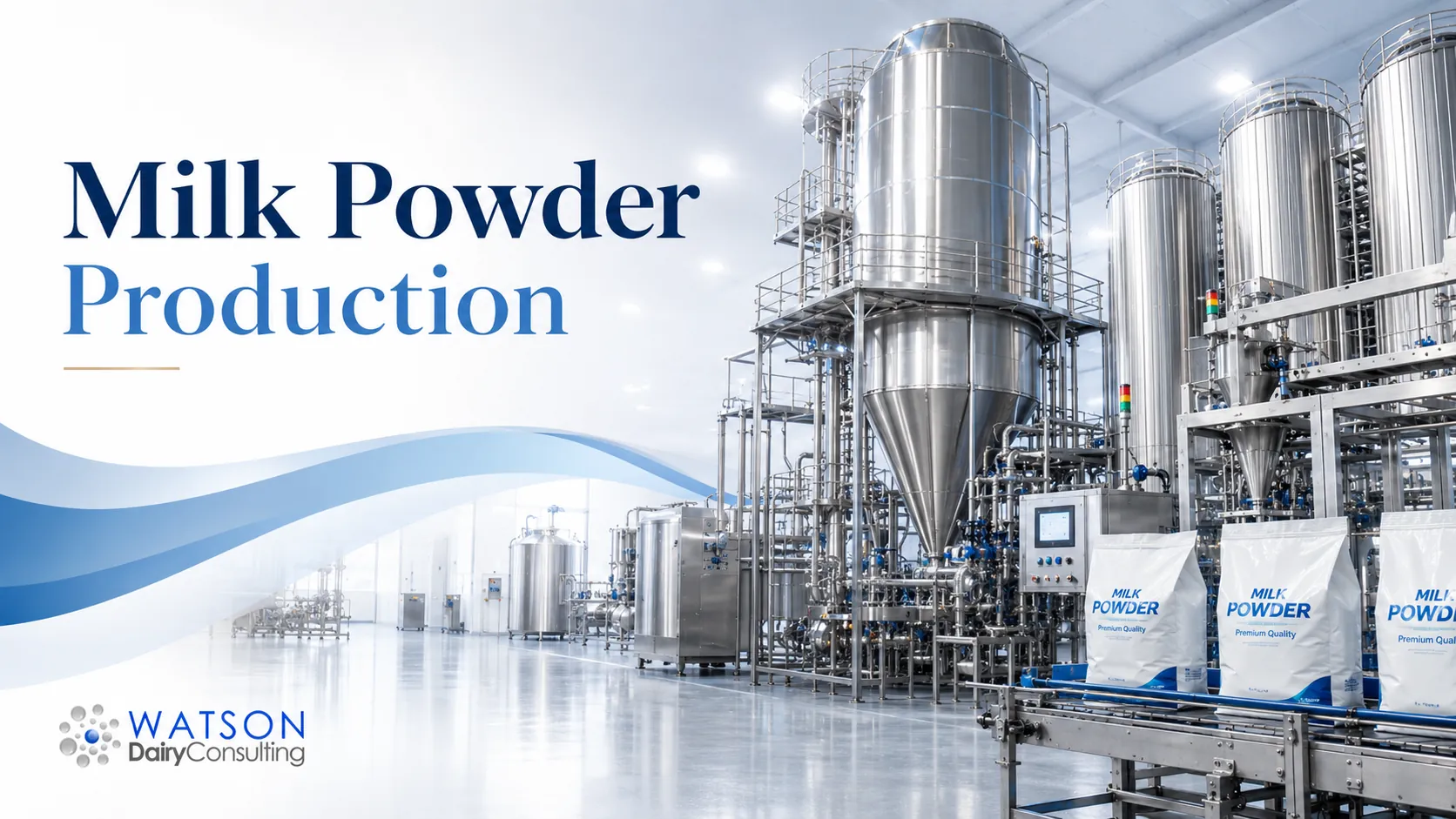
Milk powder production turns liquid milk into a stable, high-value powder through controlled removal of water. The water is taken out in two stages — first by evaporation, then by spray drying — because removing water in the evaporator is far cheaper than in the dryer.
This page describes the full process, the key control parameters at each stage, and how they affect powder quality, solubility, bulk density and yield.
Milk Powder Production Process Overview
The spray drying milk powder production process begins with liquid milk and ends with a free-flowing powder. The same core process, with variations in heat treatment, standardisation and added ingredients, is used to make a wide range of powders:
- Skim milk powder (SMP) and whole milk powder (WMP)
- Fat-filled milk powder and buttermilk powder
- Whey powder, demineralised whey powder and whey protein concentrate (WPC)
- Cream powder and cheese powder
- Infant formula milk powder
Milk Powder Production Process Flow
The typical sequence from intake to finished powder:
Raw Milk Reception and Testing
Raw milk on arrival at the factory is rapid-tested for acidity, smell, temperature, hygiene, antibiotics, water addition and adulteration, and for fat, protein and solids-not-fat (SNF). On acceptance the milk is pumped into a silo storage tank and held below 7°C, usually below 5°C.
Raw whole milk varies in fat and SNF content — typically 3.5–4.5% fat and 8–9% SNF, giving total solids of around 12.5%. In developing countries milk solids are usually lower, so costs and yields must be calculated accurately for any planned high-volume plant. A detailed yield spreadsheet is essential; our dairy yield savings calculator shows the effect of a 0.1% protein or moisture variation on annual milk powder yield and profitability.
Brand risk: adulteration of raw milk is prolific in some countries and a real barrier to globally operating companies establishing facilities, because of the high brand risk involved. Robust intake testing is the first line of defence.
Separation and Fat Standardisation
On arrival the raw milk is usually separated into cream and skimmed milk so the fat content can be standardised before drying. High-volume manufacturers automate this with an inline "standomat" that doses cream back into the skim to give the correct fat percentage in the milk to be processed. Some high-volume plants, particularly in the US, also standardise the SNF content to maximise yields and give consistent quality.
Bacteria Removal — Bactofugation and Microfiltration
The microbial quality of milk powder is very important. At this early stage it is possible to remove around 99.9% of spore-forming bacteria by either bactofugation or microfiltration, prior to heat treatment. This is the ideal next stage, though many processors omit it on cost grounds.
Both processes require the milk to be separated first; the skimmed milk portion then has the bacteria removed, and the cream is high-temperature pasteurised and returned to the milk if required. This is the method used for ESL (Extended Shelf Life) milk. Infant formula manufacturers operating in developing countries should use a bactofuge or microfiltration plant to ensure finished product quality.
Pasteurisation and Heat Treatment
The milk is high-temperature short-time (HTST) pasteurised by heating to at least 72.3°C and holding at or above this temperature for at least 15 seconds, or an equivalent time/temperature combination. Many high-volume liquid milk plants now hold for 25–35 seconds as a precaution against the possible survival of Mycobacterium avium subspecies paratuberculosis (MAP), which has been linked to Crohn's disease in humans. Research published in 2019 indicated an optimum combination for liquid milk of 72.3°C for 26 seconds.
Heat treatment affects the functional properties of skim milk powder and the keeping quality of whole milk powder, so time and temperature combinations vary widely depending on the required finished-powder properties. In skim milk powder, the extent of heat treatment is measured by the whey protein nitrogen index (WPNI), which quantifies the amount of un-denatured whey protein.
Heat Classification
Skim milk powder processing differs from whole milk and buttermilk processing in the heat treatment given to the skim before evaporation. The temperature and holding time together determine the heat classification of the powder:
- Low-heat: milk is low-temperature pasteurised with little or no holding.
- High-heat: milk is heated to 85–88°C and held for 15 to 30 seconds.
There is no requirement to homogenise skim milk for powder production because of its low fat content. High-heat, heat-stable powders can also be produced by varying the evaporation conditions.
Thermophiles: special treatments from certain evaporator manufacturers can substantially reduce thermoduric bacteria that grow in evaporators and cause high thermophile counts in the powder. Counts vary with the time of year and feed — winter silage feed typically increases thermophilic spore counts in raw milk.
Homogenisation
Homogenisation is not mandatory for whole milk or buttermilk, but is usually applied to stop the fat separating out after reconstitution — particularly important in infant formula milk. Two-stage homogenisation is normally used, as single-stage can allow fat globules to coalesce into larger globules more readily; two-stage is preferable to minimise re-coalescing, which matters for infant formula manufacturing.
Fat globules with damaged protective membranes reduce powder solubility and increase the risk of oxidative rancidity. Homogenisation helps convert free fat into fat globules, and the membranes are regenerated by protein adsorption on the globule surfaces. Where required, optional ingredients such as vegetable fats, vitamins and minerals are added to the milk prior to drying, with appropriate heat treatment.
Infant formula milk powder is heat-treated more than most other powders. The aim is to destroy all pathogenic and as many other microorganisms as possible, and to inactivate enzymes — particularly lipase, which can cause fat lipolysis during storage, leading to off-odours — while also reducing the risk of oxidative changes.
Evaporation
The milk is concentrated in a series of calandrias in an evaporator to around 40–60% total solids before spray drying. Most milk evaporators today are of the falling-film type, where a fine film of milk or concentrate passes down the inside of the tubes, wetting the surface, while steam is on the other side and the vapours are extracted from the centre by vacuum. Vapours are normally recompressed in a vapour recompressor, making evaporators very efficient, and the water recovered from evaporators can be reused.
Why evaporate before drying? Removing water in the evaporator is far cheaper than spray drying it. The energy used in multi-pass evaporators with steam vapour recompression is about 10 times less than spray drying for the equivalent water removed.
Tube wall thickness and tube supports are critical to evaporator design. Tube "straightness" is maintained using tube supports; a tube out of alignment or curved causes uneven concentrate flow, burning-on, scorched particles, reduced running times and potentially expensive blocked tubes and significant downtime. See milk evaporator training for detail.
Spray Drying
Spray drying milk powder involves atomising concentrated milk into a hot air stream (180–220°C). The atomiser may be either a pressure nozzle or a centrifugal disc. By controlling droplet size, air temperature and airflow, almost all the moisture is evaporated while exposing the solids to relatively low temperatures. Spray drying yields milk powders with excellent solubility, flavour and colour, and is the most common procedure for manufacturing milk powders.
The process is typically two-stage: the spray dryer at the first stage, with a static fluid bed integrated in the base of the drying chamber, and an external vibrating fluid bed at the second stage. Product is moved through the two stages quickly to prevent overheating. Powder leaving the dryer enters a system of cyclones that simultaneously cool it.
Spray dryers can also have bag filters to reduce environmental emissions, increase yield, and ensure no powder particles are emitted to attract birds and rodents or to act as a medium for microbial growth that could be carried back into the plant. Filtration and conditioning of the inlet air to a consistent moisture and temperature is important for high-volume, high-quality products, improving yield through consistent moisture and giving a consistent bulk density. See milk spray dryer training.
Atomisation — Nozzles and Centrifugal Atomisers
The two principal means of atomisation are centrifugal (disc) and pressure nozzle, each with advantages and disadvantages. Centrifugal atomisers generally produce a finer powder particle than pressure nozzle atomisers.
Concentrate Viscosity
Viscosity is generally maintained below 250 centipoise at the atomiser. The most efficient way to reduce viscosity is to increase the feed temperature, which also increases spray dryer capacity.
Pressure Nozzle
A high-pressure pump feeds liquid to nozzles and the dryer chamber. Nozzles typically produce a powder with high bulk density, a narrow particle size distribution and, for fat-containing powders, a low free-fat content due to the homogenising effect. Bulk density is mostly affected by the density of the concentrate, and a good process control system is essential for a consistent product.
Cone Angle and Swirl Chamber
Optimum mixing between the liquid spray and the hot inlet air is achieved using the widest possible spray angle together with multiple nozzles. Chamber capacity can usually be increased by increasing the number and type of nozzles and by adjusting air flows and temperatures. Feed liquid enters the swirl chamber tangentially — the greater the feed pressure, the faster the rotational speed and the wider the spray angle. Swirl chamber size affects the spray angle, and selection charts are available for nozzles and swirl chambers depending on powder requirements and chamber design.
Orifice Size, Flow Rate and Nozzle Pressure
- Orifice size depends on the liquid flow rate and the desired particle size. For finer particles use a higher nozzle pressure; for larger particles use a bigger orifice to achieve a lower pressure/velocity.
- Concentrate flow rate into the dryer controls the outlet temperature and powder moisture. Reduced feed solids waste energy and reduce throughput while raising bulk density.
- For larger particle size use a lower nozzle pressure; for finer particle size use a higher pressure. For a given orifice, nozzle pressure varies as the square of the flow rate — a higher flow gives a much higher pressure.
Centrifugal Atomiser
For finer particles run the wheel at higher speed; for coarser particles use a lower wheel speed. Wheel speed affects the hydraulic capacity of the atomiser, usually only seen at extremely high liquid rates or very low wheel speeds. A higher wheel speed causes greater pumping action within the wheel. If the hydraulic capacity is exceeded, feed liquid is forced up the atomiser spindle and through the bearings, causing very rapid failure in most cases.
Drying Air Temperatures and Control
- Inlet temperature controls the production rate of the final powder — higher inlet temperature gives higher production.
- Powder ignition temperature is a limiting factor: many powders ignite and burn above their ignition temperature, and in a spray dryer this can cause a fire and possibly an explosion. Fire and explosion safety is a critical design and operating consideration.
- Outlet temperature is controlled by adjusting the feed rate and, in turn, controls powder moisture — based on a consistent inlet temperature, feed solids content and inlet-air humidity.
Agglomeration and Instantising
Instantising produces a spray-dried powder with improved reconstitution properties. It is achieved by agglomeration — increasing the air incorporated between powder particles. During reconstitution that air is replaced by water, allowing a larger amount of water to contact the powder particle immediately. With whole milk and buttermilk powders, a small amount of lecithin (a natural phospholipid, which also occurs in milkfat) is typically applied during agglomeration to improve the ability of high-fat products to dissolve in water.
Fine, non-agglomerated powders (below about 100 micron) tend to form lumps when mixed with water: water penetrates the narrow spaces between particles, the powder forms a thick gel-like mass that resists further penetration, and lumps of dry powder can float and resist dispersion. Agglomerated powder with an open structure has large passages between particles that quickly displace air and let liquid penetrate before an impenetrable gel layer forms, so the powder disperses into the bulk of the liquid.
Particles agglomerate when brought into contact with at least one sticky surface. The most common method is spray humidification, where the particle surface is uniformly wetted by a fine spray mist — also used in the lecithination process. Agglomeration is usually carried out in a vibrating fluidised bed where re-wetting takes place and particles collide and stick while further gradual drying occurs. There must be sufficient agitation to distribute the spray and prevent lump formation, and agglomerate characteristics can be adjusted via fluidising velocity, spray rate and temperatures.
The product level in the fluid bed is held constant by an overflow weir, so the re-wetting section is never emptied of powder; even during a complete interruption of powder flow, fluidised material remains in the re-wet section as a stabilising factor. Agglomeration is very consistent because of this stabilising effect. Water alone can be used as the re-wet medium for most dairy products and maltodextrin-based flavour formulations; for some products a solution of the material itself, or a separate binder that does not compromise final-product integrity, is used.
Roller or Drum Drying
Roller drying involves direct contact of a layer of concentrated milk with the hot surface of rotating rollers or drums. It is not used often because of the adverse effect of heat on milk components — heat causes irreversible changes such as lactose caramelisation, Maillard reaction and protein denaturation. Roller drying typically produces more scorched particles and poorer solubility than spray drying.
Specifications, Tools and Factory Design
Powder specifications — whole milk powder, skim milk powder (medium heat) and whey powder — define the heat class, moisture, fat, solubility and microbiological limits a buyer expects. Getting yield and cost right at the planning stage is critical, especially in lower-solids markets.
Powder specifications: Whole Milk Powder · Skimmed Milk Powder (Medium Heat) · Whey Powder · Buttermilk Powder
- Milk powder production cost — cost estimation for powder producers.
- Milk fat standardisation (Pearson’s square) — set the fat % to give the desired fat in the powder.
- Dairy yield savings calculator — the effect of 0.1% protein or moisture on annual yield and profitability.
- Evaporator steam economy calculator — energy use across evaporator effects.
- Dairy factory design — including milk powder dry blending plant layout options.
- Spray dryer crack testing of chambers and cyclones.
Building, commissioning or troubleshooting a milk powder plant? Watson Dairy Consulting provides independent process expertise across evaporation, spray drying, infant formula and powder factory design — including hot-climate and developing markets. Please contact us to discuss your requirements.
Discuss a Milk Powder ProjectMilk Powder Production FAQs
What is the milk powder production process?
Why is milk evaporated before spray drying?
What is the difference between low-heat and high-heat skim milk powder?
What spray dryer inlet and outlet temperatures are used?
Pressure nozzle or centrifugal atomiser — which is better?
What is agglomeration or instantising?
Why is homogenisation important for infant formula?
Is roller (drum) drying still used for milk powder?
Related pages: Spray Dryer Training · Evaporator Training · Spray Dryer Crack Testing · Spray Dryer Fines · Infant Formula Milk Powder · Dairy Factory Design · Process Optimisation · Factory Benchmarking
Contact Watson Dairy Consulting
For advice on milk powder production, spray drying, evaporation, infant formula or powder factory design, please contact us.
Further reading: John Watson publishes articles on dairy industry topics on LinkedIn — from infant formula safety and milk supply to plant design, yield improvement and dairy commodity outlook. Browse all articles by John Watson on LinkedIn →
John Watson
Office: +44 1224 861 507
Mobile: +44 7931 776 499
jw@dairyconsultant.co.uk
We are a longstanding member of the Society of Dairy Technology
and have Fellowship of the Institute of Food Science and Technology.



Contact Details
John Watson
Office: +44 1224 861 507
Mobile: +44 7931 776 499
jw@dairyconsultant.co.uk
What Our Clients Say
We are a longstanding member of the Society of Dairy Technology
and have Fellowship of the Institute of Food Science and Technology.
Locations

Services
Enquiry Form

