
Milk Pasteuriser Training
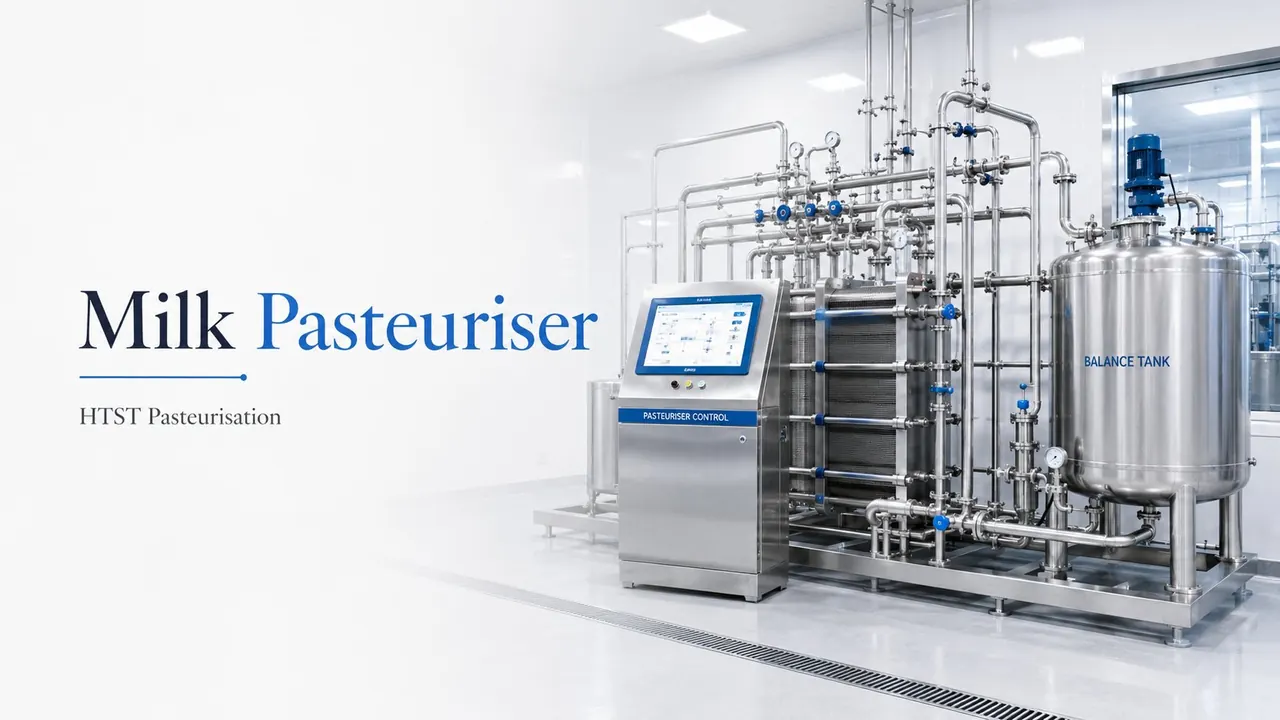
HTST milk pasteuriser operator training covering regenerative heat exchange, holding tube verification, flow diversion, pasteuriser CIP, fouling control and structured troubleshooting.
Watson Dairy Consulting delivers training that covers both halves of the operator's job: running the pasteuriser cleanly on milk, and cleaning it properly afterwards. The two are inseparable.
Pasteuriser Running on Product

HTST pasteuriser running on milk: balance tank, regeneration, heating, holding tube, flow diversion and cooling.
Pasteuriser Running on CIP

Same pasteuriser on CIP: alkali wash, intermediate rinse, acid wash, final rinse - flow direction, temperatures and verification points.
What Pasteuriser Training Covers
Heat Exchange Principles
Plate heat exchanger design, regeneration efficiency, heating and cooling sections, flow patterns and the relationship between temperature, residence time and product safety.
The Holding Tube
Holding tube sizing, residence time calculation, the legal minimum (typically 72°C for 15 seconds or equivalent), turbulent flow requirements, and verification methods.
Flow Diversion
The flow diversion valve as the critical safety device, fault response, verification testing, daily checks and the regulatory framework around diversion.
Pasteuriser CIP
Cycle design, alkali and acid wash, intermediate rinses, verification points, fouling chemistry, milk-stone control and the link between operation and CIP outcomes.
Key Pasteuriser Concepts
Regeneration efficiency
A well-designed HTST pasteuriser uses incoming cold milk to cool outgoing hot pasteurised milk — recovering most of the heat that went into pasteurisation. Regeneration efficiencies above 90% are achievable on modern plate designs. Operators need to understand why the regeneration section matters, how to spot when it is underperforming (rising steam consumption is the usual tell), and what causes degradation (plate fouling, plate gasket leaks, wrong plate count after maintenance).
The holding tube and residence time
The holding tube is where pasteurisation actually happens. Legal pasteurisation requires a minimum temperature and minimum residence time — for example 72°C for 15 seconds in the UK and most of Europe, with equivalent time/temperature combinations available for higher temperatures. The holding tube must be sized for the maximum design flow, sloped to drain, and the residence time must be verified rather than assumed. Turbulent flow is required (Reynolds number above 4,000) so that the fastest-flowing milk particle still spends the minimum holding time at the minimum temperature.
Flow diversion — the critical safety device
If pasteurised milk temperature drops below the legal minimum during operation, the flow diversion valve must divert that under-processed milk back to the balance tank, where it goes through the pasteuriser again. Verifying that diversion happens reliably under realistic fault conditions — not just on paper — is the single most important compliance check on any pasteuriser. Operators need to know how to test diversion, what records to keep, and how to respond when diversion triggers in production.
Fouling and milk-stone
Fouling reduces heat transfer, raises steam consumption, creates uneven flow distribution and shortens production runs. The two main mechanisms are protein deposition (especially β-lactoglobulin at temperatures above 75°C) and calcium phosphate precipitation (worse with hard water and at high temperatures). Milk-stone is the cumulative deposit of inadequately-removed fouling. Operators need to understand which fouling type they are seeing (the colour and texture give it away on a plate inspection), and how to adjust CIP to address it.
The Standard CIP Sequence Explained
- Push-through and pre-rinse — cold or warm water flush to remove bulk product, recover what can be recovered, and minimise the load on the alkali wash.
- Alkali wash — typically 1.0–1.5% caustic at 75–85°C, recirculated for 15–30 minutes. This removes protein and fat soiling.
- Intermediate rinse — fresh water to remove caustic residue and soil suspended in the alkali phase.
- Acid wash — typically 0.5–1.0% nitric acid at 65–75°C for 10–20 minutes. This removes calcium phosphate and milk-stone.
- Final rinse — fresh water until conductivity confirms acid residue is gone, then drain.
Each step requires correct chemical concentration, correct temperature, correct flow velocity and correct contact time. Cutting any one of them creates the conditions for the next problem.
Common Pasteuriser Problems We Help Resolve
- Rapid fouling shortening production runs — usually preheating profile, calcium balance or velocity problem.
- Frequent flow diversion events — controller tuning, steam supply pressure stability, plate fouling on the heating side.
- Milk-stone build-up despite CIP — acid wash too dilute, too cold, too short, or skipped altogether.
- Plate gasket failures — CIP temperatures too high, chemical concentration too high, or installation technique issue.
- Regeneration efficiency declining — plates fouled on regeneration side, or wrong plate count after a maintenance shutdown.
- Operator confidence on diversion testing — written procedure not matching plant reality, or no structured training on the test sequence.
Frequently Asked Questions
What does HTST pasteuriser training cover?
Plate heat exchanger principles, regeneration efficiency, holding tube design and verification, flow diversion valve operation, start-up sequences, steady-state control, product-to-water and water-to-product changeover, pasteuriser CIP, fouling mechanisms, milk-stone control and structured troubleshooting.
What is the flow diversion valve and why does it matter?
The flow diversion valve is the critical safety device on every HTST pasteuriser — if pasteurised milk temperature drops below the legal minimum during operation, the valve must divert that under-processed milk back to the balance tank instead of allowing it to pass forward. Verifying that diversion happens reliably, every time, under realistic fault conditions, is fundamental to compliance and food safety.
How often should a milk pasteuriser be CIP'd?
Every production run, without exception, and within a defined time window from end of product to start of CIP. Typical full CIP cycle is alkali wash, intermediate rinse, acid wash, final rinse — with verification at each stage. Mid-run intermediate CIP may be needed for high-fouling products or extended runs. The right CIP frequency depends on product, temperature profile, plate design and water hardness.
Why does my pasteuriser foul so quickly?
Common causes include excessive pasteurisation temperature, hard water, poor preheating profile, milk protein denaturation at heat exchanger entry, calcium phosphate precipitation, low flow velocity, plate fouling carry-over from previous runs and milk-stone build-up. Each requires a different fix. We diagnose root cause from log-sheet data, water analysis and plate inspection.
Can you train operators on both operation and CIP?
Yes — in fact training one without the other is the wrong approach. Pasteuriser operation and pasteuriser CIP are two sides of the same skill. Operators who understand why CIP cycles are designed the way they are make better operational decisions. Our standard training programme always covers both, with line-side coaching during real production and real CIP cycles.
Further reading: John Watson publishes articles on dairy industry topics on LinkedIn — from infant formula safety and milk supply to plant design, yield improvement and dairy commodity outlook. Browse all articles by John Watson on LinkedIn →
See our related milk reception training, CIP training, evaporator training and spray dryer training pages, or browse all dairy training programmes.
John Watson
Office: +44 1224 861 507
Mobile: +44 7931 776 499
jw@dairyconsultant.co.uk
We are a longstanding member of the Society of Dairy Technology
and have Fellowship of the Institute of Food Science and Technology.



Contact Details
John Watson
Office: +44 1224 861 507
Mobile: +44 7931 776 499
jw@dairyconsultant.co.uk
What Our Clients Say
We are a longstanding member of the Society of Dairy Technology
and have Fellowship of the Institute of Food Science and Technology.
Locations

Services
Enquiry Form

