
Dairy Supply Chain Evaluation
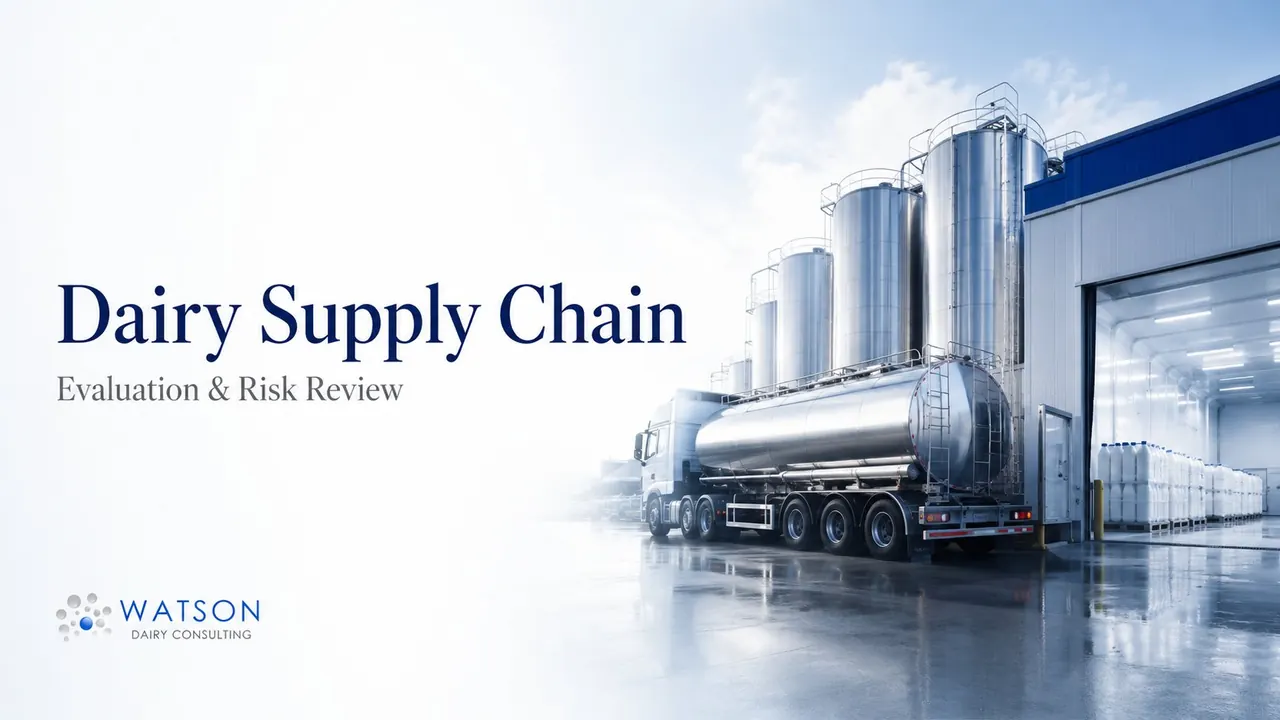
Independent dairy supply chain evaluation and risk review — structured assessment of upstream milk supply, inbound ingredients and packaging, outbound logistics, supplier capability and supplier financial health.
Watson Dairy Consulting works for dairy manufacturers reviewing their own supply chains, and for investors and lenders evaluating supply chain risk in dairy targets. Independent of suppliers, neutral on commercial choices, focused on what the data actually shows.
Why Supply Chain Evaluation Matters Now
The last five years have delivered four consecutive supply chain shocks to the dairy industry: the 2020–21 pandemic disruption, post-Brexit border friction, the 2022–23 energy price spike, and the ongoing Ukraine-related impact on grain, sunflower oil and labour. Add to that the persistent UK milk-supply concentration (the top four processors take roughly 60% of UK milk) and the growing regulatory load on supplier environmental and social claims, and "let's look at the supply chain" has moved from a back-burner item to a board-level priority.
Most dairy supply chains were built incrementally over decades, with supplier relationships and contractual structures that were sensible at the time. They are rarely the structure you would design today if you started with a blank sheet. A structured evaluation is how you find out which legacy choices are still serving you, which are concentrating risk, and where margin is being given away to suppliers who are not earning it.
What We Evaluate
Upstream Milk Supply
Supplier concentration, contract structure, pricing exposure, regional risk, segregation requirements (organic, A2, grass-fed), supplier financial health and farm-gate sustainability.
Inbound Ingredients & Packaging
Sole-source identification, qualified-second-source mapping, supplier financial review, geographic concentration risk, audit findings and contract terms review.
Outbound Logistics
Cold-chain integrity, fleet vs 3PL economics, route network design, last-mile risk, customer service-level performance and delivery cost benchmarking.
Supplier Capability & Audit
Technical capability assessment, quality system maturity, certification status (BRCGS, FSSC, IFS), operator competence, capacity headroom and continuous-improvement track record.
Upstream Milk Supply
Raw milk is typically 60–75% of cost of goods sold for a liquid milk or cheese plant, and 50–65% for milk powder. Small changes in milk supply economics dwarf almost any other supply chain decision in financial impact. We evaluate:
- Supplier concentration — what percentage of your milk comes from your top three suppliers, and what does losing any of them cost?
- Contract structure — are you on a B-formula, A+B, spot, cost-of-production or sustainable contract? Is the pricing mechanism aligned with your competitive position?
- Pricing exposure — what proportion of your milk cost moves with downstream pricing power, and what proportion is fixed against commodities you can't influence?
- Regional risk — is your supply concentrated in one region exposed to specific weather, disease, regulatory or political risk?
- Segregation requirements — if you sell organic, A2, grass-fed, antibiotic-free or origin-labelled product, is the segregation discipline through the supply chain actually delivering what your label claims?
- Supplier financial health — are your milk suppliers solvent, investable and likely to be there in three years? Particularly relevant given the structural decline in dairy farmer numbers across the UK and EU.
- Sustainability and Scope 3 — what is your carbon footprint at farm gate, and how does it compare to peers and customer expectations?
Inbound Ingredients and Packaging
After milk, the next-largest cost categories in most dairy plants are packaging (often 8–15% of cost of goods sold) and specialist ingredients (cultures, enzymes, stabilisers, vitamins, additives). These are where single-source dependency is most common — and most expensive when it bites.
Sole-source identification
Every dairy plant has sole-source dependencies. The question is whether you know what they are, whether they are justified by genuine technical requirements, and whether qualified second sources exist if you needed them. We map this systematically: every input, current supplier, qualified alternatives, switching cost, technical risk, and time to switch.
Supplier financial health
A supplier going into administration with your only proven culture or your specific bottle preform is an existential threat to production. Routine credit checks miss a lot — we look at filed accounts, parent-company exposure, customer concentration on their side, and operating margin trends. For critical suppliers, a supplier financial review every 12 months is appropriate; for sole sources, every 6 months.
Geographic concentration
A 2021 reminder for many dairy businesses: if your bottle preforms come from one EU plant, and a border closes, you have three weeks of stock and then no product. We map geographic concentration across the input base — not just by country but by individual plant where it matters.
Audit programme
Supplier audits should be doing more than ticking a BRCGS box. A meaningful audit programme covers technical capability, quality system maturity, capacity headroom, financial health, sustainability claims and continuous-improvement track record. We design and run audit programmes for clients who don't have internal capacity, and we audit critical suppliers for clients who want a second opinion.
Outbound Logistics
Outbound is the supply chain link where customer satisfaction is won or lost. It is also where the cost-vs-service trade-off is most visible. We evaluate:
- Cold-chain integrity — temperature recording, excursion frequency, customer complaints by route and by carrier
- Fleet vs 3PL economics — the make-vs-buy analysis is rarely revisited after the original decision; the right answer can shift as volumes, geography and labour cost change
- Route network design — whether your hub-and-spoke or direct-delivery model is still the right one for your current customer footprint
- Service-level performance — on-time-in-full to each customer, by carrier, by depot, with the drift over time visible
- Last-mile risk — particularly for products serving multiple retailers with different delivery-window requirements and penalty regimes
- Cost benchmarking — what does each pallet-kilometre actually cost you compared to industry benchmarks?
Supplier Audit — What We Cover
Technical & Quality
Quality management system, HACCP, prerequisites, allergen control, foreign body management, microbiological monitoring, traceability and recall capability.
Certifications
BRCGS, FSSC 22000, IFS, ISO 9001, ISO 22000, customer-specific standards, organic/RSPO/sustainability certifications and the gap between paper compliance and actual practice.
Financial Health
Filed accounts review, parent-company exposure, customer concentration, operating margin trend, working capital position and capex appetite.
Capability & Capacity
Operator competence, equipment condition, planned vs unplanned downtime, headroom against current and projected demand, continuous improvement evidence.
A focused supplier audit and financial review usually costs less than one day of unplanned downtime if the worst-case scenario materialises. Schedule a call with Watson Dairy Consulting →
Supply Chain Network Design
Beyond evaluating what you have, we help clients think strategically about what the supply chain should look like:
- Make-vs-buy analysis for ingredients, packaging and intermediate processing — with full cost-of-ownership comparisons, not just direct unit cost
- Vertical integration economics — when does it make sense to bring an input in-house, and when is it better left to specialists?
- Inventory positioning — where in the supply chain should inventory be held, and how does that change with promotion calendars, seasonality and supplier reliability?
- Capacity location — for multi-site businesses, which products belong on which site, and what does that look like five years out?
- Risk register — a documented, prioritised list of supply chain risks suitable for board-level review and audit committee discussion
How We Run a Supply Chain Evaluation
1. Brief & Scope
Discussion to agree what's in and out, what success looks like, what data is available, and who in the team will be the day-to-day contact. NDAs in place before any sensitive information is exchanged.
2. Desk Review
Current-state mapping from supplier contracts, master data, financial records, audit history, complaint logs and service-level reporting. Often catches things on-site visits cannot.
3. Site Visits & Supplier Interviews
Plant walks, supplier visits where appropriate, interviews with key personnel on both sides. Triangulates desk findings with reality on the ground.
4. Report & Action Plan
Quantified risk register, prioritised opportunity list, recommended actions with capital and operational implications called out. Briefings to executive and board as required.
Who We Work For
- Dairy manufacturers reviewing their own supply chains for risk and cost
- Private equity and trade investors evaluating supply chain risk in dairy acquisition targets
- Lenders reviewing supply chain resilience as part of credit risk assessment
- Retail customers auditing the supply chain of strategic dairy suppliers
- Infant formula brands with elevated traceability and supplier-quality obligations
- Insurance providers reviewing supply chain risk as part of underwriting
Frequently Asked Questions
How long does a dairy supply chain evaluation take?
A focused evaluation of one part of the supply chain (upstream milk, inbound ingredients, or outbound logistics) is typically 1 to 2 weeks of work including on-site visits and supplier interviews. A full end-to-end supply chain review is typically 3 to 6 weeks depending on the number of sites, suppliers and product categories in scope. Scope and timeline are agreed upfront against a written brief.
What is the deliverable from a supply chain evaluation?
A written report covering the current-state map, identified risks (with severity and likelihood ratings), identified opportunities (with quantified savings or value where possible), a prioritised action plan and a risk register suitable for board-level review. Where the brief includes supplier audits, individual audit reports are issued separately to the client. Briefings to the executive team and to the board are included as standard.
Do you audit individual suppliers?
Yes — both desk-based audits (financial health, quality system review, certifications, sustainability claims) and on-site audits (facility walk, quality system verification, capability assessment, operator competence). On-site audits cover BRCGS, FSSC 22000, IFS and customer-specific requirements as appropriate. We can audit one critical supplier or run a programme covering the full supplier base.
What dairy sectors and supply chains do you cover?
All major dairy sectors — liquid milk, cheese, yogurt and fermented products, butter and AMF, milk powder and infant formula, whey processing, ice cream and frozen desserts. Supply chains include upstream raw milk supply, inbound ingredients (cultures, enzymes, additives, packaging, chemicals), outbound logistics, contract manufacturing and toll processing. We also support investors and lenders doing supply chain due diligence on dairy targets.
What is your fee model for supply chain evaluation?
Day rate plus expenses, agreed upfront against a scoped brief. No success fees or commission arrangements — we are paid for independent technical opinion, not for any particular conclusion. Confidentiality clauses are standard. Travel from Aberdeen, Scotland.
How confidential is the evaluation process?
Strictly confidential. NDAs are signed before any sensitive information is exchanged. When evaluating suppliers, we represent the client — not the supplier — and findings are shared only with the client. When commissioned by investors or lenders, target-company information is held under the same protections that govern any technical due diligence.
Related Guidance
Reference guide:
- Dairy raw material risk categorisation & supply chain control
Guide to risk-categorising raw materials and packaging, supplier approval, traceability and proportionate controls.
Further reading: John Watson publishes articles on dairy industry topics on LinkedIn — from infant formula safety and milk supply to plant design, yield improvement and dairy commodity outlook. Browse all articles by John Watson on LinkedIn →
See our related dairy due diligence, cost reduction reviews, dairy factory benchmarking, joint ventures and infant formula quality pages, or browse all consultancy services.
John Watson
Office: +44 1224 861 507
Mobile: +44 7931 776 499
jw@dairyconsultant.co.uk
We are a longstanding member of the Society of Dairy Technology
and have Fellowship of the Institute of Food Science and Technology.



Contact Details
John Watson
Office: +44 1224 861 507
Mobile: +44 7931 776 499
jw@dairyconsultant.co.uk
What Our Clients Say
We are a longstanding member of the Society of Dairy Technology
and have Fellowship of the Institute of Food Science and Technology.
Locations

Services
Enquiry Form

