
Yogurt Factory Design & Production
Independent yogurt and fermented dairy factory design — for greenfield projects, capacity expansion, new product line addition and capex-driven plant modification.
Watson Dairy Consulting has designed yogurt plants for set, stirred, drinking and Greek-style products across multiple market positions, from artisanal to high-volume commodity.
Independent yogurt factory design and yoghurt production support – covering process flow, plant layout, starter cultures, incubation, set, stirred, drinking and Greek-style yogurt, composition standards and equipment selection, for new and established manufacturers.
Yogurt Factory Design and Yoghurt Production
Yogurt (also spelled yoghurt) is one of the most versatile dairy products, made in set, stirred, drinking, Greek-style, fruit and frozen forms. Designing a yogurt factory means designing around the product range, the cultures and the process – from milk reception and standardisation through to incubation, cooling, filling and cold storage. The right process flow, plant layout and equipment selection determine product quality, consistency, yield and cost.

Watch on a dedicated video page: Yogurt production process flow →
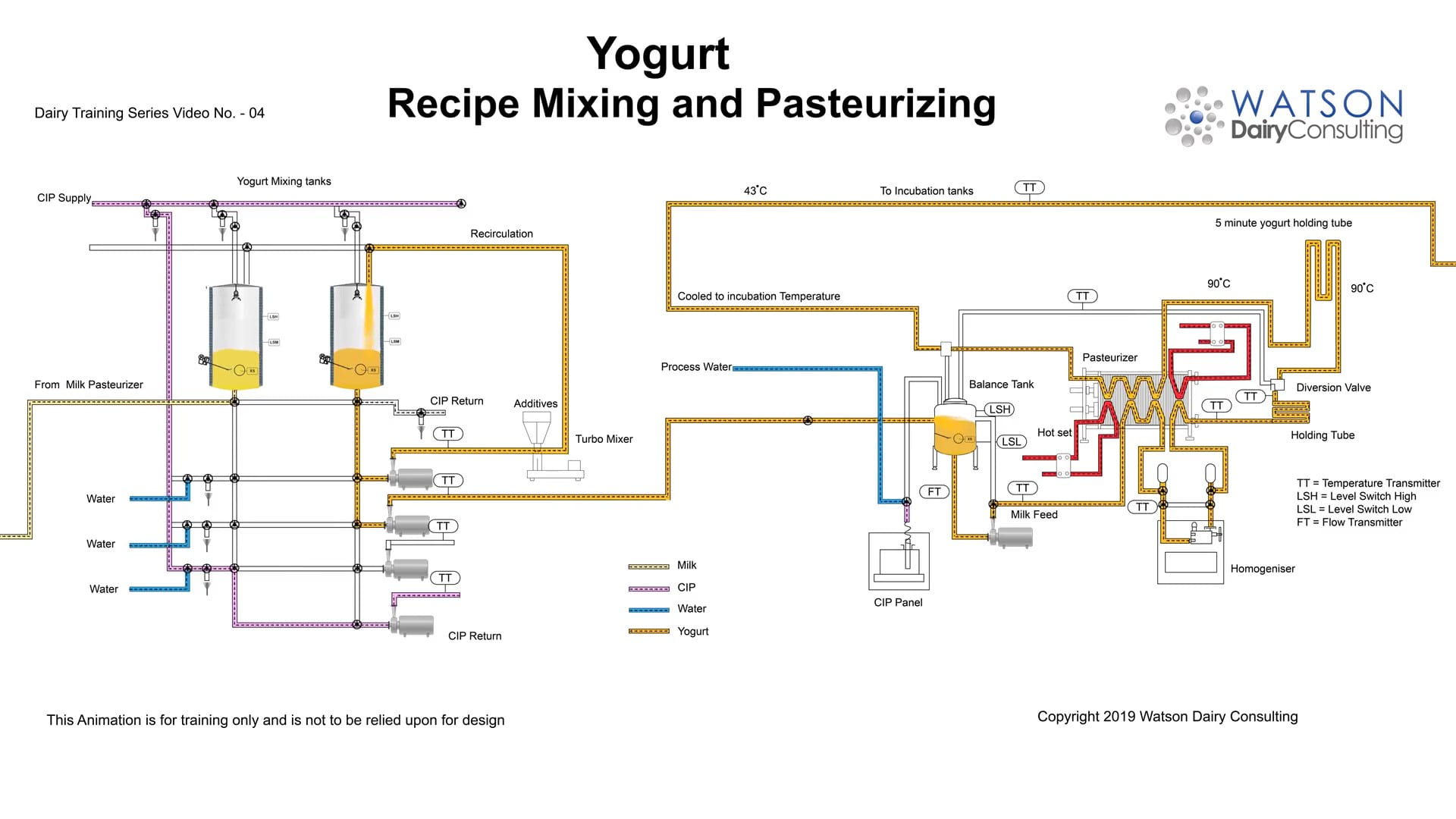
Watson Dairy Consulting training animation: yogurt recipe mixing and pasteurising process flow.
The Yogurt Production Process
Whatever the final format, yogurt manufacture follows a core sequence, each stage of which has to be designed correctly into the factory:
- Milk reception and standardisation – adjusting fat and increasing total solids (often with skimmed milk powder, concentrated milk or membrane filtration) to build the body and texture the product needs.
- Homogenisation – reducing fat globule size for a smooth, stable product and good mouthfeel.
- Heat treatment – a high heat treatment (typically around 90 degrees C with a hold) denatures the whey proteins, which improves texture, water binding and set, and ensures food safety.
- Cooling to incubation temperature – cooling to around 40 to 45 degrees C ready for the culture.
- Inoculation and incubation – adding the starter culture and holding until the target acidity (pH) is reached.
- Cooling and breaking – cooling to arrest fermentation; for stirred and drinking yogurt the gel is broken and smoothed.
- Fruit, flavour and filling – adding fruit or flavour and filling into the final pack, then cold storage.
Set, stirred and drinking yogurt
The choice of format drives much of the factory design:
| Format | How it is made | Design implication |
|---|---|---|
| Set yogurt | Inoculated milk is filled into the final pot and incubated so it sets in the pack. | Needs incubation rooms or tunnels for filled pots; gentle handling to protect the set gel. |
| Stirred yogurt | Incubated in bulk tanks, then the gel is broken, cooled and pumped before filling. | Needs incubation tanks, smoothing, cooling and gentle pumping to protect texture. |
| Drinking yogurt | A stirred yogurt broken down further to a pourable consistency, often homogenised after fermentation. | Needs post-fermentation smoothing and a filling line suited to a liquid product. |
| Greek / strained | Concentrated by straining whey (or by adding protein) to raise solids and create a thick, rich texture. | Needs separators or membrane filtration and whey handling; large milk volumes per tonne of product. |
Cultures, Composition and Standards
Getting the microbiology and composition right is central to a reliable yogurt. The international standard for fermented milks (CODEX STAN 243-2003) sets out the definitions most countries build on:
Yoghurt cultures: true yoghurt is made with a symbiotic culture of Streptococcus thermophilus and Lactobacillus delbrueckii subsp. bulgaricus. The two organisms support each other, driving fermentation, acidity and the characteristic flavour and texture.
Composition (yoghurt): a minimum milk protein of 2.7%, milk fat of less than 15%, and a minimum titratable acidity of 0.6% (as lactic acid). The live starter organisms should be present at a minimum of 10 million (107) per gram through to the date of minimum durability – unless the product is heat-treated after fermentation, in which case the live-organism requirement does not apply.
Concentrated (Greek-style, Labneh): protein increased to a minimum of 5.6%. Whey removal after fermentation is only permitted for these concentrated products.
Phage control, milk quality, culture handling, incubation control and hygienic design all matter to consistency, and we build these into the process and factory design. For recipe formulation and nutritional calculation, you can also use our frozen yogurt recipe and nutrition calculator.
How Watson Dairy Consulting Can Help
We provide independent, experienced support across the whole yogurt project – from concept to a reliably running line:
- Yogurt factory design – process flow, plant layout, hygiene zoning and utilities
- Process and recipe development – set, stirred, drinking, Greek-style, fruit and frozen yogurt
- Culture selection and fermentation control
- Equipment selection and tendering – mixing, heat treatment, incubation, smoothing, filling, with no equipment to sell
- Feasibility studies and business planning
- Food safety, HACCP and quality assurance
- Process optimisation – texture, yield, consistency and throughput on existing lines
- Operator training and expert witness support
Planning a yogurt factory, developing a product, or improving an existing line? Watson Dairy Consulting provides independent, experienced yogurt manufacturing support worldwide.
Discuss Your Yogurt ProjectYogurt Production FAQs
What cultures are used to make yogurt?
What is the difference between set, stirred and drinking yogurt?
What temperature is yogurt incubated at?
How is Greek or strained yogurt made?
Can you design a yogurt factory or production line?
Related pages: Frozen Yogurt · Yogurt Production Process · Frozen Yogurt Calculator · Dairy Factory Design · Dairy Science Information
Disclaimer: the information on this page is provided as general technical guidance. Composition, cultures, food safety and labelling requirements for yogurt and fermented milks vary by product and country and are subject to change; they should be confirmed against current regulations and validated for your specific operation. Watson Dairy Consulting can provide project-specific advice.
For more information or to discuss your requirements please contact us.
Further reading: John Watson publishes articles on dairy industry topics on LinkedIn — from infant formula safety and milk supply to plant design, yield improvement and dairy commodity outlook. Browse all articles by John Watson on LinkedIn →
John Watson
Office: +44 1224 861 507
Mobile: +44 7931 776 499
jw@dairyconsultant.co.uk
We are a longstanding member of the Society of Dairy Technology
and have Fellowship of the Institute of Food Science and Technology.



Contact Details
John Watson
Office: +44 1224 861 507
Mobile: +44 7931 776 499
jw@dairyconsultant.co.uk
What Our Clients Say
We are a longstanding member of the Society of Dairy Technology
and have Fellowship of the Institute of Food Science and Technology.
Locations

Services
Enquiry Form

