
For new starters
Build a consistent knowledge foundation before and during supervised plant training.
Watson Dairy Training Academy
Build the knowledge behind safer, more profitable operation.
A structured online programme for operators, supervisors and technical teams — grounded in around 50 years of practical evaporator experience.
23 sections · Self-paced learning · Knowledge assessment
A structured, 23-section online knowledge programme for commercial falling-film evaporators, built around Watson Dairy Consulting’s V40 technical training manual.
Use it alongside an experienced operator on your own plant: every trainee gains a common knowledge base, while your site develops and signs off the practical skills. For infant formula manufacturers, it supports documented training evidence as part of a controlled approach to staff competence.
Buddy training transfers valuable plant experience. Its coverage can also vary with the trainer, the shift and the situations encountered. When an experienced operator retires, moves role or is absent, undocumented knowledge can be difficult to replace.
The Evaporator Operator Programme provides a defined learning path. Trainees use it to understand what to ask, what to watch and why it matters while learning the actual plant alongside their experienced colleague.
Build a consistent knowledge foundation before and during supervised plant training.
Identify knowledge gaps and reinforce the reasoning needed when providing shift cover.
Refresh process understanding and discuss operating habits against a common technical reference.
Structure learning, retain assessment and completion evidence, and keep knowledge available as the workforce changes.
Infant formula manufacturing · Training due diligence
Training due diligence means being able to show what each person was taught, what they understood, how practical competence was checked and who authorised them to work. Attendance or a certificate alone does not answer those questions.
For an infant formula manufacturer, evaporator operator knowledge is one part of a wider, role-specific training system. Staff need to understand how operating deviations, cleaning failures, product routing and incomplete records can affect the next process stage and the product eventually released.
Map required knowledge to each job, the site’s hazard analysis, equipment, validated procedures and product specifications. Include new starters, relief staff and contractors where relevant.
Keep learner-level assessment results and identify gaps requiring coaching or reassessment. Use questions that test recognition, reasoning and escalation, as well as recall.
Pair online learning with supervised practice on the actual plant. Record the tasks observed, the assessor, the outcome and any operating restrictions before independent work is authorised.
Maintain a training matrix, dated records, procedure versions and competency sign-offs. Review training after equipment or procedure changes, deviations and relevant findings, and check effectiveness over time.
Training priorities include understanding process limits, CIP verification, hygiene controls, product recovery and routing, deviation reporting, and when to stop or seek QA review. The Academy’s knowledge assessment and completion record support this process; your site supplies the product-specific instructions and practical authorisation.
Upstream pasteurisation does not remove the need for downstream contamination controls. For infant formula, operator training must sit alongside the site’s controls for microbiological hazards, including Cronobacter and Salmonella, and the defined responsibilities for sampling, hold and release.
For US manufacture, 21 CFR 106.10 requires sufficient personnel qualified by education, training or experience for infant formula operations and recordkeeping. Applicable requirements must be checked for each manufacturing and destination market. This evaporator course supports a training system; completion alone does not establish regulatory compliance or legal due diligence.
References: 21 CFR 106.10 — personnel controls · FDA infant formula manufacturing oversight
Discuss infant formula staff trainingCommercial falling-film evaporation
The 23-section programme ranges from milk chemistry to food safety and HACCP. The topic groups below summarise the areas identified in the programme’s business case and accompanying quick-reference card.
Relate total solids, whey protein behaviour, concentration and heat exposure to concentrate quality, viscosity and deposit formation.
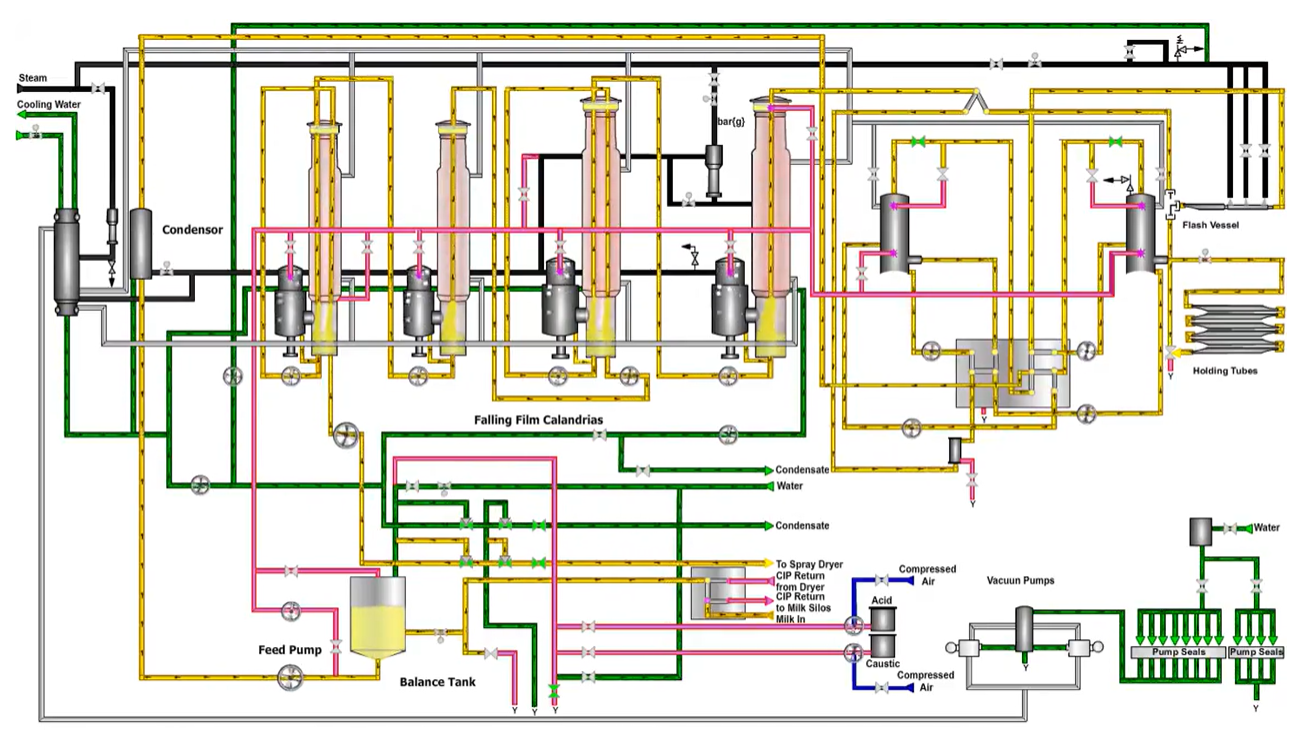
Follow the feed, concentrate, steam, vapour, condensate and cooling-water systems through a multi-effect falling-film evaporator.
Understand pre-start checks, water running, staged heating, product introduction and the role of alarms and interlocks.
Explore vacuum leaks, condensers, cooling-water conditions and the symptoms of deteriorating vacuum performance.
Understand measurement checks, process lag, density and feed-flow loops, and disturbances during silo changes.
Connect feed solids, concentrate flow, water removal and steam use. Understand multi-effect operation and thermocompression.
Recognise changing heat-transfer performance and review the purpose of rinse, caustic and acid stages alongside site-approved cleaning routines.
Connect hygiene and run-length decisions with thermophile control, concentrate condition and scorched-particle concerns.
Review vacuum loss, foaming, carryover, unstable solids, pump-seal problems and other signs that operation needs investigation.
Understand how product in condensate, dilution and start/end-of-run changeovers affect recoverable solids and waste.
Reinforce awareness of chemical exposure, steam, pressure, vacuum and the need for approved isolation and safe working practices.
Relate operating observations, quality escalation, HACCP awareness and traceable records to the site’s food-safety system.
The quick-reference card uses an illustrative plant configuration. Actual setpoints, cleaning recipes and operating limits must come from your plant’s validated procedures and design data.
The value lies in better understanding of the decisions operators make each shift. Assess results against your own plant records; training is not a promise of a fixed percentage saving.
| Plant priority | What understanding supports | What the site can measure |
|---|---|---|
| Safety and reliable response | Recognition of hazards, interlocks and situations requiring escalation | Training gaps, observed safe practice and site competency sign-off |
| Yield and recovery | Attention to carryover, recovery routes and changeover losses | Solids lost to condensate or drain; recovered product per run |
| Steam and utility cost | Understanding the relationship between fouling, vacuum, loading and steam demand | Steam per tonne of water removed; water and chemicals per clean |
| Product quality | Awareness of heat exposure, hygiene, run length and concentrate consistency | Off-spec concentrate, microbiological trends and powder downgrades |
| Production continuity | More consistent onboarding and a shared approach to process upsets | Unplanned stops, recovery time and availability of trained cover |
The training manager agrees learner roles, existing knowledge and the plant procedures that will guide practical work.
Learners work through the online sections around shift patterns, discussing the relevant equipment, trends and routines with an experienced operator.
The programme includes a knowledge assessment drawn from a question bank and a traceable completion record.
Your site separately observes and approves practical performance on its own evaporator. Course completion is one part of the training evidence.
The programme complements college and university learning. It brings that underpinning theory into the commercial operating context and supports the hands-on hours that remain essential.
Watch the freely available evaporator operation animation for an introduction to Watson Dairy Consulting’s visual training approach. Request a demonstration to see the full online programme and assessment.
For a training manager, the case includes workforce continuity, quality, energy use, recovery and downtime. Our business-case framework helps you select the measures that matter locally.
For example, recovered solids can be valued using your actual product contribution; avoided downtime can be valued using the production contribution genuinely recovered. Include learning time, supervision and implementation costs, and avoid counting the same benefit twice.
One named learner, with three months’ hosted access.
£45 per learner.
£39 per learner.
£35 per learner.
VAT added where applicable. Hosted access starts when invitations are issued. Your own LMS licence and live plant-specific coaching are quoted separately.
The course is hosted on SCORM Cloud. A SCORM 1.2 Dispatch package is available for delivery through a compatible company learning platform, with content launched from the hosted service. We will confirm compatibility and licensing before deployment.
Send your learner count, preferred start date and delivery preference using the enquiry form. We confirm the programme details and arrange enrolment. Learning time, pass mark, retake arrangements and distinction criteria will be supplied before purchase.
John Watson brings around 50 years of dairy evaporator consulting practice to the programme. Its knowledge base is built around Watson Dairy Consulting’s V40 technical training manual, with an accompanying operator quick-reference card.
The emphasis is on connecting plant behaviour with operating decisions: what has changed, why it matters, what to check and when to escalate.
About Watson Dairy Consulting · Evaporator training and plant support
The programme includes knowledge assessment and a completion certificate. The sample below shows the proposed distinction design; the distinction threshold must be confirmed before that grade is offered. The certificate records learning achievement; practical operating competence is signed off by your site.

This certifies that
has successfully completed the professional training course in
and achieved
Tell John Watson your company, role, number of learners and whether you need individual access, team training, an infant formula training discussion or a company LMS licence.
Your enquiry will be submitted using the Watson Dairy Consulting website form. Read our privacy policy.
Combine operator development with practical support from Watson Dairy Consulting.
Discuss how online learning can complement training on your own equipment.
Explore operational improvements in product recovery, efficiency and consistency.
Connect staff development with your wider approach to manufacturing quality.
Discuss development needs across your production and technical teams.
Related tools: Evaporator mass and steam balance · Evaporator steam economy
John Watson
Office: +44 1224 861 507
Mobile: +44 7931 776 499
jw@dairyconsultant.co.uk
We are a longstanding member of the Society of Dairy Technology
and have Fellowship of the Institute of Food Science and Technology.



John Watson
Office: +44 1224 861 507
Mobile: +44 7931 776 499
jw@dairyconsultant.co.uk
We are a longstanding member of the Society of Dairy Technology
and have Fellowship of the Institute of Food Science and Technology.