
Spray Dryer Powder Agglomeration
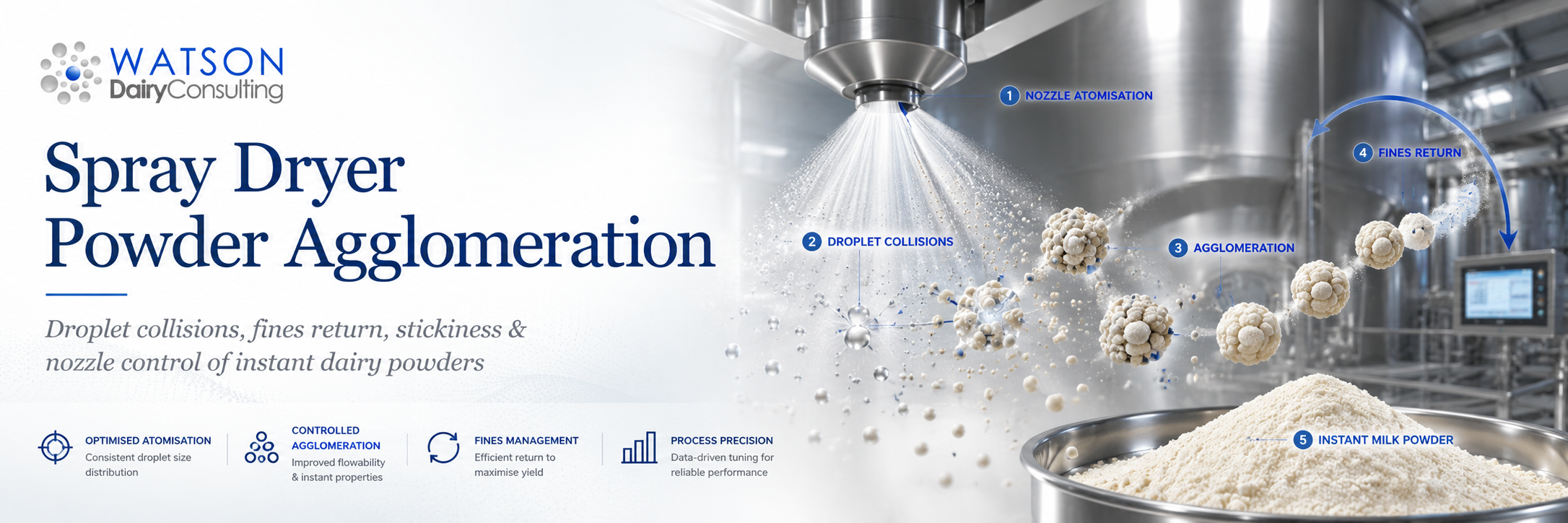
Agglomeration is what turns a fine, dusty, slow-wetting spray-dried powder into an instant one. Small primary particles are joined into porous clusters, typically several times the primary particle size, so that water penetrates the powder bed instead of floating it, the powder flows and meters cleanly, and dust in the packing hall falls. Instant skim milk powder, whole milk powder, infant formula base powders, whey protein and many food-ingredient powders depend on it.
This guide explains how agglomeration actually happens inside a dairy spray dryer — droplet-to-droplet collision in overlapping sprays and droplet-to-fines collision in the nozzle zone — why droplet size and surface stickiness decide whether particles merge, stick or bounce, how the atomiser is used to control it, and how the result is measured. The references are independent (GEA/Niro handbooks, Tetra Pak, peer-reviewed work from Massey, Wageningen and Hohenheim) with supplier data from Delavan used where it adds practical detail.
What Agglomeration Does to a Dairy Powder
A spray dryer running without deliberate agglomeration produces near-spherical primary particles. For skim milk they are small — commonly a volume-median well under 100 μm — dense, and difficult to reconstitute: dropped into water they float, wet slowly from the outside and form lumps with a dry core. An agglomerated powder is made of the same primary particles bonded into open, irregular clusters. The difference in behaviour comes from the pore structure between the particles rather than from the particles themselves.[1][3]
| Property | Non-agglomerated powder | Agglomerated (instant) powder | Why it matters |
|---|---|---|---|
| Particle size | Small primary particles, narrow distribution | Clusters several times larger, wider distribution | Larger clusters wet and sink; fines under about 50 μm are the ones that dust and float |
| Bulk density | Higher | Lower — agglomeration builds air into the bed | Bulk density is usually the first specification affected when agglomeration drifts; it drives bag fill, silo capacity and shipping cost |
| Wettability | Poor — lumps and floating | Good — capillary pores draw water in | For whole milk powder the fat-covered surface must also be lecithinated for the powder to be instant[1] |
| Dispersibility & sinkability | Poor | Good | Clusters break apart as they wet rather than forming a gel skin |
| Flowability | Cohesive, arching in hoppers | Free-flowing | Metering into cans, sachets and blending lines |
| Dust | High | Low | Explosion risk, hygiene, product loss to bag filters |
| Mechanical strength | Not relevant | Clusters can be broken by conveying and handling | Pneumatic conveying and screw feeders can undo the dryer’s work; test at the packing point, not the dryer outlet |
How Agglomeration Happens Inside the Dryer
Two mechanisms operate in a modern multi-stage dairy dryer, and most plants use both.
1. Spray-to-spray agglomeration (primary, or “straight-through”)
Where the cones from adjacent pressure nozzles overlap, droplets that are part-dried collide with one another. If both have a viscous, tacky surface the collision produces a doublet or larger cluster; if they are still liquid they simply coalesce into one larger sphere; if they are too dry they bounce. Nozzle spacing, spray angle and lance geometry therefore set how much inter-spray mixing occurs. Delavan’s spray-visualisation work shows the two extremes clearly: separated cones give individual sprays with no agglomeration, converging cones give inter-spray mixing and agglomeration.[15]
2. Fines-return agglomeration (secondary, or “nozzle-zone”)
Fine powder recovered from the cyclones or bag filter and from the fluid bed is blown back into the chamber close to the atomiser. These dry fines collide with drying droplets and act as collectors: each successful collision leaves a fine particle bonded to the surface of a droplet, and repeated collisions build the cluster. This is the dominant lever on an industrial instant-powder dryer, and it is the reason the position of the fines-return duct relative to the nozzles is a design decision rather than a piping convenience.[1][8][9]
The Massey University and Fonterra work by Williams and co-workers is the most-cited experimental study of the mechanism. Running skim milk at small and pilot scale with and without a fines curtain, they confirmed that fines addition promotes agglomeration and that the extent of agglomeration depends principally on the mass flux ratio of fines to spray, followed by particle size.[8] Fröhlich and co-workers at Hohenheim found that the total solids of the feed strongly affects agglomerate properties in nozzle-zone agglomeration,[12] and van Boven and co-workers showed by response-surface trials that a higher droplet-collision frequency increases the degree of agglomeration and improves rehydration.[10]
Merge, Stick or Bounce: The Physics of a Collision
Every collision between a fine particle and a drying droplet has one of three outcomes, and only one of them builds an agglomerate.[9][11]
Merge
The droplet is still liquid; the fine sinks into it and disappears. The result is a single, larger, dense primary particle — layering, not agglomeration. This is what happens when fines are returned too close to the nozzle.
Stick
The droplet has formed a viscous skin; the fine adheres to the surface without being absorbed. Several sticking collisions on one droplet, and sticking of doublets to each other, produce the open cluster that gives instant properties. This is the target regime.
Bounce
The droplet has dried to a glassy or elastic skin; the fine rebounds. No agglomeration. This is what happens when fines are returned too far from the nozzle or when the surface has already passed through its sticky window.
The single-droplet collision experiments at Wageningen quantified the window. Colliding glass beads with drying maltodextrin droplets and timing the collision against the droplet’s locking point (the moment a solid skin forms), Eijkelboom and co-workers found that sticking occurred only between about 0.75 and 1.5 times the locking-point time, regardless of the maltodextrin grade; before that window collisions merged, after it they bounced. Collision speed, in the 0.3–3 m/s range typical of a spray dryer, had no clear effect within that window.[11] The implication for a dairy dryer is direct: agglomeration is controlled by when in its drying history a droplet meets a fine, which is set by droplet size, chamber temperature and humidity, and fines-return position.
Why surface stickiness follows the glass transition
The sticky window exists because the surface of a drying milk droplet passes through a rubbery state on its way from solution to glass. Amorphous lactose is the component that governs it. Dry amorphous lactose has a glass transition temperature (Tg) of around 100 °C, but water is a powerful plasticiser and a few percent of moisture brings Tg down by tens of degrees.[5] Roos showed that dairy powders become sticky once their surface temperature exceeds Tg by roughly 10–20 °C, and Hennigs, Kockel and Langrish measured the sticky-point curve for skim milk powder directly as a function of moisture content; reported T − Tg values for skim milk powder range from the mid-teens to the low thirties of degrees depending on the test method.[4][6] Palzer’s analysis of amorphous food powders puts the same rule to work for both the agglomeration you want in the dryer and the caking you do not want in the silo.[7]
Two consequences follow. First, the surface composition of the droplet matters as much as its bulk composition: Kim, Chen and Pearce showed that spray-dried milk powders are fat- and protein-enriched at the surface relative to the bulk, and that drying conditions change the surface composition.[16] Fat-rich surfaces on whole milk powder are the reason it needs lecithination to become instant, while protein at the surface promotes sticking — the Wageningen group found that adding protein to a maltodextrin feed increased the fraction of agglomerated particles.[11] Second, the same Tg physics that builds agglomerates in the chamber will build wall deposits and cake the powder if the outlet temperature and humidity are too high or the fluid bed does not cool the powder below its sticky point before packing.[4][7]
The Atomiser Is the Primary Control
On a nozzle dryer the droplet size distribution leaving the atomiser sets everything downstream: how quickly each droplet reaches its locking point, how many collision partners exist per kilogram of feed, and how much surface area is available for evaporation. A litre of concentrate atomised to 50 μm droplets contains around 15,000 million droplets; at 100 μm it contains about 2,000 million. Droplet count scales with the inverse cube of diameter, and surface area with the inverse of diameter, so a 10% reduction in droplet size gives roughly 37% more droplets and 11% more evaporating surface.
Pressure nozzles: orifice, swirl chamber and pressure
A pressure-swirl (hollow-cone) nozzle has two replaceable parts that set its duty: the orifice disc, which fixes flow at a given pressure, and the swirl chamber, which fixes the tangential velocity and hence spray angle and film thickness. Flow through a given orifice rises with the square root of pressure; droplet size falls as pressure rises. Delavan’s SDX range offers 12 swirl chambers and 240 orifice sizes from 0.6 to 6.3 mm in 0.025 mm steps, and its published selection data give the practical rules of thumb: each step up in swirl chamber raises flow by about 17–20% at the same pressure; the best spray angle for milk concentrate is about 65–90°; a narrower angle produces around 8% larger droplets and less agglomeration, a wider angle around 6% smaller droplets and more agglomeration.[15]
The exponents tell you which levers are strong and which are weak. Doubling nozzle pressure cuts droplet size by roughly a quarter and raises flow by about 41%, which is why concentrate pumps run at 150–300 bar. Viscosity has a weak exponent, but the range over which dairy feed viscosity varies is enormous: Delavan’s own droplet calculator gives about 53 μm for water through a given nozzle at 200 bar, 150 μm at 100 cP and 225 μm at 500 cP with nothing else changed.[15] A change in evaporator concentrate viscosity is therefore felt at the nozzle far more than the 0.25 exponent suggests, and feed viscosity is the variable that most often explains a dryer that “drifted” without anyone touching a setting.
What moves feed viscosity
Concentrate viscosity is set upstream of the dryer, and the dryer inherits it. The factors, all documented in the GEA/Niro handbooks, are: total solids (a 1% change in solids can change viscosity substantially at 48–52% TS); concentrate temperature; the intensity of preheat treatment before evaporation, which sets the whey protein denaturation and casein aggregation state; protein content and the casein-to-whey ratio of the feed; whether the concentrate is homogenised; and age thickening in the balance tank, which rises with holding time and temperature.[1][2] A concentrate that has stood for an hour is not the same feed as one that is pumped straight to the lances, and viscosity should be measured at the lance, not at the evaporator outlet.
Before adjusting nozzles or fines return, check concentrate solids, temperature and viscosity at the lance against the commissioning values. Ask us about dryer performance reviews.
Droplet size versus powder size: fines return changes the whole distribution
The droplet size distribution at the nozzle and the particle size distribution in the bag are different curves. Delavan’s comparison for one duty shows a droplet distribution peaking near 60 μm at the nozzle, a primary-particle distribution peaking near 90 μm without fines return, and a distribution peaking near 140 μm with a second mode near 110 μm once fines return is active — the bimodal shape being the signature of forced agglomeration.[15] Matching the droplet formed to the powder required is the design task; the fines-return rate and position are then the operating levers.
The same supplier’s laser-diffraction trials on a milk protein isolate illustrate how a swirl-chamber change alone alters the powder: moving from an SH/097 to an SG/115 combination reduced the D50 from 58 to 51.9 μm and raised the specific surface area from 1,179 to 1,416 m²/kg — about 20% more evaporating surface, with a smaller D10 and more fines available to act as collectors.[15]
Cluster nozzles
Cluster heads place several small orifices on one lance so that the same total flow is delivered at lower pressure with more, smaller sprays. Delavan’s comparison for a 1,470 L/h duty gives a single SDX V nozzle (SG swirl, 106 orifice) at 200 bar producing a 70° cone with a Sauter mean diameter of about 74 μm, against a cluster assembly (SF swirl, 069 orifices) at 100 bar giving 65° cones and about 73 μm — the same droplet size at half the pressure, with the overlapping cones producing agglomeration without fines reintroduction, fewer lances, and headroom to increase dryer capacity.[15] The trade-off is that inter-spray agglomeration is now designed into the head geometry and is less adjustable from the control room than a fines-return rate.
Two-fluid nozzles for viscous feeds
Where the feed is too viscous for a pressure nozzle, two-fluid (air-atomising) designs use compressed air at 100–240 m/s to shear a liquid film that leaves the tip at only 0.1–5 m/s, and can produce droplets below 10 μm.[15] They are common on pilot dryers and on high-viscosity or high-value feeds, and the operating discipline is different: air on before liquid, liquid off before air, and gauge pressures read as close to the nozzle as possible because air and liquid settings interact.[15] For a given droplet size they consume compressed air that a pressure nozzle does not, which is why large dairy dryers stay on high-pressure nozzles.
Rotary atomisers
Rotary (disc) atomisers set droplet size by wheel peripheral speed rather than pressure, handle viscous and abrasive feeds without orifice wear, and give a wide, flat spray. They are used on many dairy dryers, particularly older single-stage plants and for feeds that are hard on nozzles. Their spray geometry makes nozzle-zone fines return less effective than on a multi-nozzle dryer, so agglomeration on rotary dryers leans more heavily on the fluid bed.[1][2]
Beyond the Atomiser: The Other Levers
Fines-return position
The single most important geometric decision. Return too close to the nozzles and fines merge into droplets (layering, dense particles); too far and they bounce. The Queensland/DSM stickiness work mapped droplet surface tack against drying time so that the return point could be placed in the viscous window.[9] On most dairy dryers the duct is set at design and the rate is the operating variable.
Fines-to-spray ratio
The dominant operating variable in the Massey trials. Raising the fines mass flux relative to spray raises agglomeration efficiency; smaller fines at a given ratio also helped. Every kilogram recycled is a kilogram that passes through the chamber twice, so there is an energy and capacity cost to over-recycling.[8]
Feed total solids
Higher solids gives a shorter time to locking point and a more viscous surface, changing where in the chamber the sticky window falls. Hohenheim trials showed total solids strongly affects agglomerate size and structure.[12] Solids also sets evaporator load and dryer thermal efficiency, so it is rarely changed for agglomeration alone.
Outlet temperature and humidity
Together they set the surface temperature and moisture of the drying particle relative to its Tg. A higher outlet temperature or wetter outlet air keeps surfaces stickier for longer, increasing agglomeration but also wall deposits and fire risk. Chamber humidity is the variable most plants do not measure and should.[1][4]
Integrated and external fluid beds
In two- and three-stage dryers the powder leaves the chamber at 6–8% moisture and is finished in a fluid bed. A static (integrated) bed at the chamber base keeps the powder in its sticky state a little longer and builds further agglomerates; the external vibrating bed dries, cools below the sticky point, and, for whole milk powder, is where lecithin is sprayed on.[1][3]
Downstream handling
Agglomerates are fragile. Long pneumatic conveying, high-speed sifters and rough screw feeders break clusters back to primary particles and fines. A powder that meets spec at the fluid bed outlet and fails at the filler has a conveying problem, not a dryer problem. Measure at both points.
Measuring Agglomeration
Agglomeration is not measured directly; it is inferred from particle size, bulk density and reconstitution behaviour. The standard methods are:[17][18]
| Measurement | Method | What it tells you |
|---|---|---|
| Particle size distribution | Laser diffraction (dry or wet dispersion); sieve analysis for coarse fractions. Report D10, D50, D90, span and the fraction below about 50 μm | Degree and consistency of agglomeration. Wet dispersion breaks weak agglomerates and reports something closer to primary particle size; be explicit about which is used. A bimodal distribution is the signature of forced agglomeration |
| Bulk density (loose and tapped) | ISO 8967 | IDF 134. Loose (poured), tapped after 100 and after 625 taps; the ratio between them (Hausner ratio) indicates cohesiveness | Air built into the bed by agglomeration; the specification most sensitive to drift. The 100-tap value is the one most instant-powder specifications quote |
| Wettability | IDF 87 / GEA Niro method A 6: time for a defined mass of powder to sink below the surface of water at a defined temperature | The primary instant property. Typically specified as under a few tens of seconds for instant SMP; whole milk powder will not pass without lecithination regardless of particle size |
| Dispersibility | IDF 87: powder stirred into water for a defined time, sieved, and the solids passing the sieve expressed as a percentage | Whether clusters break down and disperse rather than forming a gel skin. Sensitive to both agglomerate structure and protein denaturation |
| Insolubility index | ISO 8156 | IDF 129: volume of sediment after reconstitution and centrifugation | Heat damage during drying rather than agglomeration as such, but a high index with poor wettability usually points to droplets that were too large or an outlet temperature too high |
| Fines fraction | Mass balance on cyclone and bag-filter recovery versus fluid-bed product; or PSD fraction below a cut-off | The other side of the agglomeration balance. A rising fines fraction with falling bulk density is the classic signature of lost agglomeration |
| Scanning electron microscopy | SEM of powder samples | Not a routine QC test, but the only way to see whether clusters are open agglomerates or layered, dense particles — the merge-versus-stick outcome made visible[8] |
Interactive Atomisation Change Estimator
The estimator below applies the droplet-size and flow scaling rules from the atomisation section to a change you are considering — a different orifice disc, a pressure change, a different number of lances, or a concentrate that has come in at a different viscosity — and reports the expected change in droplet size, flow per nozzle, droplet count and evaporating surface area. It scales from your current duty, so it does not need to know your swirl chamber or dryer geometry, but it does need an honest starting point.
How to use it
- Fill in the left-hand panel with how the dryer runs today. Take the nozzle pressure from the gauge at the high-pressure pump or lance, the orifice size from the number stamped on the orifice disc, the number of lances that are actually spraying, and the total concentrate feed from the dryer feed flowmeter. Viscosity and surface tension are the concentrate’s properties at the lance; if you do not have measurements, use the typical values in the table below.
- Enter a baseline droplet size. This is the mean droplet size the current set-up produces. The best source is the nozzle supplier’s selection calculator (Delavan’s SDX calculator reports it as a Sauter mean diameter for water at your orifice, swirl chamber and pressure) or a spray measurement. If you have neither, 60–90 μm is representative of milk concentrate through a hollow-cone nozzle at 150–250 bar, and the tool’s relative outputs are still valid.
- Change only what you are proposing to change in the right-hand panel. Leave everything else equal to the baseline. Total feed is held constant, so if you change pressure, orifice or nozzle count the tool checks whether the nozzles can actually pass the feed at that pressure.
- Read the note. It tells you whether the flow balance works, what pressure the pump will really settle at if it does not, and which way the sticky window and agglomeration will move.
| Input | What it is | Where to find it | Typical values |
|---|---|---|---|
| Nozzle pressure | Concentrate pressure at the nozzle, in bar | Pressure gauge at the high-pressure pump or lance manifold | 150–300 bar for dairy pressure nozzles; 200 bar is common |
| Orifice diameter | Bore of the orifice disc in the nozzle, in mm. It sets how much flows at a given pressure | Stamped on the orifice disc or in the nozzle spec sheet. Delavan SDX orifice numbers are the bore in thousandths of an inch: divide by 39.37 to get mm (106 → 2.69 mm; 087 → 2.21 mm; 118 → 3.00 mm). Use the converter below | 0.6–6.3 mm; 2–3.5 mm on large dairy dryers |
| Number of nozzles | How many lances are spraying at the same time (not how many the dryer has) | Count the lances open on the panel or in the chamber roof | 1–8 on most dairy dryers; large SMP dryers may run more |
| Total concentrate feed | Concentrate flow to the dryer, litres per hour. Divided by nozzle count to give flow per nozzle | Dryer feed flowmeter; or evaporator concentrate discharge rate | Anything from 500 L/h (pilot) to 30,000+ L/h |
| Feed viscosity | How thick the concentrate is, in centipoise (cP = mPa·s). Water is 1 cP | Viscometer reading on a sample taken at the lance, at lance temperature. If not measured, use the presets | Skim concentrate 45–50% TS at 45–55 °C: roughly 50–150 cP; whole milk concentrate somewhat lower; infant formula and high-protein feeds higher. Rises sharply with solids and with holding time (age thickening) |
| Surface tension | The concentrate’s surface tension in mN/m (dyn/cm); water is 72 | Rarely measured in a dairy. Leave at the preset unless you have a value | About 45–50 mN/m for milk concentrates; 72 for water |
| Baseline droplet size | Mean droplet diameter the current set-up produces, in micrometres (μm) | Supplier nozzle calculator, spray measurement, or the representative range | 50–100 μm for dairy pressure nozzles; 60–90 μm typical |
Baseline (how the dryer runs today)
Proposed change (edit only what you intend to change)
Formula basis: D₂/D₁ = (do2/do1)0.33 × (μ₂/μ₁)0.25 × (σ₂/σ₁)0.6 × (ΔP₁/ΔP₂)0.4, the pressure-swirl scaling published by Delavan.[15] Flow per nozzle scales as (do2/do1)² × √(ΔP₂/ΔP₁) for a fixed swirl chamber, and the flow each nozzle must pass is total feed ÷ nozzle count, and the note reports whether the two agree and what pressure the pump would settle at if they do not. Delavan SDX orifice numbers are converted to millimetres as number ÷ 39.37 (thousandths of an inch). Droplet count per litre scales as (D₁/D₂)³ and surface area per kilogram as D₁/D₂. This is a relative screening tool: it does not know your swirl chamber, spray angle, feed solids or chamber conditions, and it says nothing about the fines-return side of agglomeration. Confirm any nozzle change against the supplier’s selection tables or calculator and a plant trial.
Related calculator: Spray Dryer Fines-Risk Indicator — screen inlet/outlet conditions and feed solids for fines generation, and Milk Powder Mass Balance Calculator for evaporator and dryer water removal.
Troubleshooting Guide
| Symptom | Likely causes | Where to look first |
|---|---|---|
| Bulk density rising, powder less instant | Loss of agglomeration: fines return reduced or blocked; concentrate viscosity or solids changed; nozzle worn (orifice enlarged, coarser droplets); outlet temperature reduced | Fines-return rate and duct; concentrate viscosity at the lance against commissioning value; nozzle inspection |
| Bulk density falling, powder dusty | Over-agglomeration or excessive fines; droplets too small (pressure up, orifice worn small, viscosity down); outlet too hot or humid | Nozzle pressure and orifice; PSD fines fraction; outlet humidity |
| Wettability fails but PSD is on target | For whole milk powder: lecithination rate or lecithin distribution; surface fat. For skim: protein denaturation from over-intensive preheat; too-dense (layered) particles from fines returned too close to the nozzle | Lecithin dosing and spray pattern; preheat conditions; SEM of the powder |
| Lumps and wall deposits in the chamber | Surface temperature above sticky point for too long: outlet temperature or humidity too high; droplets too large; spray impinging on the wall (angle too wide, nozzle misaligned) | Outlet temperature and humidity; spray angle and lance alignment; nozzle pressure |
| Agglomeration varies shift to shift | Concentrate age thickening (balance-tank holding time); concentrate temperature drift; inconsistent nozzle assembly or damaged sealing faces | Balance-tank residence time; lance temperature; nozzle maintenance records |
| Fines fraction rising with no other change | Nozzle wear (a worn orifice changes both flow and spray angle); swirl-chamber or orifice material not suited to the feed; conveying breakage after the fluid bed | Nozzle inspection and replacement history; PSD at fluid-bed outlet versus filler |
| Insolubility index rising | Droplets too large for the chamber (coarse atomisation, high viscosity) so the outer surface overheats before the core dries; outlet temperature too high | Concentrate viscosity; nozzle pressure; outlet temperature |
Nozzle maintenance is agglomeration control
Orifice discs and swirl chambers in a dairy dryer run at 150–300 bar with an abrasive feed. Wear enlarges the orifice, which raises flow and coarsens the spray at a given pressure, and erodes the swirl geometry, which changes the spray angle. Delavan’s guidance is that any damage to a sealing face, a thread or a carbide component is grounds for replacement, and that incorrect orifice and swirl-chamber material selection shows up as premature wear.[15] A dryer that cannot hold bulk density between nozzle changes usually has a wear problem, not a control problem, and a log of pressure, flow and bulk density against nozzle hours is the cheapest diagnostic there is.
Frequently Asked Questions
What is the difference between agglomeration and granulation?
In spray drying, agglomeration means joining primary particles into porous clusters during or immediately after drying, using the particles’ own sticky surfaces as the binder. Granulation usually refers to a separate wet process in which a binder liquid is sprayed onto dry powder in a fluid bed or mixer to build granules. Spray-fluid-bed granulation is used for some food and pharmaceutical powders, but dairy instant powders are made by in-dryer agglomeration with fines return, finished in a fluid bed.
Why does whole milk powder need lecithin to be instant?
Spray-dried whole milk powder has a fat-enriched surface, and fat is hydrophobic, so even a well-agglomerated WMP wets poorly. A small amount of lecithin, usually dissolved in butter oil, is sprayed onto the warm powder in the fluid bed; the amphiphilic lecithin coats the fat surface and lets water in. Skim milk powder has little surface fat and can be instant on agglomeration alone.[1][3][16]
Does a higher nozzle pressure always give more agglomeration?
No. Higher pressure gives smaller droplets and more of them, which increases collision frequency and moves the sticky window closer to the nozzle. Whether that increases agglomeration depends on whether the fines-return point and the chamber conditions still put fines into that window. Raising pressure without re-tuning fines return can reduce agglomeration and raise the fines fraction.
How much fines should be returned?
There is no universal figure. The Massey work found that the fines-to-spray mass flux ratio is the dominant variable and that more fines gives more agglomeration up to the point where the extra recycle load costs capacity and energy.[8] Most plants set it by trial against bulk density and wettability targets. What matters more than the number is that the ratio is stable, because a dryer whose fines return fluctuates cannot make a consistent powder.
Can agglomeration be modelled and controlled automatically?
Partly. CFD models coupled with population balances now predict agglomeration and coalescence in spray dryers,[13] and single-droplet drying models can predict the locking point that defines the sticky window.[11] Industrially, the controllable inputs are still nozzle pressure, fines-return rate, outlet temperature and humidity, and the measured outputs are bulk density, PSD and wettability with a lag of minutes to hours. Closing that loop with inline particle sizing and humidity measurement is where the practical gains are; claims of large energy or uniformity improvements from AI control should be checked against the specific plant and product before being relied on.
Can agglomeration be measured online?
Inline laser-diffraction and image-analysis particle sizers are available for powder lines and are used on some dairy dryers to track PSD in near-real time. Bulk density, wettability and dispersibility remain laboratory measurements. Because agglomerates break during sampling and conveying, any online result has to be correlated against the laboratory method at the packing point before it is used for control.
References
- Písecký, J. (2012). Handbook of Milk Powder Manufacture, 2nd ed. GEA Process Engineering A/S (GEA Niro), Søborg, Denmark. The standard industry reference for dairy spray dryer design and operation, including atomisation, fines return, fluid beds, lecithination and instant powder properties.
- Westergaard, V. (2004). Milk Powder Technology: Evaporation and Spray Drying, 5th ed. GEA Niro A/S, Copenhagen. Covers concentrate viscosity, atomiser selection and multi-stage dryer configurations.
- Tetra Pak. Dairy Processing Handbook, Chapter 17: Milk and Whey Powder. Describes agglomeration, instantising and lecithination of dairy powders. dairyprocessinghandbook.tetrapak.com/chapter/milk-and-whey-powder
- Roos, Y. H. (2002). Importance of glass transition and water activity in dairy powders. Le Lait, 82(4), 475–484. Glass transition, stickiness and caking of amorphous lactose in dairy powders.
- Roos, Y. & Karel, M. (1991). Plasticizing effect of water on thermal behavior and crystallization of amorphous food models. Journal of Food Science, 56(1), 38–43. Glass transition of amorphous lactose and its depression by water.
- Hennigs, C., Kockel, T. K. & Langrish, T. A. G. (2001). New measurements of the sticky behavior of skim milk powder. Drying Technology, 19(3–4), 471–484. Sticky-point curve for skim milk powder as a function of moisture content.
- Palzer, S. (2005). The effect of glass transition on the desired and undesired agglomeration of amorphous food powders. Chemical Engineering Science, 60(14), 3959–3968. doi:10.1016/j.ces.2005.02.015
- Williams, A. M., Jones, J. R., Paterson, A. H. J. & Pearce, D. L. (2009). Effect of fines on agglomeration in spray dryers: an experimental study. International Journal of Food Engineering, 5(2). Massey University / Fonterra trials at two scales establishing the fines-to-spray mass flux ratio as the dominant variable. doi:10.2202/1556-3758.1635
- van der Hoeven, M., Howes, T., Meesters, G., Wildeboer, W., Cameron, I. & Litster, J. D. (2006). Influence of surface stickiness of food products to agglomeration in spray drying. Paper 163e, AIChE Spring National Meeting, Orlando. Maps droplet surface tack against drying time to locate the fines-return point. aiche.org
- van Boven, A. P., Calderón Novoa, S. M., Kohlus, R. & Schutyser, M. A. I. (2023). Investigation on nozzle zone agglomeration during spray drying using response surface methodology. Powder Technology, 429, 118910. doi:10.1016/j.powtec.2023.118910
- Eijkelboom, N. M., Rang, V. J., Breevaart, S., Boom, R. M., Wilms, P. F. C. & Schutyser, M. A. I. (2024). Binary collisions of drying maltodextrin droplets and glass beads. Journal of Food Engineering, 378, 112110. Open access. Defines the merge/stick/bounce regimes and the sticking window of 0.75–1.5 times the locking-point time. doi:10.1016/j.jfoodeng.2024.112110
- Fröhlich, J. A., Raiber, T. V., Hinrichs, J. & Kohlus, R. (2021). Nozzle zone agglomeration in spray dryers: influence of total solid content on agglomerate properties. Powder Technology, 390, 292–302. doi:10.1016/j.powtec.2021.05.094
- Hussain, F., Jaskulski, M., Piatkowski, M. & Tsotsas, E. (2022). CFD simulation of agglomeration and coalescence in spray dryer. Chemical Engineering Science, 247, 117064. doi:10.1016/j.ces.2021.117064
- Lefebvre, A. H. & McDonell, V. G. (2017). Atomization and Sprays, 2nd ed. CRC Press, Boca Raton. Droplet-size correlations for pressure-swirl and twin-fluid atomisers.
- Delavan Spray Technologies (2026). Advancing Spray Drying Performance (technical article) and Spray Drying Atomisation (SDX technical presentation). Delavan Limited, Widnes, UK. Supplier data on SDX pressure-swirl nozzle selection, droplet-size scaling, spray-angle effects, cluster nozzles, two-fluid AL/Swirl Air nozzles, PDPA validation and maintenance. www.delavan.com
- Kim, E. H.-J., Chen, X. D. & Pearce, D. (2009). Surface composition of industrial spray-dried milk powders. 2. Effects of spray drying conditions on the surface composition. Journal of Food Engineering, 94(2), 169–181.
- ISO / IDF standards. ISO 8967 | IDF 134 Dried milk and dried milk products — Determination of bulk density; ISO 8156 | IDF 129 Dried milk and dried milk products — Determination of insolubility index; IDF Standard 87 Determination of the dispersibility and wettability of instant dried milk; GEA Niro Analytical Methods for Dry Milk Products (methods A 6 wettability, A 2 bulk density and others). iso.org · fil-idf.org
- Schuck, P., Dolivet, A. & Jeantet, R. (2012). Analytical Methods for Food and Dairy Powders. Wiley-Blackwell, Chichester. Particle size, density, rehydration and flowability methods for dairy powders.
See our related spray dryer training, spray dryer fines, spray dryer crack testing, milk powder production, infant formula and milk powder, evaporator training, milk powder science information and dairy factory design pages, or browse all consultancy services.
John Watson
Office: +44 1224 861 507
Mobile: +44 7931 776 499
jw@dairyconsultant.co.uk
We are a longstanding member of the Society of Dairy Technology
and have Fellowship of the Institute of Food Science and Technology.



Contact Details
John Watson
Office: +44 1224 861 507
Mobile: +44 7931 776 499
jw@dairyconsultant.co.uk
What Our Clients Say
We are a longstanding member of the Society of Dairy Technology
and have Fellowship of the Institute of Food Science and Technology.
Locations

Services
Enquiry Form

